Your security testing works on a schedule, and that is how it needs to be. But our no-so-generous opponents do not think the same! Attackers don’t work on a schedule. That mismatch is at the heart of one of the most important shifts happening in cybersecurity right now, the move from periodic penetration testing to continuous scanning. And the 2025 – 2026 data makes the case more clearly than ever.
Continuous Scanning Vs Periodic Pentesting – The Window Nobody’s Talking About
Here’s the problem in two numbers. According to Verizon’s 2026 Data Breach Investigations Report, the median time for organizations to patch a known-exploited critical vulnerability is 43 days. The median time for attackers to begin mass-exploiting that same vulnerability after it’s disclosed?
For internet-facing devices like VPNs and firewalls, it’s effectively zero days! Exploitation begins the same day the flaw becomes public. Forty-three days vs zero days. That gap is where breaches happen. And no annual or quarterly pentest schedule can close it.
This isn’t a new observation, but 2025 data shows it’s getting worse, not better. Patch coverage of CISA’s Known Exploited Vulnerabilities list dropped from 38% to 26% in a single year, even as the volume of critical vulnerabilities requiring remediation grew by 50%. Vulnerability exploitation is now the #1 initial access vector for data breaches, the first time in Verizon’s 19-year reporting history that it has overtaken stolen credentials.

Book Your Free Cybersecurity Consultation Today!
How Continuous Scanning Differs from Periodic Pentesting?
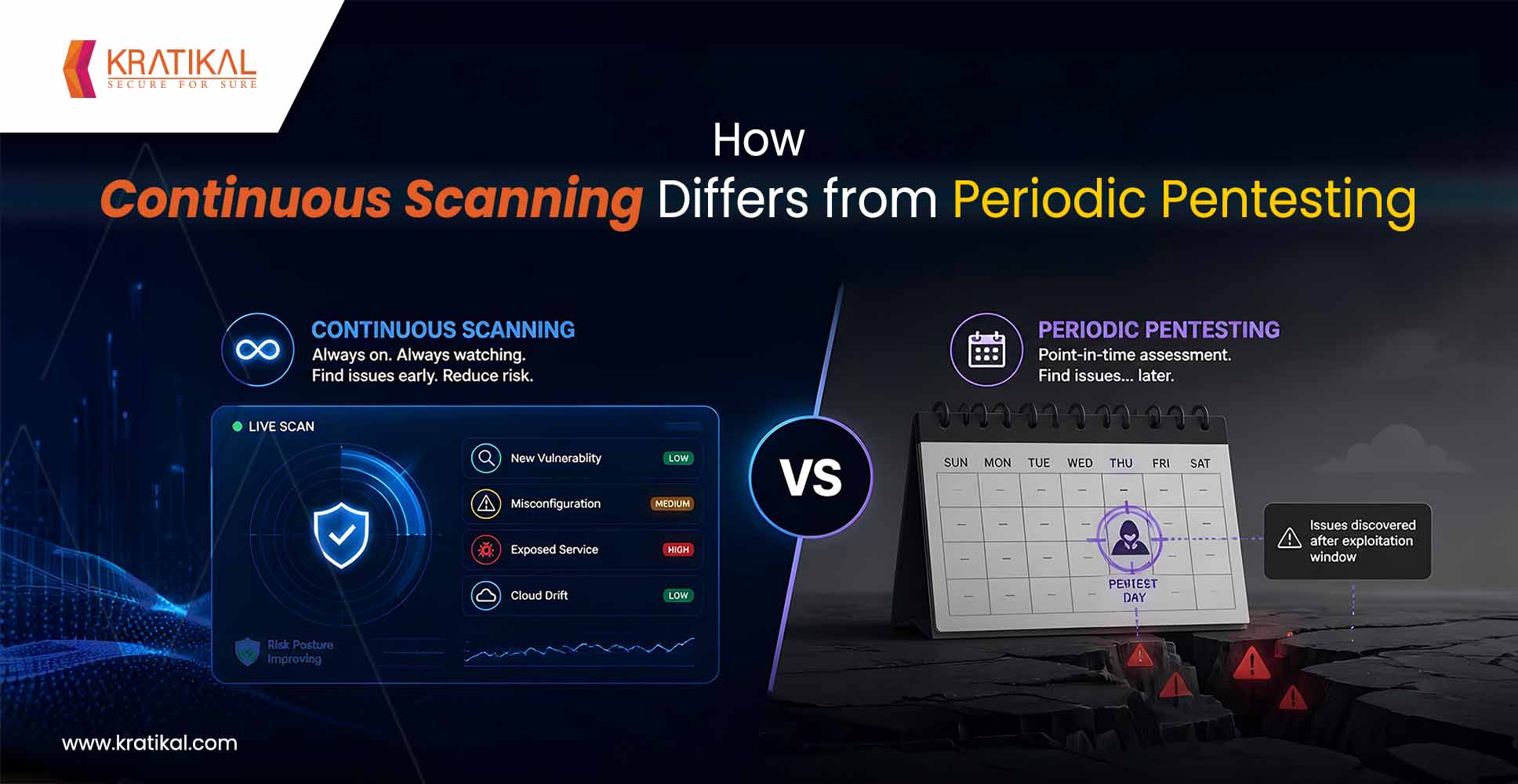
Periodic penetration testing is a point-in-time exercise. A team of security professionals emulates an attack against your environment on a fixed schedule; typically once or twice a year. The output is a report: a ranked list of vulnerabilities found during that window, with remediation guidance. It’s deep, contextual, and human-led. Its limitation is obvious: it only reflects your security posture on the days it runs.
Continuous scanning, also delivered as Penetration Testing as a Service (PTaaS), is an always-on model. Automated tools constantly probe your environment for new exposures, misconfigurations, and emerging vulnerabilities. When something is found, it’s flagged in real time, not six months later in a PDF. Many PTaaS platforms layer human testers on top of automated scanning to validate and investigate complex findings, giving you both speed and depth.
The key difference isn’t just frequency. It’s the relationship between detection and the threat timeline. Periodic testing gives you a snapshot. Continuous scanning gives you a live feed.

Continuous Scanning Vs Periodic Pentesting – What the Data Shows
IBM’s 2025 Cost of a Data Breach Report, based on 600 organizations globally, found that for the first time in five years, average breach costs fell. The global average dropped 9% to $4.44 million, and the mean time to identify and contain a breach hit a nine-year low of 241 days. IBM attributes both improvements directly to AI-driven continuous monitoring adoption.
Organizations using security AI and automation extensively saved an average of $1.9 million per breach and contained incidents 80 days faster than organizations that didn’t. The financial case is no longer theoretical.
On the pentesting side, 2025 industry data shows that organizations using PTaaS reduced their mean time to remediate critical vulnerabilities by 58% compared to traditional annual engagements, while cutting total security testing costs by up to 35% over three years.
The Right Way to Continuous Scanning Through AutoSecT
Continuous scanning is not a replacement for penetration testing. It’s a different layer of the same defense. Automated continuous scanning with AutoSecT catches what changes between tests like new assets, new misconfigurations, newly disclosed CVEs in your stack.
As an AI-driven Pentest and VMDR platform, AutoSecT moves organizations away from reactive, point-in-time testing and toward a model where vulnerabilities are discovered, validated, and managed in real time, continuously, across every layer of their digital infrastructure.
1. Continuous Scanning, Across Every Surface
One of AutoSecT’s core differentiators is its ability to run automated, scheduled scans across web applications, mobile apps (both Android APK and iOS IPA), cloud environments (AWS, GCP), APIs, and network assets, all from a single platform.
The Smart Scan Scheduler is what makes this continuous in practice. Rather than relying on manual intervention to kick off a scan, teams can configure start times and recurrence patterns, ensuring that scanning happens automatically and consistently, not just when someone remembers to run it. This removes the single biggest gap in periodic testing, which is the exposure window between tests.
2. Real-Time Detection
AutoSecT’s continuous scanning is powered by Agentic AI, a system designed to discover, assess, and validate vulnerabilities in real time as they emerge, not weeks later in a static PDF. The platform’s AI-driven real-time vulnerability analysis layer continuously monitors for new threats and immediately generates AI-based patch recommendations alongside each finding.
Crucially, AutoSecT pairs detection with AI-verified vulnerabilities, meaning threats are automatically validated for accuracy before being surfaced to the team. This eliminates false positives that typically consume hours of analyst time in traditional scanning setups.Thus, ensuring that what reaches the team’s attention represents only true, confirmed risks.
3. Risk-Prioritization
Continuous scanning produces volume. What separates AutoSecT is what it does with that volume. The platform’s VMDR framework uses risk-based analysis to prioritize vulnerabilities based on severity, exploitability, business impact, and likelihood of exploitation. Critical issues surface first. Teams aren’t left triaging a flat list of findings; they’re given a prioritized, actionable queue.
This feeds directly into AutoSecT’s Vulnerability Lifecycle Management module. It means it tracks each vulnerability from detection through remediation, categorized by risk level, critical, high, medium, and low, so nothing falls through the cracks between scan cycles.
4. Centralized View Across All Projects
All of this feeds into a centralized CISO and Analytics Dashboard that gives security leaders a real-time, consolidated risk score across all active projects and assets. Whether an organization is managing web applications, cloud assets, or third-party vendor access through the Vendor Vulnerability Management Hub, everything is visible in one place.
Integrations with JIRA, Slack, Microsoft Teams, Cliq, and Google Chat mean that when AutoSecT flags a vulnerability, the right team member gets notified immediately, keeping remediation timelines tight and accountability clear.
Explore AutoSecT at kratikal.com/autosect
Join our weekly newsletter and stay updated
Conclusion
If your organization still runs an annual pentest as its primary security validation, the 2025–2026 data suggests that posture carries significant financial and operational risk. The average breach now costs $4.44 million globally. Moreover, breaches detected in over 200 days cost $1.88 million more than those caught earlier.
The question isn’t whether continuous scanning is better than periodic pentesting in isolation. It’s whether your current testing frequency reflects how fast your attack surface changes and how fast attackers move. The data has an answer. Most organizations just haven’t acted on it yet.
FAQs
- What is the difference between continuous scanning and periodic pentesting?
Continuous scanning is an always-on security approach that continuously monitors systems for vulnerabilities, misconfigurations, and new threats in real time. Periodic penetration testing, on the other hand, is conducted at fixed intervals and provides a point-in-time assessment of security risks.
- Why is continuous vulnerability scanning important in 2026?
Continuous vulnerability scanning is critical because attackers now exploit newly disclosed vulnerabilities almost immediately after public disclosure. Traditional annual or quarterly pentests cannot detect threats that emerge between testing cycles.
- Can continuous scanning replace penetration testing?
No, continuous scanning should not replace penetration testing. Both serve different purposes in a modern cybersecurity strategy. Continuous scanning provides ongoing visibility into evolving threats, while penetration testing offers deeper, human-led validation of complex attack paths and business logic vulnerabilities.
- How does continuous scanning reduce cyberattack risks?
It reduces cyberattack risks by detecting vulnerabilities, exposed assets, and misconfigurations as soon as they appear. This shortens the time between vulnerability discovery and remediation, helping organizations respond before attackers can exploit weaknesses.
- What are the benefits of continuous scanning over traditional pentesting?
It offers real-time visibility, faster vulnerability detection, automated monitoring, and improved remediation timelines. Unlike traditional pentesting, which happens periodically, continuous scanning helps organizations maintain ongoing security across constantly changing environments.
- What types of vulnerabilities can continuous scanning detect?
Continuous scanning can detect outdated software, exposed ports, weak configurations, missing patches, insecure APIs, cloud security gaps, mobile app vulnerabilities, and known CVEs across web applications, cloud environments, networks, and endpoints.
- How often should organizations perform penetration testing?
Most organizations conduct penetration testing annually or quarterly, depending on compliance requirements and risk exposure. However, businesses with rapidly changing infrastructures should combine regular pentests with continuous scanning for better protection.
- Do I need PTaaS for my organization?
PTaaS, or Penetration Testing as a Service, is a modern security testing model that combines automated continuous scanning with expert-led penetration testing. It provides ongoing vulnerability assessment, faster reporting, and real-time collaboration between security teams and testers.
- How does AI improve continuous vulnerability scanning?
AI improves continuous vulnerability scanning by automating threat detection, validating vulnerabilities, prioritizing risks, and reducing false positives. AI-driven platforms can also provide real-time remediation recommendations, helping security teams respond faster.
- What industries benefit most from continuous security scanning?
Industries handling sensitive data or critical infrastructure benefit most from continuous security scanning, including finance, healthcare, SaaS, e-commerce, government, manufacturing, and technology companies with complex digital environments.