
In July 2026, IBM’s Cost of a Data Breach Report put a fresh number on an old problem: the global average breach now costs USD 4.99 million, up 12% in a single year, with cloud-related exposure among the costliest and slowest to contain. For CISOs, the harder question isn’t just “are we secure”; it’s “can we prove it, against every framework an auditor or regulator might ask about?” That’s the job of vulnerability compliance mapping: connecting every vulnerability a scanner finds to the specific control it violates, in ISO 27001, SOC 2, NIST or CERT-In terms. In Cloud Security Posture Management (CSPM), this mapping turns a scan into audit evidence.
What Is Vulnerability Compliance Mapping?
Vulnerability compliance mapping is the process of linking each vulnerability or misconfiguration a security platform detects to the specific clause or control it violates under frameworks like ISO 27001, SOC 2, NIST 800-53, and CERT-In Directions, turning raw scan output into audit-ready evidence rather than a disconnected list of flaws.
Traditional vulnerability scanners are good at finding problems – an exposed storage bucket, an unpatched OS, an overly permissive IAM role but they usually stop there. Compliance mapping adds a second layer: every finding is tagged against the control family it breaks, whether that’s ISO 27001’s technical vulnerability management clause, SOC 2’s common criteria for risk mitigation, or NIST 800-53’s vulnerability scanning control. Inside a CSPM platform, this happens continuously, not once a year in the scramble before an audit.
It matters to attackers as much as auditors. Organizations leave cloud misconfigurations unaddressed, making them one of the most exploited entry points because they are common and often remain unmapped to security controls for too long. A vulnerability invisible to your compliance program is usually also invisible to your risk register.
Why Are Cloud-Related Risks Critical Risks in 2026?
The numbers make the stakes concrete. IBM’s 2026 report shows the global average breach cost climbing to a record USD 4.99 million, with multi-environment and cloud-related breaches among the most expensive to contain – a trend that attackers exploiting misconfigured, internet-facing systems (mapping to MITRE ATT&CK technique T1190, Exploit Public-Facing Application) continue to benefit from directly.
Regulators haven’t slowed down either. In India, the Digital Personal Data Protection Rules, 2025, notified by MeitY on November 13, 2025, started a live, phased enforcement clock — Phase 2 (the Consent Manager framework) lands in November 2026, and penalties for failing to maintain “reasonable security safeguards” can reach ₹250 crore per violation. In the US, NIST CSF 2.0’s “Govern” function and the SEC’s cybersecurity disclosure rules, which require public companies to report material breaches within four business days, put vulnerability-to-control traceability on the board’s radar, not just IT’s.

Book Your Free Cybersecurity Consultation Today!
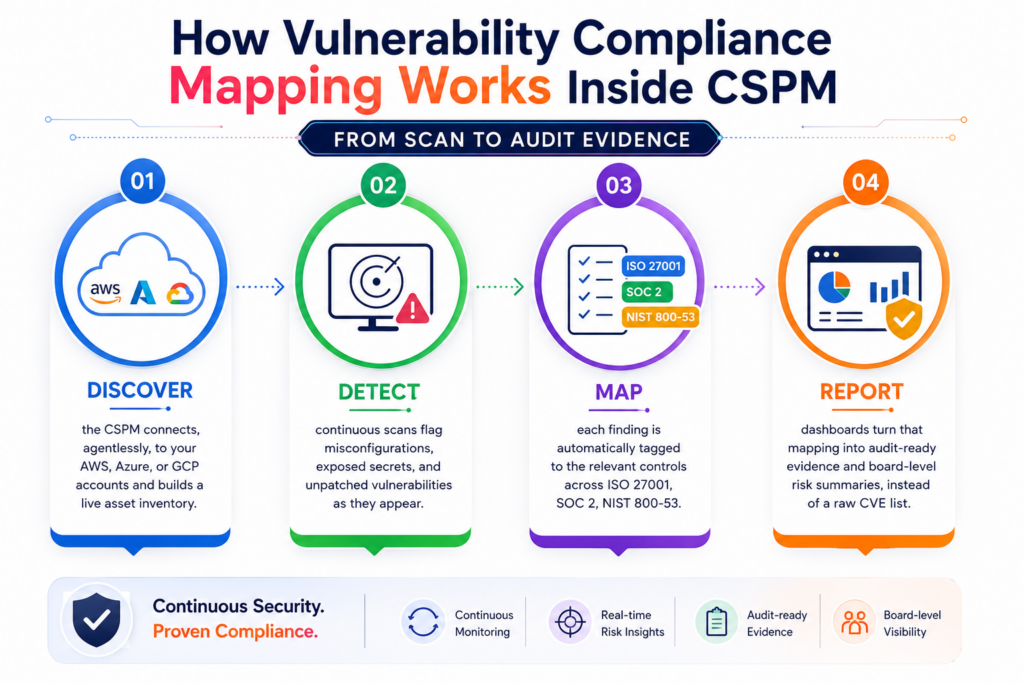
How Does Vulnerability Compliance Mapping Works Inside CSPM?
From scan to audit evidence
- Discover: the CSPM connects, agentlessly, to your AWS, Azure, or GCP accounts and builds a live asset inventory.
- Detect: continuous scans flag misconfigurations, exposed secrets, and unpatched vulnerabilities as they appear.
- Map: each finding is automatically tagged to the relevant controls across ISO 27001, SOC 2, NIST 800-53.
- Report: dashboards turn that mapping into audit-ready evidence and board-level risk summaries, instead of a raw CVE list.
How to Implement Vulnerability Compliance Mapping?
- Inventory every cloud account first. You can’t map what you haven’t discovered, connect AWS, Azure, and GCP for full, real-time asset visibility.
- Choose your framework set deliberately. Decide which of ISO 27001, SOC 2, NIST 800-53 or CERT-In actually apply to your business and customers, don’t map to everything by default.
- Automate the control-to-vulnerability tagging. A platform that auto-maps each finding beats a spreadsheet every time; manual mapping goes stale the moment your cloud environment changes.
- Prioritize by exploitability and control weight. Combine severity scoring with which controls carry the highest audit or regulatory risk.
- Route findings to accountable owners. Integrate with ticketing so every mapped gap has an owner and an SLA, not just a dashboard entry.
- Re-scan and re-map continuously. Compliance mapping loses its value the moment it becomes a once-a-year, point-in-time snapshot.
Join our weekly newsletter and stay updated
How AutoSecT Simplifies Compliance
AutoSecT, Kratikal’s AI-driven vulnerability management and CSPM platform, builds this mapping natively rather than as an afterthought. Once you connect your AWS, Azure, or GCP accounts, AutoSecT continuously discovers assets, scans for misconfigurations and vulnerabilities, and automatically maps every finding to ISO 27001, SOC 2, and NIST 800-53 controls. The AI-driven scanning engine minimizes false positives, allowing the compliance dashboard to display real exposure rather than noise.
The result is a single CISO dashboard where vulnerability data and compliance status live side by side. Reports export in audit-ready formats, and remediation routes directly into your existing workflow.
FAQs
- What is vulnerability compliance mapping in CSPM?
It’s the process of linking each vulnerability or misconfiguration a CSPM tool detects to the specific control it violates, under frameworks like ISO 27001, SOC 2, and NIST 800-53, so scan output becomes audit-ready evidence.
- Which compliance frameworks does CSPM typically map to?
AutoSecT maps vulnerabilities to compliance frameworks like ISO 27001, SOC 2, and NIST 800-53.
- Is CSPM required for SOC 2 or ISO 27001 certification?
It’s not named as a mandatory tool in either standard, but continuous, control-mapped evidence is effectively required to pass audits at scale. CSPM is the practical way most organizations meet that bar today.
- How often should vulnerability compliance mapping be updated?
Continuously, not annually. Frameworks change, and cloud environments change daily, so static, point-in-time mapping goes stale fast.