
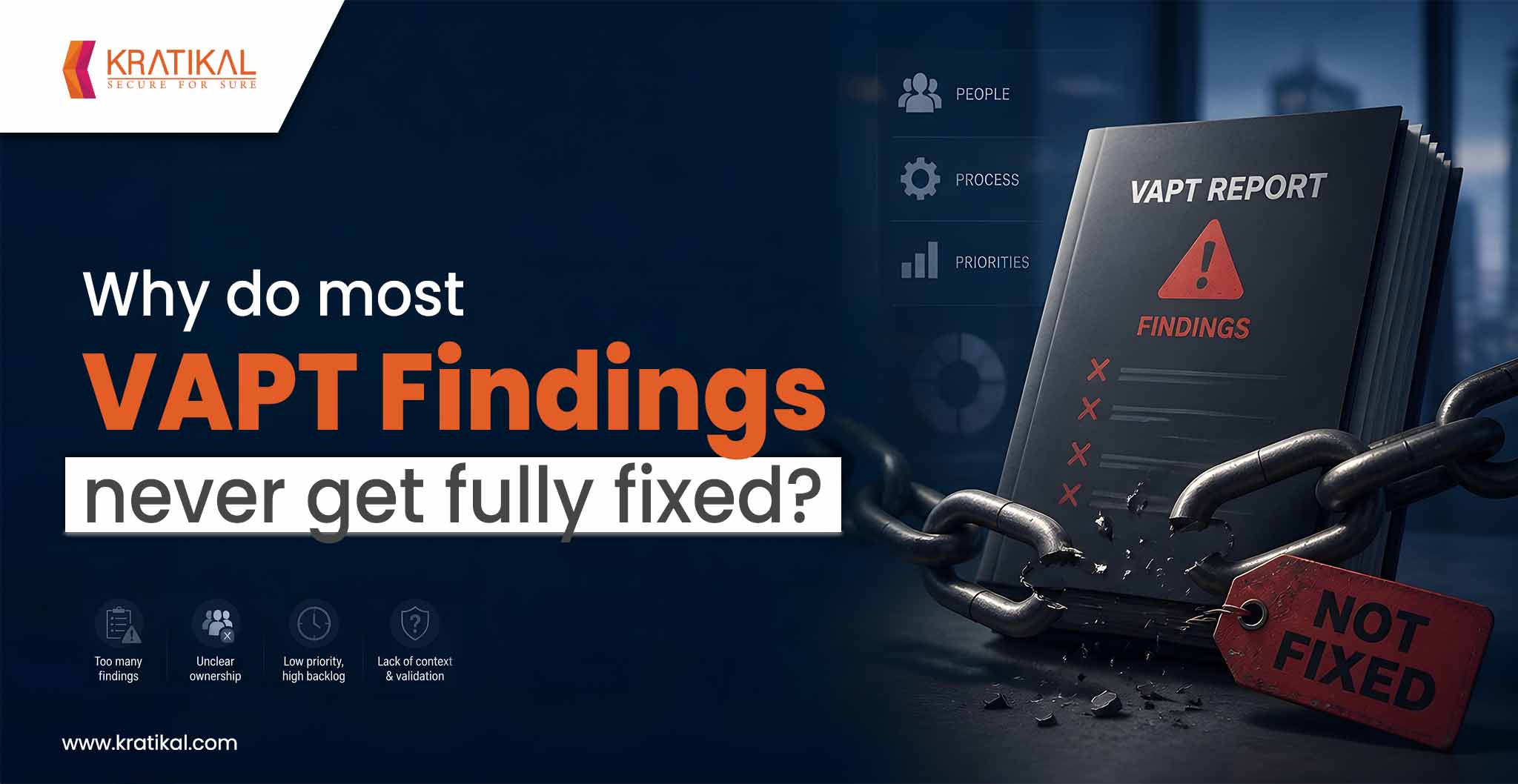
Organizations across industries are investing heavily in cybersecurity. From deploying advanced security tools to conducting regular Vulnerability Assessment and Penetration Testing (VAPT), businesses are actively trying to identify and mitigate risks before attackers exploit them. Yet, despite these efforts, a common and concerning trend continues to persist: most VAPT findings never get fully fixed.
Security teams often complete a VAPT exercise, receive a comprehensive report, close a few critical issues, and move on to the next priority. Months later, the same vulnerabilities resurface during re-assessments, compliance audits, or worse, after a security incident. This raises an important question: why do organizations struggle to fully remediate vulnerabilities even after identifying them?
The answer lies in a combination of operational, technical, and strategic challenges that affect modern cybersecurity programs.
Understanding What VAPT Actually Delivers
Vulnerability Assessment and Penetration Testing (VAPT) helps organizations identify security weaknesses across applications, networks, systems, and infrastructure. While vulnerability assessments focus on detecting known flaws and misconfigurations, penetration testing validates how real attackers could exploit those weaknesses. However, VAPT primarily delivers visibility into security risks, not automatic remediation or long-term risk reduction.
A VAPT engagement typically results in a detailed report containing identified vulnerabilities, severity ratings, exploit scenarios, and remediation recommendations. This helps organizations understand where their security posture is weak and how attackers could potentially gain unauthorized access or disrupt operations. It also supports compliance requirements and strengthens overall risk awareness across teams.
However, many organizations misunderstand the role of VAPT. The assessment itself does not patch systems, fix insecure code, or improve internal security processes. Without proper remediation planning, ownership, and continuous follow-up, even critical findings can remain unresolved for long periods. This is why organizations must view VAPT as the starting point of security improvement, not the outcome.
Join our weekly newsletter and stay updated
The Root Causes: Why Findings Get Unfixed
The failure to remediate vulnerabilities is rarely caused by a single issue; it is the result of multiple interconnected challenges operating at the same time. Understanding these underlying gaps is the first step toward achieving meaningful security outcomes.
1) Lack of Proper Prioritization
One of the biggest reasons VAPT findings remain unresolved is poor prioritization. Security teams often receive hundreds or even thousands of findings during large-scale assessments. Without proper risk context, remediation teams struggle to determine which vulnerabilities require immediate attention. Many organizations still prioritize vulnerabilities based only on CVSS scores or severity labels such as “Critical,” “High,” or “Medium.” While these metrics are useful, they rarely provide enough business context.
For example:
a) A low-complexity exploit affecting sensitive customer data may deserve higher priority than a theoretically critical issue with limited exploitability.
b) A medium-severity vulnerability exposed to the internet may pose a greater risk than a critical vulnerability isolated in an internal environment.
This is where modern vulnerability and exposure management platforms like AutoSecT help organizations move beyond static VAPT reporting.
2) Compliance-Driven Security Mindset
A major reason vulnerabilities remain unresolved is that many organizations perform VAPT primarily for compliance purposes.
Industries governed by standards such as PCI DSS, ISO 27001, SOC 2, HIPAA, and RBI guidelines often mandate periodic security testing. While these frameworks improve security maturity, some organizations approach VAPT as a checkbox activity designed to satisfy auditors rather than reduce actual cyber risk.
This mindset creates several problems:
- Assessments are performed only before audits
- Findings are closed temporarily without permanent fixes
- Evidence matters more than actual remediation
- Risk acceptance processes are poorly managed
- Vulnerabilities reappear repeatedly
3) Poor Tracking and No Closed-Loop Process
VAPT findings are rarely connected to an organization’s standard issue tracking workflow. They live in a PDF, or in a spreadsheet someone created, or in a proprietary portal from the testing firm that no one remembers how to log in to. They’re not in Jira and in your project management tool. They’re not assigned, groomed, pointed, or tracked through a sprint. Without that integration into how your teams actually work, findings have no lifecycle. There is no definition of “done,” and no retest. There is no confirmation of closure. The finding exists in a document forever, technically open, practically ignored.
4) No Clear Ownership
One of the most common reasons VAPT findings remain unresolved is the absence of clear ownership. In many organizations, it is unclear whether remediation responsibility lies with the security team, developers, infrastructure teams, or product owners. This lack of accountability often results in findings being passed between teams without action.
Without a designated owner, defined timelines, and proper tracking mechanisms, vulnerabilities remain unaddressed for long periods. Over time, the VAPT report shifts from being an actionable security document to merely a compliance artifact, while the actual risks continue to exist within the environment.
5) Remediation Fatigue
As attack surfaces expand, the number of vulnerabilities identified through VAPT also increases significantly. Over time, remediation teams experience what is commonly called remediation fatigue. When teams are overwhelmed with continuous findings, tickets, alerts, and patch requests, security issues start competing with operational priorities. Vulnerabilities that do not appear immediately exploitable are often postponed indefinitely. This creates a growing backlog of unresolved issues. In many organizations, the same vulnerabilities continue appearing across multiple VAPT cycles because they were either partially fixed or never addressed properly in the first place.
Cyber resilience starts with visibility and is strengthened through remediation. Kratikal helps organizations bridge this gap with effective VAPT services.
The Cycle That Sustains the Problem
These five causes don’t operate in isolation; they create a self-reinforcing cycle. Organizations run annual VAPT engagements. Reports arrive. Findings pile up. A few get fixed. Most don’t. The next year’s test finds many of the same vulnerabilities, plus new ones. The finding count grows. The remediation rate stays flat. Leadership sees the report, asks about critical fixes, gets reassurance that “they’re being worked on,” and approves next year’s testing budget. The cycle continues.
The testing firm benefits from repeat business. The compliance team ticks a box. The security team has documentation of due diligence. Developers get a brief burst of security work, then return to feature development. No one has obviously failed. And yet, the attack surface has not meaningfully shrunk.
Building a Remediation-Driven Cybersecurity Strategy
To ensure VAPT findings lead to meaningful security improvements, organizations must shift from assessment-focused security to remediation-focused security. Identifying vulnerabilities is only the first step.
Risk-Based Prioritization
Organizations should move beyond relying only on CVSS scores or generic severity labels. Not every critical vulnerability represents the same level of business risk. Security teams must evaluate findings based on exploitability, internet exposure, asset criticality, business impact, and the likelihood of real-world attacks.
A vulnerability affecting a public-facing business application may require immediate attention even if its severity score is lower than a critical issue isolated in a non-production environment. Risk-based prioritization helps organizations focus remediation efforts on vulnerabilities that attackers are most likely to exploit.
Continuous Validation
Implementing a fix does not automatically guarantee that the vulnerability has been eliminated. Configuration drift, incomplete patch deployment, cloud misconfigurations, and infrastructure changes can easily reintroduce security gaps.
Organizations should continuously retest vulnerabilities and validate remediation efforts to ensure fixes remain effective over time. Continuous validation helps identify failed remediation attempts, newly exposed assets, and recurring weaknesses before attackers can exploit them. Security should be treated as an ongoing process rather than a one-time assessment activity.
Exposure Management
Modern attack surfaces are highly dynamic, making traditional vulnerability management approaches increasingly ineffective. Organizations need visibility not only into vulnerabilities, but also into how attackers could realistically exploit them.
Adopting modern vulnerability and exposure management platforms helps organizations:
- Understand attack paths
- Identify internet-facing risks
- Prioritize exploitable vulnerabilities
- Correlate findings with business impact
- Reduce overall attack exposure
This allows teams to move from reactive vulnerability management to proactive exposure reduction.

Book Your Free Cybersecurity Consultation Today!
Conclusion
For many organizations, VAPT has become a routine security exercise, but security reports alone do not reduce cyber risk. The real challenge begins after the assessment, when vulnerabilities must be prioritized, assigned, tracked, remediated, and continuously validated.
When organizations treat VAPT as a compliance requirement rather than an ongoing security process, vulnerabilities remain unresolved and continue to expand the attack surface. Over time, this creates a dangerous cycle where the same findings repeatedly appear across multiple assessments.
Building a stronger security posture requires a shift from assessment-focused security to remediation-focused security. With proper ownership, risk-based prioritization, continuous monitoring, and effective exposure management, organizations can turn VAPT findings into meaningful security improvements and long-term cyber resilience.
FAQs
- Why do many VAPT findings remain unresolved?
Common reasons include poor prioritization, lack of ownership, remediation fatigue, compliance-driven security approaches, and ineffective tracking processes.
- Is fixing only critical vulnerabilities enough?
No. Medium or low-severity vulnerabilities can still pose significant business risk depending on exposure, exploitability, and asset criticality.
- Why is continuous validation important after remediation?
Continuous validation ensures vulnerabilities remain fixed and helps detect recurring risks caused by misconfigurations or infrastructure changes.
- Why do the same vulnerabilities appear in repeated VAPT assessments?
This usually happens because vulnerabilities were partially fixed, improperly remediated, or never addressed completely.
- Can medium-severity vulnerabilities become high-risk issues?
Yes. A medium-severity vulnerability affecting sensitive systems or customer data can create significant business risk.
- What are the biggest challenges in vulnerability management?
Common challenges include limited resources, lack of prioritization, poor tracking, and increasing attack surfaces.
- Is annual VAPT enough for modern organizations?
No. Modern environments require continuous security assessments and ongoing remediation validation.
- Why is vulnerability tracking important after a VAPT assessment?
Proper tracking ensures findings are assigned, monitored, and fully remediated instead of being overlooked.