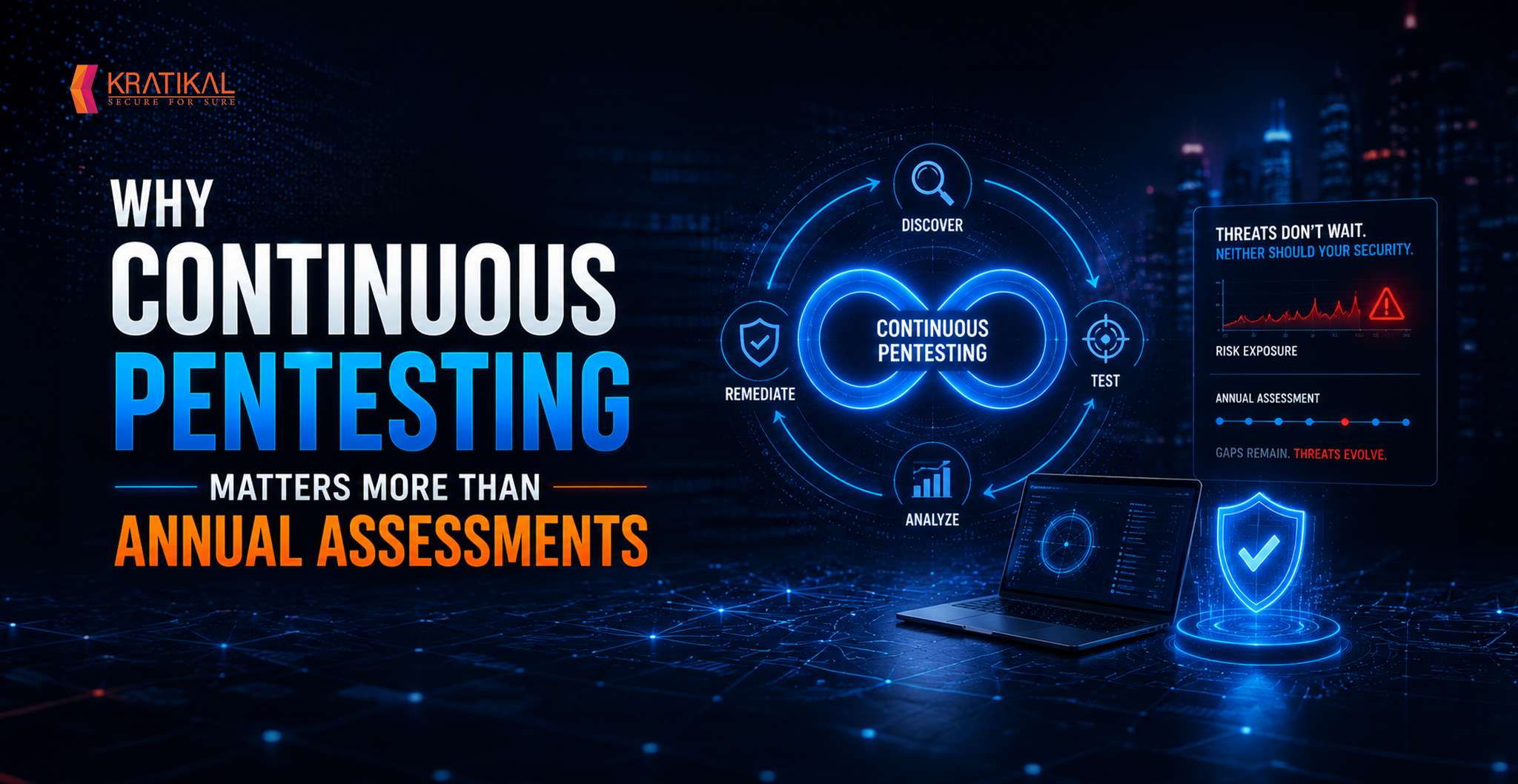
Every change in your organization can create a new security gap, and attackers constantly look for weak points. Many companies still think that a single pentest every year is enough to secure their infrastructure. Still, that test can’t cover all issues, as it only reflects your security at that moment. A week later, your environment may look completely different. This is why continuous pentesting has become a better way to manage security. It helps businesses test issues and identify gaps throughout the year. Also, it helps security teams find problems sooner, fix them faster, and minimise the chance of an attack. AutoSecT makes this process easier. It combines AI-driven vulnerability management with continuous pentesting. This strong combination helps security teams easily monitor applications, cloud environments, APIs, and networks without waiting for the next annual assessment.
Why Continuous Pentesting Matters More Than Annual Penetration Testing, Not Otherwise!
Continuous pentesting is the practice of testing your inventory regularly rather than once a year. It checks applications, APIs, cloud services, networks, and other digital assets whenever changes occur. This keeps security aligned with the way your business needs and software updates. Platforms like AutoSecT support this process by scanning assets to find exploitable vulnerabilities, validating findings with AI, and ranking them based on risk. Instead of sorting through hundreds of alerts, security teams can focus on fixing the issues that matter most.
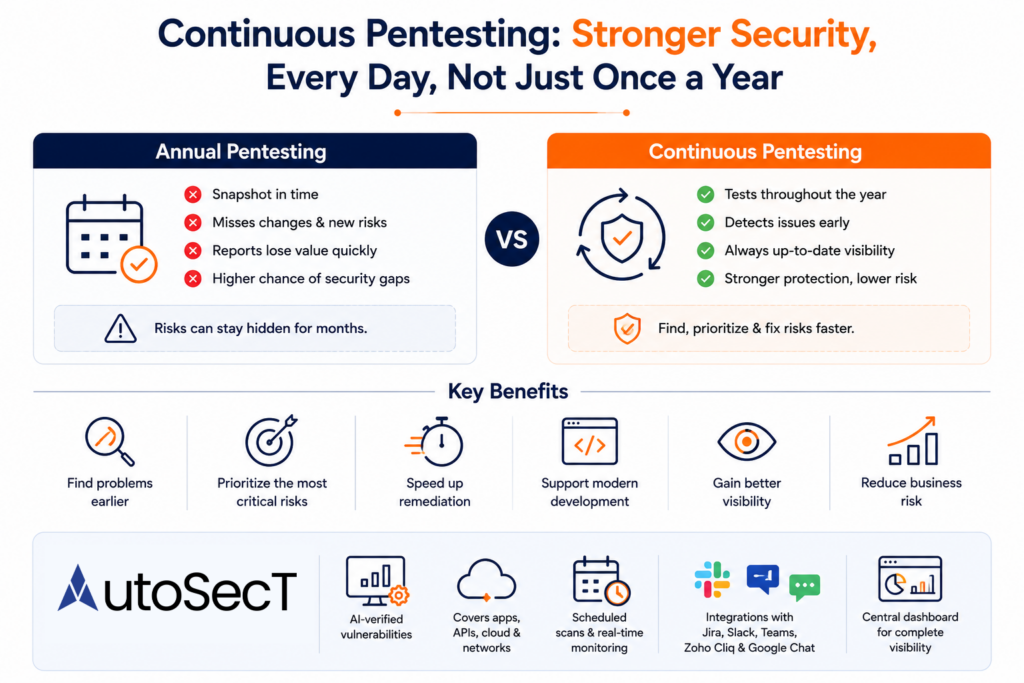
Annual penetration testing alone is not sufficient! But it still has an important role. It helps businesses meet compliance requirements and uncovers security weaknesses through detailed manual testing. The problem is everything that happens after the assessment. Modern IT environments change every day. A report created today may no longer reflect your security a few weeks later.

Book Your Free Cybersecurity Consultation Today!
Know Why Annual Penetration Testing Is Not Sufficient?
- Software Changes Faster Than Ever
Development teams release different updates, and these new features and third-party integrations become part of regular operations. Every update can introduce a new security gap. If testing happens only once a year, those weaknesses may remain hidden for months. Here, continuous pentesting helps teams catch them much sooner.
- Cloud Environments Keep Expanding
Cloud platforms make businesses more flexible and they also create more surface to secure. New virtual machines, containers, storage services, and APIs appear throughout the year and one small configuration mistake can expose sensitive business data. Continuous pentesting helps security teams review these changes before they become serious problems. AutoSecT supports this effort by testing cloud assets alongside applications, APIs, and network infrastructure. It helps the team receive regular updates instead of waiting for another annual report.
- Annual Reports Lose Value Quickly
A penetration test reflects your environment on the day it was performed. With the functioning of an asset change, that report becomes less valuable. Infra changes, new software, and cloud updates introduce security risks not present in the original assessment. Continuous pentesting keeps security testing current. Teams always have a better understanding of where new risks exist.
- The Cost of Waiting
Security gaps become more expensive when they go undetected. Grand View Research reports that the cybersecurity market is estimated to reach $663 billion by 2033, growing at an 11.9% CAGR. Many compliance frameworks require businesses to manage security throughout the year rather than relying on a single annual review. For this, continuous pentesting helps businesses stay ready for both security threats and compliance checks.
Benefits of Continuous Pentesting
Testing systems throughout the year gives businesses stronger protection and better visibility.
- Find Problems Earlier
It is easier to fix the gaps when you find them faster. Of course, continuous pentesting helps teams detect issues soon after software or infrastructure changes. AutoSecT strengthens this process with AI-driven validation, helping teams focus on real security risks.
- Fix the Most Critical Risks First
Not all vulnerabilities are similarly impactful. So, security teams need clear priorities. Continuous pentesting provides updated risk information throughout the year. AutoSecT ranks findings based on business risk, making it easier to decide what needs immediate attention.
- Speed Up Remediation
Finding vulnerability is only the beginning. Businesses also need to fix it quickly. Regular testing creates shorter feedback cycles, reducing the time between discovery and remediation. AutoSecT also offers AI-assisted guidance for each risks that helps teams resolve issues faster.
- Support Modern Development
Development teams release software at a rapid pace. Security needs to keep up. Continuous pentesting checks applications after code releases, cloud updates, and infrastructure changes. AutoSecT supports this workflow with scheduled scans and integrations with Jira, Slack, Microsoft Teams, Zoho Cliq and Google Chat.
- Gain Better Visibility
Security teams cannot protect systems they cannot see. Continuous pentesting gives them a clear view of:
- Web applications
- Mobile applications
- APIs
- Cloud environments
- Internal and external networks
- Codes
Industries That Benefit Most from Continuous Pentesting
No industry is safe from cyberattacks today. Still, some businesses face more risk because their systems change almost every day.
- Financial Services
Banks, NBFCs, and fintech companies process thousands of transactions every hour. They also store valuable customer and financial data. A missed vulnerability can lead to fraud, financial loss, or regulatory action. Regular security testing gives these businesses a better chance to catch problems before attackers do.
- Healthcare
Healthcare systems never stop running. Patient records, connected medical devices, and hospital applications all need protection. Waiting months for the next penetration test leaves too much room for risk. Continuous testing keeps security checks in step with daily operations.
- SaaS Companies
New features reach users every week. Sometimes they go live several times a day. Each release changes the application’s attack surface. Testing those changes early keeps security from becoming an afterthought.
- E-commerce
Online stores manage customer accounts, payment details, and order data around the clock. Here, regular testing reduces the chance of exposing sensitive information during website updates or payment gateway changes.
- Manufacturing
Factories now depend on connected equipment, cloud platforms, and smart devices. One weak point can affect both business systems and production lines. Continuous testing gives security teams a clearer picture of these risks.
What Happens When Testing Stops?
A penetration test gives valuable insights, but those insights fade over time. Applications change, developers add new features, cloud settings get updated, and APIs connect to new services; none of these changes will wait for the next annual assessment.
That creates several problems such as:
- New security gaps stay hidden
- Fresh cloud assets never get reviewed
- Small mistakes become larger risks
- Security fixes get pushed back
- Compliance evidence becomes outdated
- Teams lose track of their growing environment
Making Continuous Pentesting Easier with AutoSecT
Running security tests throughout the year sounds simple. Managing them across hundreds of assets is not.
Many security teams handle web applications, APIs, cloud services, mobile apps, and internal networks, but tracking every update takes time. AutoSecT reduces that workload.
Instead of waiting for a yearly assessment, the platform keeps checking your organization’s assets as they change. It covers web applications, APIs, cloud environments, mobile apps, and network infrastructure from one place.
Not every alert deserves immediate attention. AutoSecT reviews findings with AI and highlights the issues that carry the highest risk. This allows teams to spend more time fixing real problems instead of sorting through large reports.
The platform also fits naturally into existing workflows. Scheduled scans run after major releases, while integrations with Jira, Slack, Microsoft Teams, Zoho Cliq and Google Chat keep developers and security teams connected throughout remediation. A central dashboard brings everything together. Security leaders can review vulnerabilities, monitor progress, and understand risk status without switching between tools.
Best Practices for Continuous Pentesting
Let’s check some of the best practices for continuous pentesting:
- Test after every major software release
- Include APIs, cloud services, and internal networks
- Mix automated scans with human-led penetration testing
- Fix critical issues before low-risk findings
- Retest after every remediation
- Build security into the DevSecOps pipeline
- Watch internet-facing assets throughout the year
- Use a platform like AutoSecT to reduce manual effort
Small improvements made regularly are more effective than a single review done every year.
Join our weekly newsletter and stay updated
Conclusion
Remote work environments, connected devices, and AI tools have changed the working methods in companies. The security system must be changed for these environments. The focus is simple. Find risks faster, understand their impact, and reduce them before an attack with continuous pentesting. By various features such as AI-driven pentesting, ongoing vulnerability management, intelligent scan scheduling, and risk-based prioritisation, AutoSecT helps reduce these challenges. Businesses may monitor their assets year-round and take action before minor problems become major ones, rather than viewing security as an annual duty.
FAQs
- What is continuous pentesting?
Continuous pentesting is an iterative process of security testing that gives insight to the security posture of your applications, APIs, cloud environments, and networks, throughout the year.
- Why is annual penetration testing not enough?
Today, organizations are more agile and innovate with newer updates to their software and cloud systems, and create new APIs. Annual assessments will not uncover the new potential risks that are introduced. Continuous pentesting will ensure that security testing keeps pace with the changes.
- Does continuous pentesting help with compliance?
Certainly. Continuous pentesting enables organizations to have stronger security postures and helps with compliance due to the gaps of security risks being closed prior to a compliance audit or assessment inspections.
- What makes continuous pentesting different from annual penetration testing?
Annual penetration testing examines security only once. Continuous pentesting looks at your environment consistently and enables security teams to discover new security risks more quickly after changes.
- What organizations should consider continuous pentesting?
It’s helpful for organizations in financial services, health care, SaaS, e-commerce, manufacturing and those with cloud services.
- Does continuous pentesting eliminate the need for manual penetration testing?
Definitely, not. Continuous pentesting coupled with manual penetration testing, is ideal. Continuous pentesting regularly examines your security, while manual penetration testing covers other intricate attack routes and the business logic gaps testing.
- What are the advantages of continuous pentesting?
Organizations are more aware of the security gaps and risks and how to resolve them quickly.
- How does AutoSecT implement continuous pentesting?
AutoSecT offers AI-Powered continuous pentesting and exposure validation. The tool assesses web applications, APIs, cloud environments, mobile applications and networks, prioritizes security threats, verifies it, categorizes it and provides AI-based recommendations.