
The math has changed. NIST reports that CVE submissions grew 263% between 2020 and 2025, and Q1 2026 volume is already running nearly a third higher than the same period last year. Attackers aren’t waiting for anyone to catch up! The Q2 2026 vulnerability trends analysis showed that attackers most commonly exploited improper input validation (CWE-20) and missing authentication (CWE-306) in internet-facing firewalls, VPNs, and admin panels.
There’s also a structural shift worth knowing about. Since April 2026, NIST no longer immediately enriches every CVE in the National Vulnerability Database; it now prioritizes entries already on the CISA KEV list, federal software, and assets covered under Executive Order 14028’s “critical software” definition. Everything else can sit in a “Not Scheduled” queue. In practice, this means teams can no longer rely on NVD as the single source of truth for severity. They need local context: what’s actually exploitable in their environment.
This lines up with a broader industry move from CVSS-only scoring toward Stakeholder-Specific Vulnerability Categorization (SSVC), which NVD began layering into its data as of June 2026. The MITRE ATT&CK framework provides the standard reference for understanding how attackers could exploit a vulnerability within an attack chain. Cross-reference it during the analysis phase to gain deeper context.
How Vulnerability Assessment Actually Works?
Think of a vulnerability scanner! Let’s think of AutoSecT, instead of any random platform. It doesn’t just check if a risk door in your inventory is unlocked; it checks every loophole and crawlspace against a known list of ways attackers can break into it, then hands you a report ranked by how easy each one would be to exploit.
Every unpatched critical vulnerability is a line item risk. Boards and regulators increasingly expect a documented, repeatable assessment process instead of a once-a-year scan before an audit. For organizations in finance, healthcare, or critical infrastructure, the assessment rhythm itself has become a compliance signal, and a thin or inconsistent process is now something examiners and cyber insurers actively probe.
In India, the CERT-In Directions of 2022 require reporting certain cyber incidents within six hours, a timeline that’s nearly impossible to meet without an existing, current vulnerability inventory. The DPDPA 2023 adds data fiduciary obligations that make unpatched systems handling personal data a direct compliance exposure. Banks and NBFCs also fall under the RBI Cybersecurity Framework, which expects documented vulnerability management as baseline hygiene.
In the US, NIST CSF 2.0’s new “Govern” function explicitly ties vulnerability management to board-level oversight. The SEC’s Cybersecurity Disclosure Rules require public companies to report material breaches within four business days, again, difficult without knowing your exposure in advance. HIPAA-covered entities and CMMC-scoped defense contractors face similar documentation expectations.

Book Your Free Cybersecurity Consultation Today!
Step-by-Step Guide to Vulnerability Assessment
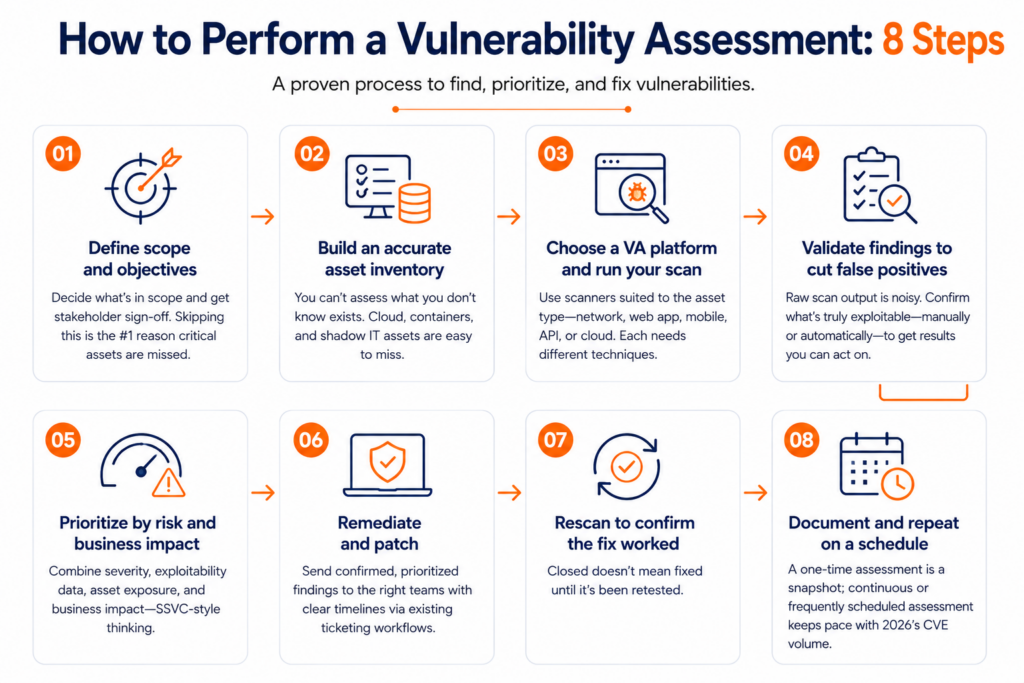
#1 Define scope and objectives.
Decide which inventories, applications, and environments are in scope, and get sign-off from stakeholders. Skipping this step is the most common reason assessments miss critical assets.
#2 Build an accurate asset inventory.
You can’t assess what you don’t know exists. This is especially hard with cloud workloads, containers, and shadow IT; short-lived assets are easy to miss with agent-based tools.
#3 Choose a VA platform and run your scan.
Use scanners suited to the asset type – network, web app, mobile, API, or cloud configuration scanning; each needs different techniques.
#4 Validate findings to cut false positives.
Raw scan output is noisy. Manually or automatically confirming which findings are truly exploitable is what separates a useful report from a long PDF nobody reads.
#5 Prioritize by risk and business impact.
Combine severity score with exploitability data, asset exposure, and business impact; this is the SSVC-style thinking NVD itself is now pushing teams toward.
#6 Remediate and patch.
Redirect confirmed, prioritized findings to the teams responsible with clear timelines, ideally through existing ticketing workflows rather than a separate spreadsheet.
#7 Rescan to confirm the fix worked.
Closed doesn’t mean fixed until it’s been retested.
#8 Document and repeat on a schedule.
A one-time assessment is a snapshot; continuous or frequently scheduled assessment is what actually keeps pace with 2026’s CVE volume.
How AutoSecT by Kratikal Helps With Vulnerability Assessment?
Most of the friction in this process- manual asset discovery, scanner noise, and CVSS-only prioritization- is exactly what AI-driven VM platforms were built to remove. AutoSecT approaches vulnerability assessment as a continuous discipline rather than a periodic project for ensuring the security of your web app, mobile app, network, API, and cloud.
Getting started with AutoSecT is straightforward: log in to AutoSecT, add the assets you want to assess, and set up scans for each one. For teams managing multiple assets, projects act as a unified workspace, grouping related assets together so scanning and management stay organized rather than scattered across individual scans.
From there, the platform’s AI engine takes over the heavy lifting. Instead of surfacing every theoretical match the way traditional scanners do, it validates each finding against real exploitability, which is exactly what cuts down the false-positive fatigue most security teams know too well. Confirmed findings land on a centralized dashboard with risk-based prioritization, and built-in integrations with JIRA, Slack, and Teams mean remediation gets assigned and tracked without anyone leaving their existing workflow. AI-based recommendations attached to each vulnerability go a step further, guiding teams toward fixing risks the right way rather than just flagging that they exist.
Join our weekly newsletter and stay updated
FAQs
- What’s the difference between a vulnerability assessment and a penetration test?
A vulnerability assessment identifies and ranks weaknesses across your environment at scale. A penetration test manually attempts to exploit specific weaknesses to prove real-world impact. Most programs need both.
- How often should a vulnerability assessment be performed?
Quarterly is a common minimum for compliance purposes, but given current CVE growth, many security teams are moving toward continuous or monthly scanning for internet-facing assets.
- Is a vulnerability assessment mandatory for compliance?
It’s required under frameworks like CERT-In Directions, DPDPA, RBI’s cybersecurity framework, NIST CSF 2.0, HIPAA, etc all of which assume you know your exposure before an incident occurs.
- Can vulnerability assessment be automated?
Discovery and scanning have been automatable for years; what’s newer is AI validating whether a finding is truly exploitable, which meaningfully cuts the manual triage that used to dominate this process. AutoSecT does exactly that, listing out the true exploitable risks with AI-remediation fixes.