
SQL injection payloads don’t succeed because attackers are unusually clever. They succeed because applications leave small, avoidable gaps in how they handle data. A single unsanitized input field, a poorly configured database account, or an error message that reveals too much can be all it takes for a simple payload to turn into a full-blown breach. Understanding these mistakes isn’t just useful for developers; it’s essential for security teams, CISOs, and anyone responsible for protecting web applications from one of the oldest and still most damaging attack techniques in existence.
In this blog, we break down the common mistakes that allow SQL injection payloads to work, and why fixing them requires more than just “sanitizing inputs.”
A Gist on SQL Injection Payloads
Before discussing the mistakes, it’s important to understand what SQL Injection Payloads actually are.
An SQL injection payload is the malicious SQL code inserted into an application’s input fields with the goal of manipulating the backend database query. Attackers inject these payloads into login forms, search boxes, URL parameters, APIs, cookies, or hidden fields.
For example, if an application directly inserts user input into a SQL query, an attacker may provide specially crafted input that changes the intended behavior of the query.
Successful SQL Injection Payloads can enable attackers to:
- Bypass authentication
- Read confidential data
- Modify or delete records
- Escalate privileges
- Execute administrative operations
- In some database systems, even possible to execute operating system commands
The payload itself is only one part of the attack. The real issue lies in the application’s inability to safely handle untrusted input.
Hidden Weaknesses Behind Successful SQL Injection Payloads
These payloads rarely exploit complex flaws; they succeed by taking advantage of common security oversights that are often preventable.
1) Relying on Blacklists Instead of Parameterized Queries
One of the most common mistakes organizations make is relying on blacklist-based filtering to stop SQL Injection Payloads. Blocking specific keywords such as SELECT, DROP, or special characters like single quotes may seem effective, but attackers can easily bypass these restrictions. By using techniques such as mixed-case keywords (SeLeCt), inline comments (/**/), URL or hexadecimal encoding, and other obfuscation methods, malicious payloads can evade simple filters and still reach the database.
A far more effective approach is to use parameterized queries (prepared statements) or secure ORM frameworks, which separate SQL commands from user input. This ensures that all user-supplied data is treated strictly as input rather than executable code, preventing SQL Injection Payloads from altering the intended database query.
2) Excessive Database Privileges
A successful SQL Injection Payload can only be as damaging as the permissions granted to the database account it exploits. One common mistake is configuring applications to connect using highly privileged database accounts with administrative access, allowing operations such as deleting tables, creating new users, modifying database structures, or accessing sensitive system data.
To minimize the impact of a successful attack, organizations should follow the Principle of Least Privilege. Assign only the permissions that database accounts need to perform the application’s intended functions. For example, an application that only needs to read and update specific tables should never have privileges to execute administrative commands like DROP DATABASE, alter schemas, or access system tables. Restricting database permissions significantly reduces the potential damage caused by SQL Injection Payloads.
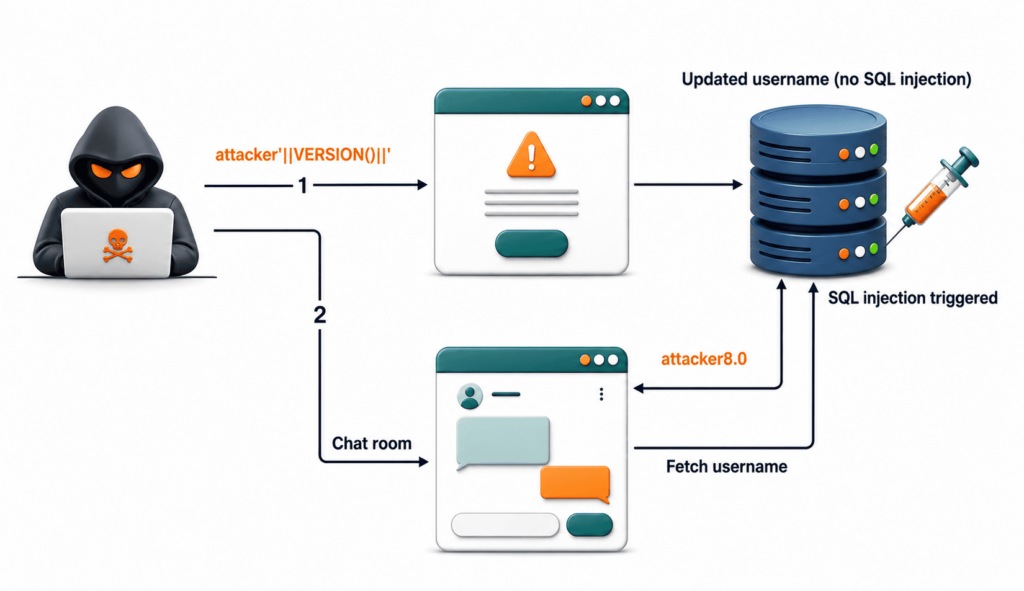
3) Ignoring Second-Order Injection
Many organizations focus on testing these payloads only at the point where user input is received, such as login forms, search fields, or contact forms. However, a less obvious but equally risky mistake is overlooking second-order SQL injection. Attackers initially store malicious input in the database, and the application subsequently uses it in another SQL query without validating or parameterizing it properly.
For instance, a username containing a malicious payload may be stored securely using parameterized queries. Assuming previously validated or stored data is always safe is a common misconception that can leave applications vulnerable to SQL Injection Payloads.
4) Missing Web Application Firewall (WAF) Tuning
A Web Application Firewall can catch many known SQL injection payload patterns, but a common mistake is deploying it with default rules and never tuning it to the specific application. Attackers are aware of standard WAF signatures and craft payloads specifically designed to evade them using techniques like whitespace manipulation, inline comments, or alternate encoding.
Treat a WAF as one layer of defense rather than replacing secure coding practices with it. Relying on it exclusively creates a false sense of security.
Join our weekly newsletter and stay updated
5) Lack of Regular Security Testing
Finally, one of the most overlooked mistakes is simply not testing for SQL injection vulnerabilities on a regular basis. Applications change constantly, new features, new integrations, new developers, and a codebase that was secure six months ago may not be secure today.
Regular Vulnerability Assessment and Penetration Testing (VAPT) helps identify injection points before attackers do, especially in evolving codebases where manual code review can miss subtle mistakes introduced during updates.
How to Reduce the Success Rate of SQL Injection Payloads?
Bringing these mistakes together, a few practices consistently reduce risk across applications of any size:
- Use parameterized queries everywhere, including in reporting tools, admin panels, and internal scripts, not just customer-facing forms.
- Apply the principle of least privilege to every database account tied to an application.
Standardize error handling so internal details never reach the end user.
- Validate input at every layer, including data that was already validated once and is being reused elsewhere.
- Audit every entry point, including APIs, headers, and legacy endpoints, not just the primary user interface.
- Tune security tools like WAFs to the specific application instead of relying on default configurations.
- Patch consistently and track CVEs relevant to the database and frameworks in use.
If you want to know more about SQL injection attacks, check out the blog on “SQL Injection Attack: Your Website Might Be Undergoing One Right Now”

Book Your Free Cybersecurity Consultation Today!
Conclusion
SQL injection payloads succeed not because the technique is new or sophisticated, but because foundational security practices are skipped, misconfigured, or inconsistently applied. Parameterized queries, least-privilege database access, proper error handling, and regular testing form the backbone of real protection. Avoiding these common mistakes doesn’t just block basic payloads; it closes the door on the more advanced injection techniques attackers rely on when the simple ones fail.
For organizations handling sensitive data, treating SQL injection prevention as an ongoing discipline rather than a one-time fix is the difference between a minor vulnerability report and a major data breach.
FAQs
- Are parameterized queries enough to stop SQL Injection Payloads?
Parameterized queries are one of the strongest defenses against SQL Injection Payloads, but they should be combined with other security measures, such as input validation, secure error handling, least-privilege database access, regular patching, and continuous security testing for comprehensive protection.
- Can SQL Injection Payloads target APIs?
Yes. APIs are common targets for SQL Injection Payloads, especially when they interact directly with backend databases and fail to properly validate or parameterize user input. Securing API endpoints is just as important as protecting web applications.
- Why is the Principle of Least Privilege important against SQL Injection Payloads?
The Principle of Least Privilege limits the permissions granted to database accounts. Even if SQL Injection Payloads successfully exploit an application, restricted database permissions minimize the attacker’s ability to access, modify, or delete sensitive data.
- How often should organizations test for SQL injection vulnerabilities?
Organizations should perform security testing regularly, especially after application updates, feature releases, or infrastructure changes. Combining automated vulnerability scanning with periodic penetration testing helps identify weaknesses before attackers can exploit them using SQL Injection Payloads.
- Which applications are most vulnerable to SQL Injection Payloads?
Any application that interacts with a database can be vulnerable if it improperly handles user input. This includes web applications, mobile applications, APIs, e-commerce platforms, content management systems (CMS), and enterprise applications.
- What is the best defense against SQL Injection Payloads?
The best defense against SQL Injection Payloads is a layered security approach that includes parameterized queries, input validation, least-privilege database access, secure coding practices, timely patch management, and continuous security testing.
- What impact can successful SQL Injection Payloads have on a business?
Successful SQL Injection Payloads can lead to data breaches, financial losses, regulatory penalties, service disruption, reputational damage, and unauthorized access to sensitive customer or business information.