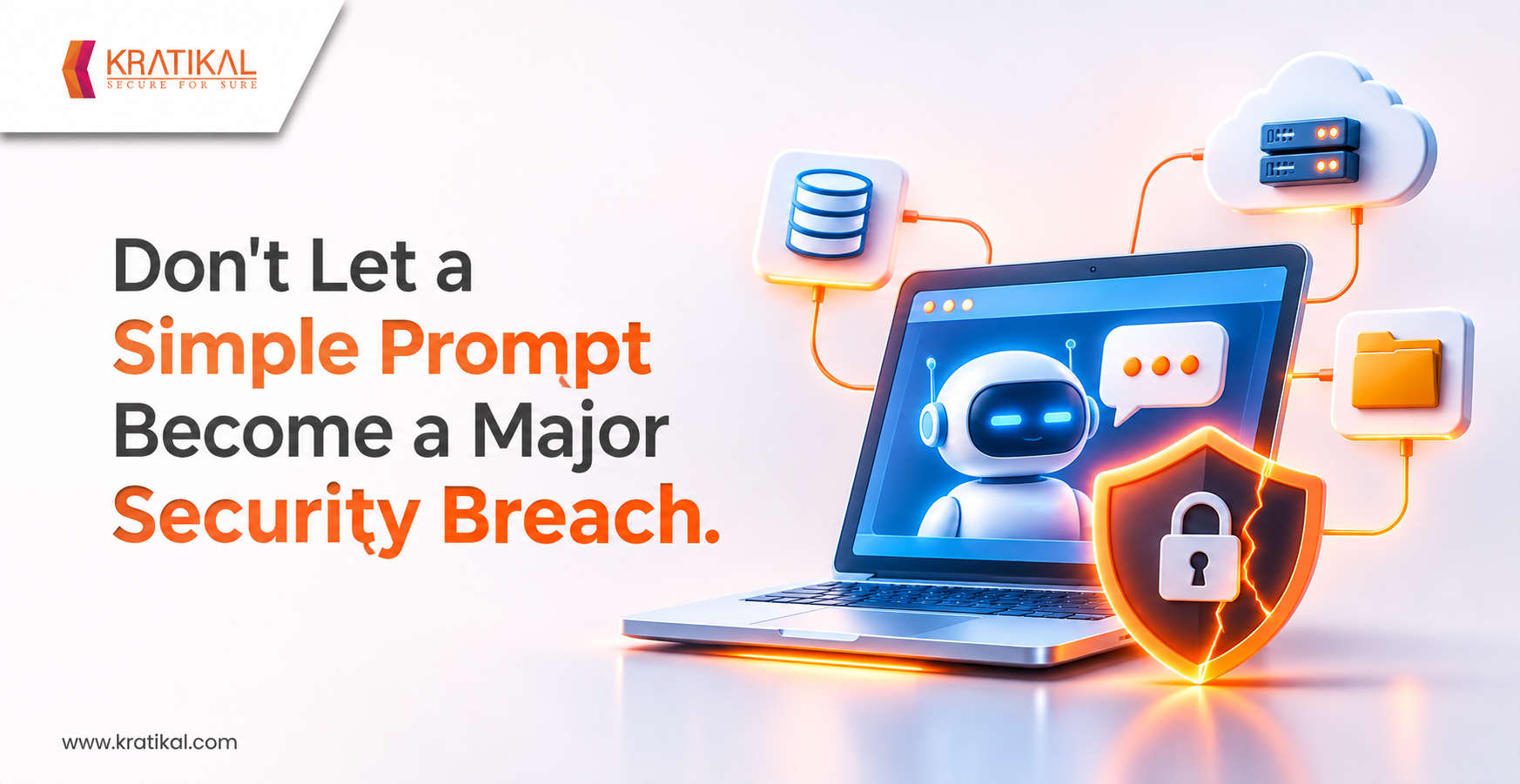
Large Language Models (LLMs) are transforming business operations through AI-powered chatbots, enterprise copilots and automated workflows. However, their growing access to sensitive data and external tools introduces security risks that require specialised testing. AI Red Teaming helps organisations identify these weaknesses by simulating real-world attacks against LLM applications.
While traditional Vulnerability Assessment and Penetration Testing (VAPT) identifies weaknesses across applications, APIs, networks and infrastructure, AI applications require additional testing of system prompts, data retrieval mechanisms and model behaviour. Attackers can exploit these areas to manipulate responses, expose confidential information, or trigger unauthorised actions.
Let’s explore 10 critical security risks organisations should test through AI red teaming and how these assessments strengthen their VAPT strategy.
AI Red Teaming: Extending VAPT to LLM Applications
This is a structured security assessment that simulates how attackers could manipulate an AI application into producing unintended, unsafe, or unauthorised outcomes.
Unlike conventional VAPT, which primarily examines application logic, configurations and infrastructure vulnerabilities, AI red teaming evaluates how an LLM responds to malicious instructions, processes untrusted information and interacts with connected systems.
For example, consider an enterprise chatbot connected to an organisation’s internal knowledge base. Although the application may have authentication and access controls, an attacker could manipulate its prompts to reveal confidential documents or retrieve information belonging to another user. An AI red team assessment investigates such scenarios by testing the model’s instructions, security guardrails, data retrieval mechanisms, integrations and monitoring controls.
The assessment can be aligned with established frameworks such as the OWASP Top 10 for LLM Applications, MITRE ATLAS and the NIST AI Risk Management Framework. These frameworks help organisations categorise AI-specific vulnerabilities and establish a structured approach to managing them.
10 Security Risks Organisations Should Test Through AI Red Teaming
LLM applications face multiple attack vectors that can compromise data confidentiality, application security, and business operations. Here are 10 critical risks organisations should evaluate through AI red teaming:
- Direct Prompt Injection
Prompt injection occurs when attackers craft malicious instructions to manipulate an LLM into ignoring its original instructions or security policies.
For example, an AI assistant designed to answer customer queries may have restrictions against revealing internal business information. An attacker could submit specially crafted prompts that attempt to override these restrictions and extract confidential information.
During AI red teaming, security professionals evaluate whether:
- Malicious user instructions can override system-level prompts.
- The model follows unauthorised instructions.
- Security guardrails remain effective across different prompt variations.
- Multi-turn conversations can gradually manipulate model behaviour.
Testing should include different instruction patterns to determine whether the model consistently follows its intended policies.
- Indirect Prompt Injection
Indirect prompt injection occurs when malicious instructions are embedded in external content that an AI application processes. This is particularly relevant to Retrieval-Augmented Generation (RAG) applications, which retrieve information from documents, emails, websites, and internal knowledge repositories before generating responses.
For example, an attacker could insert malicious instructions into a document that an AI assistant later retrieves. If the application fails to distinguish external content from trusted instructions, the model may follow the embedded commands.
- Jailbreaking and Policy Bypass
Jailbreaking involves manipulating an LLM into generating responses that violate its configured safety policies or operational restrictions.
Attackers may use role-playing scenarios, encoded instructions, alternative languages, persona-based manipulation, or multi-turn conversations to bypass content restrictions. For instance, an AI assistant designed to provide general cybersecurity guidance could be manipulated into generating restricted or harmful instructions.
AI red teaming evaluates whether the application’s safety mechanisms can withstand these attempts. Testing should cover role-play manipulation, obfuscated prompts, multi-turn attacks, and attempts to generate restricted content.
- Sensitive Information Disclosure
LLM applications often process confidential information, including customer records, employee details, internal documents, credentials, and proprietary business data. Inadequate access controls, retrieval permissions, or prompt configurations can allow attackers to manipulate the model into revealing information that should remain confidential.
During AI red teaming, security professionals assess whether an application can disclose:
- Hidden system prompts and configuration instructions.
- API keys, authentication tokens, and credentials.
- Confidential business documents and proprietary information.
- Personal information belonging to other users.
- Sensitive information accessible through connected data sources.
Testing also helps identify weaknesses in user-level access restrictions and data isolation mechanisms.
- Insecure Output Handling
LLM-generated responses are not automatically safe for downstream applications. When model outputs are passed to websites, databases, APIs, or other connected systems without proper validation, they can introduce security vulnerabilities. For example, an AI application may generate content that is directly rendered on a website. If the output contains malicious scripts and is not properly sanitised, attackers may exploit the application through Cross-Site Scripting (XSS).
Organisations should test whether:
- Generated HTML and scripts are safely rendered.
- AI-generated outputs are validated before database operations.
- Generated code is reviewed before execution.
- API inputs and outputs follow appropriate validation requirements.
- Connected systems safely handle unexpected model responses.
This makes output validation an important component of both AI red teaming and application security VAPT.
- Excessive Agency and Unauthorised Tool Usage
AI agents can interact with external tools, APIs, databases, and enterprise applications to perform tasks autonomously. However, excessive permissions can allow attackers to manipulate these agents into performing unauthorised actions.
Consider an AI-powered enterprise assistant with access to email, customer records, and payment-related APIs. If an attacker successfully manipulates the agent, it could potentially disclose information, modify records, or initiate unauthorised transactions.
AI red teaming evaluates whether:
- Agents can access tools beyond their intended permissions.
- Sensitive operations require human approval.
- API permissions follow the principle of least privilege.
- Malicious instructions can trigger unauthorised tool calls.
- Irreversible actions have additional verification controls.
Organisations must ensure that AI agents operate within clearly defined permission boundaries and cannot independently execute high-impact actions without appropriate authorisation.
- Training and Retrieval Data Attacks
LLM applications depend on training datasets, fine-tuning information and external knowledge sources to generate relevant responses. If these sources are manipulated or compromised, the model may produce inaccurate or attacker-influenced outputs.
One example is data poisoning, where attackers introduce manipulated information into training datasets or knowledge repositories. In RAG applications, malicious documents or altered content may influence the information retrieved by the model.
Red team assessments should examine whether:
- Sensitive training information can be extracted.
- Manipulated documents influence generated responses.
- Retrieval mechanisms identify untrusted information sources.
- Users can retrieve information outside their permissions.
- Unauthorised changes to knowledge repositories affect response integrity.
These tests help organisations protect the confidentiality and reliability of the information used by their AI applications.
- Supply Chain and Model Integrity Risks
LLM applications often depend on third-party foundation models, plugins, APIs, datasets, open-source libraries, and external integrations. A vulnerability in any of these components can compromise the security of the entire application.
For example, integrating an untrusted model, malicious plugin, or compromised dependency could introduce backdoors, expose sensitive information, or alter application behaviour.
AI red teaming should evaluate whether:
- Models and plugins originate from trusted sources.
- External integrations have excessive permissions.
- Dependencies contain vulnerable or tampered components.
- Model configurations can be modified without authorisation.
- Third-party components introduce unexpected application behaviour.
This assessment helps organisations identify security weaknesses beyond the LLM itself and evaluate the integrity of the wider AI ecosystem.
- Misinformation, Hallucination and Harmful Outputs
LLMs can generate responses that sound convincing but contain fabricated information, inaccurate references, or unsafe recommendations. These issues become significant business risks when AI applications support critical decisions.
For instance, an AI-powered financial assistant may generate incorrect regulatory guidance, while a healthcare chatbot could provide misleading information that influences patient decisions.
AI red teaming evaluates whether the application:
- Generates fabricated facts, references, or citations.
- Presents uncertain information as verified.
- Produces biased or discriminatory responses.
- Provides unsafe recommendations in sensitive scenarios.
- Fails to communicate limitations when reliable information is unavailable.
Testing should also examine whether the application distinguishes verified information from unsupported assumptions.
- Unbounded Consumption and Resource Exhaustion
LLM applications consume computational resources and often incur costs based on token usage, API requests, and model processing. Attackers can exploit inadequate resource controls to increase operational expenses or degrade application availability.
For example, repeated requests containing excessively long prompts or recursive instructions may cause an application to consume significant computational resources and tokens.
During AI red teaming, security professionals assess whether:
- Token limits are appropriately configured.
- Excessive or repeated requests are restricted.
- Recursive prompts trigger uncontrolled processing.
- API usage is monitored and rate-limited.
- Cost thresholds and resource controls are enforced.
These tests help organisations reduce the risk of resource exhaustion, service degradation, and unexpected AI infrastructure expenses.

Book Your Free Cybersecurity Consultation Today!
The AI Red Team Assessment Process
Identifying AI-related vulnerabilities requires a structured assessment rather than relying on a few isolated prompts. A comprehensive AI red team engagement generally follows six phases:
1. Scoping and Rules of Engagement
The assessment begins by defining target applications, authorised testing techniques, access levels, testing boundaries, and assessment objectives. Organisations also establish data-handling requirements and prohibited activities.
2. Reconnaissance and Characterisation
Security professionals examine the model, system prompts, connected tools, data sources, input and output mechanisms, guardrails, rate limits, and logging controls. This establishes the application’s intended behaviour and potential attack surface.
3. Threat Modelling
Relevant attackers and abuse scenarios are identified based on the application’s deployment and business requirements. Test categories are prioritised according to their likelihood and potential business impact.
4. Adversarial Testing
Manual and automated techniques are used to execute attacks across different vulnerability categories. Testing includes single-turn prompts, multi-turn conversations, prompt variations, and attempts to manipulate connected tools. Attack responses and success rates are recorded.
5. Impact Analysis
Successful attacks are evaluated against realistic business consequences, including sensitive data exposure, unauthorised actions, downstream compromise, reputational damage, and compliance risks.
6. Reporting and Remediation
Findings are documented with severity ratings, reproduction steps, evidence, attack success rates, and business impact. Security teams receive prioritised remediation recommendations, followed by retesting to validate the effectiveness of implemented fixes.
Since LLM responses are probabilistic, attack success rates should be measured across repeated attempts instead of relying on a single successful or unsuccessful test.
Join our weekly newsletter and stay updated
Strengthen AI Application Security with AI Red Teaming and VAPT
AI adoption is expanding the enterprise attack surface beyond traditional applications and infrastructure. Organisations must evaluate not only whether their AI applications function correctly but also whether they can withstand deliberate manipulation.
Traditional VAPT remains essential for identifying weaknesses across application code, APIs, networks, cloud environments and infrastructure. However, AI-powered systems require additional adversarial testing to examine prompt behaviour, retrieval mechanisms, model outputs and autonomous tool interactions.
AI red teaming complements conventional VAPT by addressing these AI-specific risks through structured attack simulations and impact analysis.
Effective protection also requires layered security controls, including input and output validation, least-privilege permissions for AI agents, isolation of untrusted content, continuous monitoring, rate limiting, and human approval for high-impact actions.
FAQs
- What are the most common vulnerabilities identified through AI red teaming?
Common vulnerabilities include direct and indirect prompt injection, sensitive information disclosure, jailbreaking, insecure output handling, excessive agency, data poisoning, supply chain risks, harmful outputs, and resource exhaustion.
- Why is AI red teaming important for enterprise LLM applications?
Enterprise LLM applications often interact with confidential business data, internal knowledge bases, APIs, and external tools. AI red teaming helps identify weaknesses that could lead to data exposure, unauthorised operations, compromised workflows, and business disruption before attackers exploit them.
- How frequently should organisations conduct AI red teaming?
Organisations should conduct AI red teaming before deploying LLM applications and repeat assessments whenever significant changes are introduced to models, prompts, datasets, integrations, or security configurations. Periodic testing also helps identify emerging vulnerabilities as AI applications evolve.
- What security vulnerabilities can AI red teaming uncover in RAG applications?
AI red teaming evaluates whether RAG applications can resist malicious documents, indirect prompt injection, unauthorised data retrieval, and attempts to access information outside user permissions. It also examines how retrieved content influences model responses.
- How are vulnerabilities prioritised during an AI red team assessment?
Vulnerabilities are prioritised based on exploitability, attack success rate, potential impact, data sensitivity and the level of access an attacker could obtain. This helps security teams focus remediation efforts on the most significant risks.