The current nature of cyber threats is evolving rapidly, making it difficult for most organizations to keep up with vulnerability remediation. In the meantime, bigger cloud environments, remote workforces, connected devices, and more intricate IT ecosystems have made managing the attack surface an even more difficult task. Security teams are tasked with identifying, ranking, and remediating thousands of flaws, as well as coordinating limited resources, compliance requirements, and business continuity imperatives. The selection of the appropriate vulnerability management tool is thus a strategic investment rather than a routine technology purchase.
Why Your Organization Needs a Vulnerability Management Tool
Every business today depends on different digital inventory to run its daily operations. And as they grow, they add more endpoints, applications, APIs, connected devices, and cloud technologies. Each new asset brings an entry point for attackers. Cyber attackers constantly look for these entry points to infiltrate the environment, and without continuous monitoring, these security gaps can remain unnoticed for a long time. Managing vulnerabilities manually is no longer a possible solution. So, using a vulnerability management tool like AutoSecT gives complete visibility to the security teams.
The goal of such tools is not only to find vulnerabilities but to fix the most important ones before an attack. With the right tool, security teams can respond faster, improve security, and reduce business risk.
- Scan for true exploitable vulnerabilities
- Gets you AI-verified vulnerabilities with scan details
- Near Zero False Positives
- Risk prioritization with intelligent patch recommendation
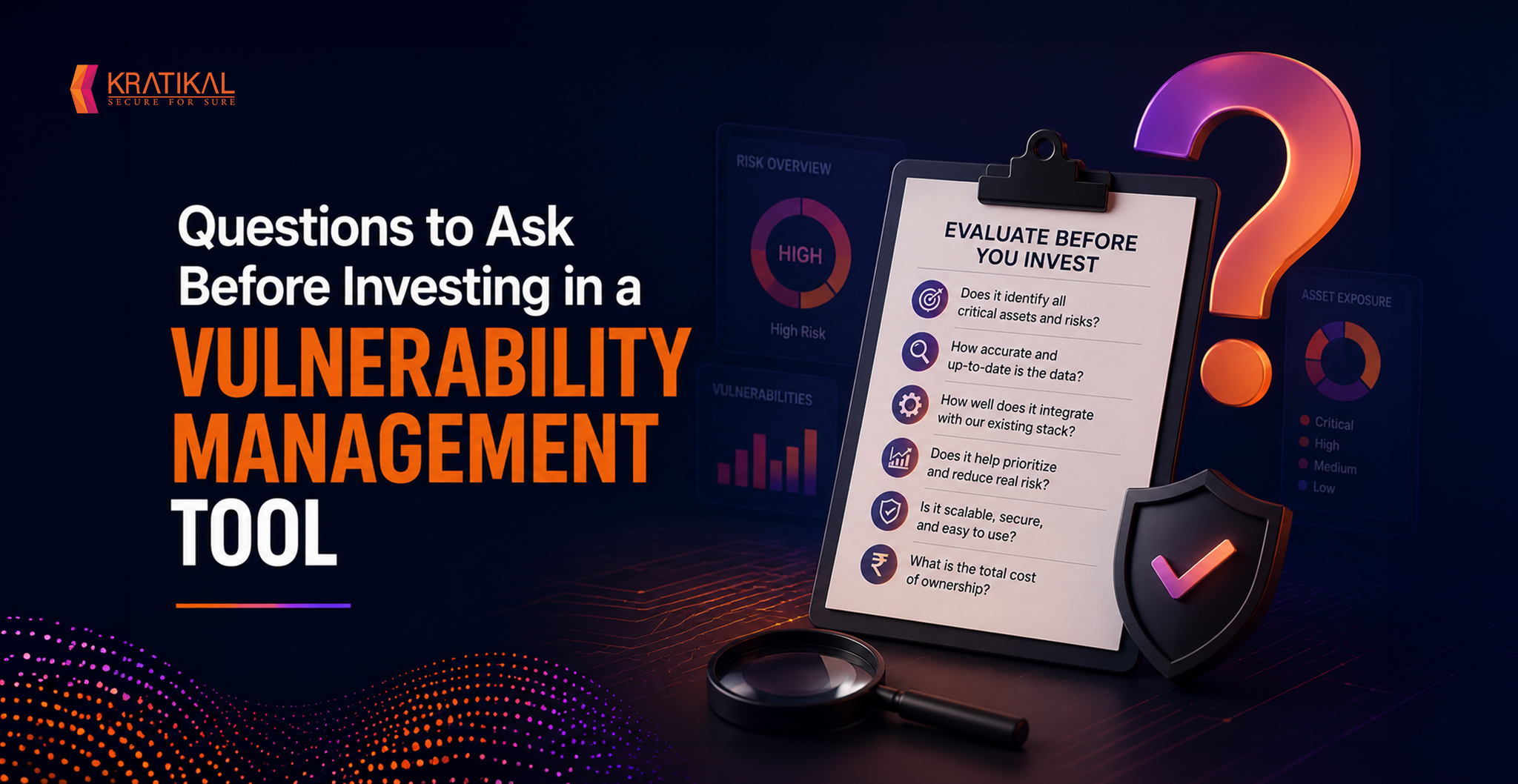
7 Questions to Ask Before Investing in a Vulnerability Management Tool
Vulnerability management tools play a major role in securing your network data. It identifies the gaps that attackers may use to exploit an asset. These tools give you a chance to fix the vulnerabilities before they impact your organization. Vulnerability management has a wide range of possibilities, just as many other cybersecurity solution categories. In order to assist you in choosing the best solution for your company, ask some questions.
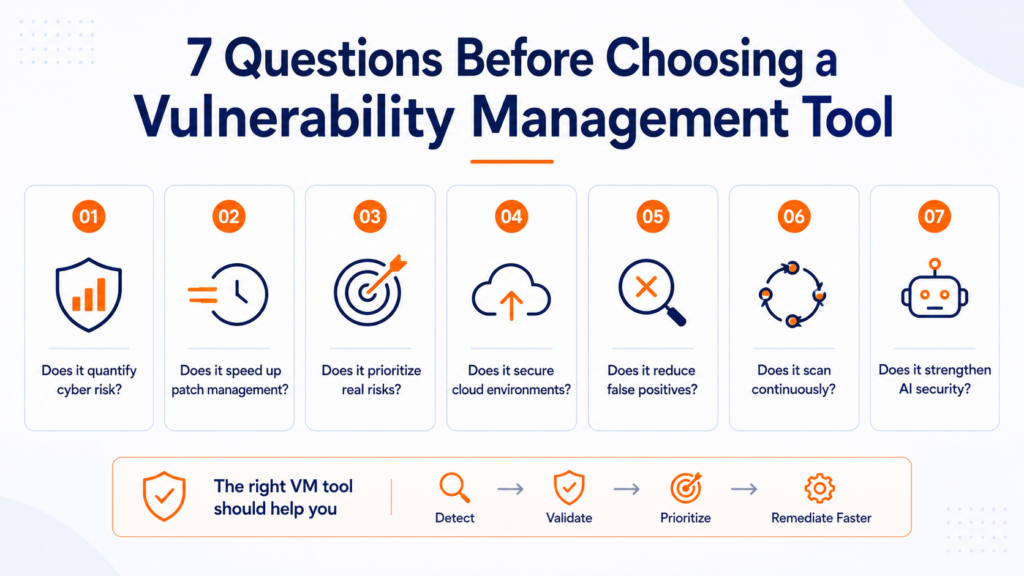
1. Does it offer Cyber Risk Quantification?
Cyber risk quantification starts with accurate visibility into your security environment. Without reliable vulnerability data, it becomes difficult to identify and understand business risk and prioritize the right actions.
An AI-powered vulnerability management platform helps CISOs by:
- Mapping assets across the environment
- Detecting exploitable security weaknesses
- Displaying CVSS scores, affected assets, scan results, and risk severity
AutoSecT by Kratikal is an AI-powered pentesting and VMDR platform. It scans web, mobile, API, cloud, and network environments for exploitable vulnerabilities. Its AI engine verifies every finding before it is reported. This reduces false positives and delivers continuous security visibility through real-time scanning.
To support faster decision-making, AutoSecT includes a dedicated dashboard that gives CISOs a clear view of:
- Overall scan progress
- Critical assets and their risk scores
- High-priority vulnerabilities with impacted assets
- Vulnerability severity and remediation progress
- Remediation status across different asset categories
By bringing AI-validated vulnerability intelligence into one place, AutoSecT enables CISOs to prioritize risks with confidence and make cyber risk quantification faster, simpler, and more accurate.
2. Does it speed up Patch Management?
Patch management is the process of identifying, testing, and deploying security updates to fix vulnerabilities in code, cloud, and applications. It helps organizations close security gaps before attackers can exploit them. A fast and well-managed patching process reduces cyber risk, minimizes downtime, and keeps IT environments secure.
Delays in patch management increase the risk of cyberattacks and leave critical systems exposed. Faster patching helps security teams reduce risk, improve efficiency, and protect business operations before vulnerabilities are exploited.
AutoSecT delivers AI-powered security insights in hours, supported by human expertise:
- AI-Verified Vulnerabilities
- Risk Prioritisation of Exploitable Vulnerabilities
- AI-Based Patch Recommendation
- Comprehensive Dashboard
AutoSecT’s CISO dashboard highlights high-risk vulnerabilities, remediation progress, and vulnerability dwell time. The Analytics dashboard tracks patching status, fixed and unresolved vulnerabilities, and critical findings across different asset types. This helps security teams prioritize and monitor remediation more efficiently.

Book Your Free Cybersecurity Consultation Today!
3. Does It Prioritize Risks Instead of Listing Every Vulnerability?
Not every vulnerability needs immediate attention. A good platform ranks findings based on risk, so your team can focus on the most critical issues first. This saves time and improves the overall remediation process.
Why Risk Prioritization Matters
Finding vulnerabilities is only the first step in cyber risk management. Security teams also need to understand which issues create the greatest business risk. Combining vulnerability data with business context helps teams prioritize the right threats and focus remediation where it matters most.
- Prioritize critical risks
- Assess business impact
- Consider asset value
- Use threat intelligence
- Fix exploitable vulnerabilities
- Improve remediation efforts
How AutoSecT Prioritizes Cyber Risk
AutoSecT helps security teams focus on the vulnerabilities that need immediate attention. Instead of reviewing every security finding, the platform uses AI to rank risks based on business context and exploitability. This helps organizations reduce response time, improve remediation, and strengthen their overall security posture.
- AI-based risk prioritization
- Exploitability analysis
- Business impact assessment
- Real-time risk monitoring
- CVSS-based risk scoring
- AI-powered patch recommendations
- Continuous attack surface visibility
- JIRA, Slack, Teams, and Google Chat integration
- Faster remediation workflows
4. Does it Provide Cloud Security Analysis?
Today, lots of applications run in cloud environments. The cloud infrastructure offers flexibility and scalability. But security issues are brought in as well.
AutoSecT helps identify:
- Misconfigured cloud resources
- Excessive permissions
- Weak security settings
- Exposed assets
The platform supports cloud security posture management and continuous visibility across cloud environments. These checks strengthen the overall security posture of AI deployments. Cloud controls also play a major role because many security incidents originate from configuration mistakes.
5. Can It Reduce False Positives?
False positives slow down security teams and waste valuable resources. A reliable vulnerability management tool should validate findings and improve reporting accuracy. This allows your team to spend more time fixing real security issues.
Look for:
- AI-assisted validation
- Accurate reporting
- Faster remediation with AI-based recommendation
How AutoSecT Ensures Near-Zero False Positives?
AutoSecT helps organizations reduce cyber risk with AI-verified findings, intelligent risk prioritization, and real-time security insights. Its automated workflows and team integrations speed up remediation, enabling scalable and more effective vulnerability management. AutoSecT was built to reduce false positives at scale while improving vulnerability management. It reduces false positives using:
- AI-Verified Vulnerabilities
- Agentic AI
- Risk-Based Prioritization
- AI-Driven Patch Recommendations
- Smarter Collaboration
- Scale Without Compromise
6. How Frequently Does It Scan for Vulnerabilities?
Cyberthreats are constantly evolving. A tool that only sometimes scans could overlook recently found vulnerabilities. Frequent scanning enables your team to identify problems early on and begin fixing them before attackers exploit them.
Security teams often struggle with manual testing. Manual assessments take time and require significant resources. AutoSecT automates vulnerability scanning across applications and assets. The platform examines assets and identifies potential weaknesses.
It helps teams discover:
- Security flaws in connected applications
- API weaknesses
- Misconfigurations
- Authentication issues
- Exposed services
7. How Does It Build Trust in AI?
Customers expect organizations to protect their data, partners expect strong security controls, and regulators expect compliance with security requirements. And security testing helps meet these expectations.
How AutoSecT Helps Build Trust
AutoSecT is an automated vulnerability management platform of various digital assets, such as web applications, APIs, cloud-based environments, mobile applications, and networks. These features assist companies in evaluating the security of assets and the infrastructure underpinned by the same. The platform integrates human expertise with AI-based analysis to detect risks in less time.
- Secure APIs with Continuous Testing
Most AI applications depend on APIs. The model may connect with payment systems, databases, CRM platforms, or internal business tools. AutoSecT scans APIs for security vulnerabilities. It checks for issues such as broken authentication, insecure data handling, and injection risks. This helps organizations secure one of the most critical parts of their AI ecosystem.
- Monitor Security Continuously
AutoSecT performs ongoing security scans to identify risks as they appear. Regular assessments help organizations maintain a stronger security posture and keep applications protected throughout their lifecycle.
- Prioritize Critical Risks Faster
The identification of vulnerabilities is not the sole task. Security teams must understand which issues require immediate action. AutoSecT uses AI-driven analysis to help prioritize vulnerabilities based on risk and impact. This helps teams focus on the most critical threats first. As a result, organizations can reduce exposure faster and improve remediation efforts.
Join our weekly newsletter and stay updated
Conclusion
When organizations test their applications regularly, they reduce risks and improve trust. AutoSecT by Kratikal offers the visibility to comprehend the vulnerabilities and enhance protection. With automated scanning, AI-based analysis, and constant monitoring, organizations will have a better idea of their security posture.
FAQs
- What should I look for in a vulnerability management tool?
Look for a platform that provides continuous vulnerability scanning, AI-powered risk prioritization, accurate reporting, patch recommendations, cloud security analysis, and near-zero false positives. The right tool should help your team identify, prioritize, and remediate exploitable vulnerabilities efficiently.
- Why is AI important in vulnerability management?
AI helps security teams verify vulnerabilities, reduce false positives, prioritize exploitable risks, and recommend remediation steps. This allows organizations to respond faster, improve operational efficiency, and focus on the vulnerabilities that pose the highest business risk.
- How does a vulnerability management tool improve patch management?
A vulnerability management tool identifies missing patches, prioritizes vulnerabilities based on risk, and provides actionable remediation guidance. This accelerates patch deployment, reduces vulnerability dwell time, and minimizes the chances of attackers exploiting known security gaps.
- How often should vulnerability scans be performed?
Organizations should perform continuous or frequent vulnerability scans rather than relying on periodic assessments. Continuous scanning helps detect newly discovered vulnerabilities, misconfigurations, and exposed assets before they become security incidents.
- Why is risk-based vulnerability prioritization important?
Risk-based prioritization enables security teams to focus on vulnerabilities that are most likely to be exploited and have the greatest business impact. Instead of addressing thousands of findings, teams can remediate the most critical risks first and improve overall security posture.
- Can a vulnerability management tool help secure cloud environments?
Yes. Modern vulnerability management platforms continuously monitor cloud environments for misconfigurations, exposed resources, excessive permissions, and insecure settings. This improves cloud security posture and reduces the risk of cloud-based attacks.
- Can vulnerability management tools integrate with existing security workflows?
Yes. Most enterprise-grade vulnerability management solutions integrate with ticketing and collaboration platforms such as Jira, Slack, Microsoft Teams, and Google Chat. These integrations automate remediation workflows, improve collaboration, and help security teams resolve vulnerabilities faster.
- How do I choose the best vulnerability management tool for my organization?
Choose a solution that offers AI-powered vulnerability validation, continuous scanning, risk-based prioritization, cloud security visibility, automated patch recommendations, comprehensive dashboards, and seamless integrations. A platform that combines automation with actionable insights will help improve security while reducing operational overhead.