

A compromised user account, an exposed application, or an unsecured API can give attackers access to critical business systems, even when an organisation has multiple security controls in place. Traditional security models often rely on network boundaries and assume that users or devices inside the corporate environment can be trusted. However, this approach creates security gaps when attackers gain access through stolen credentials, misconfigured systems, or vulnerable applications.
Zero Trust Architecture addresses these gaps by removing implicit trust from the security model. It follows a simple principle: never trust, always verify. Every user, device, application, and access request must be authenticated, authorised, and continuously evaluated before accessing organisational resources.
However, implementing Zero Trust does not automatically guarantee security. Misconfigured access policies, weak authentication mechanisms, excessive permissions, and exposed internal services can undermine the entire architecture.
A structured Zero Trust checklist, supported by penetration testing, helps organisations identify these weaknesses and determine whether their security controls work as intended. This blog explores the essential penetration testing checks organisations should perform to validate their Zero Trust Architecture and strengthen their overall security posture.
Brief Overview of Zero Trust
Zero Trust Architecture is a security framework that requires continuous verification of every access request, regardless of whether it originates inside or outside the corporate network.
Unlike traditional perimeter-based security, Zero Trust does not consider a user or device trustworthy simply because it has connected to an internal network.
Instead, access decisions depend on multiple factors, including:
- Identity verification: Confirming the identity of users, applications, and services requesting access.
- Device security: Evaluating device health, configuration, and compliance before granting access.
- Least-privilege access: Providing users with only the permissions necessary to perform their responsibilities.
- Continuous monitoring: Tracking access activities and identifying unusual behaviour.
- Network segmentation: Restricting communication between systems to limit unauthorised access and lateral movement.
These principles help organisations reduce unauthorised access and limit the impact of compromised accounts or devices. However, the effectiveness of Zero Trust depends on how.
Zero Trust Checklist: 10 Essential Pentest Checks
The following Zero Trust checklist covers the critical security areas organisations should validate through penetration testing.
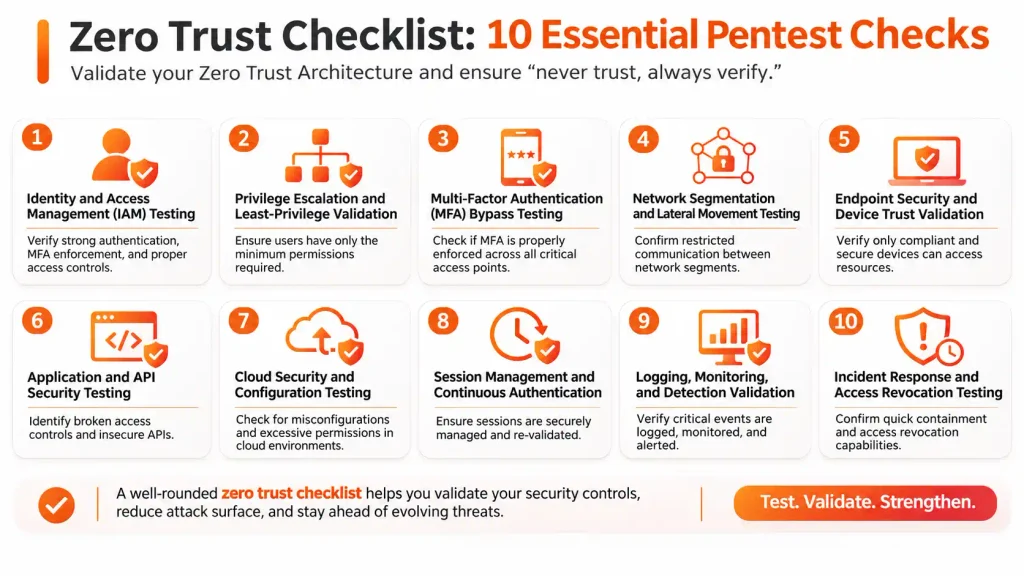
- Identity and Access Management (IAM) Testing
Identity is one of the most important components of Zero Trust. Every access request must be linked to a verified identity with appropriate permissions. Penetration testers should evaluate whether identity and access management controls prevent unauthorised users from accessing sensitive resources.
Key Pentest Checks:
- Test authentication mechanisms for weak passwords and insecure login configurations.
- Check whether MFA is enforced across all critical applications and privileged accounts.
- Identify authentication bypass vulnerabilities.
- Test session management, including session expiration and invalidation.
- Check for insecure password reset and account recovery mechanisms.
- Verify whether inactive and terminated user accounts are properly disabled.
What to look for: Weak authentication controls, inconsistent MFA enforcement, compromised sessions, and unauthorised account access.
- Privilege Escalation and Least-Privilege Validation
Zero Trust follows the principle of least privilege, ensuring users receive only the access required for their roles. However, excessive permissions and poorly configured role-based access controls can allow attackers to gain access to sensitive systems.
Key pentest checks:
- Identify users with unnecessary administrative privileges.
- Test horizontal privilege escalation, where one user accesses another user’s resources.
- Test vertical privilege escalation, where standard users gain administrative permissions.
- Evaluate Role-Based Access Control (RBAC) configurations.
- Check whether service accounts have excessive permissions.
- Verify whether privileged access is restricted and monitored.
What to look for: Unauthorised access to administrative functions, excessive privileges, and insecure role assignments.
- Multi-Factor Authentication (MFA) Bypass Testing
MFA adds another layer of security by requiring additional verification beyond passwords. However, incorrectly implemented MFA can create opportunities for attackers to bypass authentication controls.
Penetration testing should validate whether MFA protects all relevant access points.
Key pentest checks:
- Test whether MFA can be bypassed through alternative authentication endpoints.
- Check whether legacy protocols allow access without MFA.
- Evaluate OTP validation and expiration mechanisms.
- Test MFA enforcement across VPNs, cloud applications, and administrative portals.
- Check whether session tokens remain valid after MFA settings are changed.
- Evaluate account recovery mechanisms for weaknesses.
What to look for: Inconsistent MFA enforcement, weak verification workflows, and authentication paths that allow unauthorised access.
- Network Segmentation and Lateral Movement Testing
Network segmentation prevents attackers from moving freely between systems after compromising an endpoint or account. In a Zero Trust environment, access between network segments should be restricted based on identity, application requirements, and security policies.
Key pentest checks:
- Identify unrestricted communication between internal network segments.
- Test whether compromised endpoints can access critical servers.
- Evaluate firewall rules and access control lists.
- Check for exposed internal services and unnecessary open ports.
- Test whether access to sensitive databases is restricted.
- Simulate lateral movement using authorised penetration testing techniques.
What to look for: Flat network configurations, unrestricted internal communication, and weak isolation between critical systems.
- Endpoint Security and Device Trust Validation
Zero Trust requires organisations to evaluate device security before granting access to applications and resources. A compromised or unmanaged device should not receive the same level of access as a compliant corporate endpoint.
Key pentest checks:
- Test whether unmanaged devices can access corporate applications.
- Evaluate device compliance enforcement.
- Check whether outdated operating systems or vulnerable software are permitted to connect.
- Assess endpoint detection and response (EDR) coverage.
- Test access restrictions for jailbroken or rooted devices.
- Verify whether compromised devices can access sensitive resources.
What to look for: Weak device validation, incomplete endpoint protection, and access granted to non-compliant devices.
- Application and API Security Testing
Applications and APIs frequently handle sensitive business information and connect multiple internal and external systems. Weak application-level security can undermine Zero Trust policies, even when network access is restricted.
Key pentest checks:
- Test applications for broken authentication and authorisation.
- Identify Broken Object Level Authorization (BOLA) vulnerabilities.
- Check for insecure direct object references.
- Test API authentication and token validation.
- Evaluate rate limiting and access restrictions.
- Identify exposed API endpoints and sensitive information leakage.
- Check whether service-to-service communication uses secure authentication.
What to look for: Broken access controls, exposed endpoints, insecure API tokens, and unauthorised data access.
- Cloud Security and Configuration Testing
Cloud environments introduce additional access points through management consoles, storage services, APIs, and interconnected workloads. A Zero Trust approach requires every cloud resource and workload to follow strict identity and access policies.
Key pentest checks:
- Identify publicly accessible cloud storage and sensitive resources.
- Review cloud IAM roles and permissions.
- Test access restrictions across cloud workloads.
- Check for exposed management interfaces.
- Evaluate security group and firewall configurations.
- Test whether compromised cloud credentials can access additional resources.
- Verify workload identity and service account permissions.
What to look for: Excessive cloud permissions, exposed resources, insecure workload communication, and misconfigured access policies.
- Session Management and Continuous Authentication Testing
Zero Trust is not limited to verifying identities during login. Access decisions must account for changing user behaviour, device conditions, and potential security threats. Weak session management can allow attackers to reuse stolen credentials or session tokens to access protected resources.
Key pentest checks:
- Test session timeout and automatic logout mechanisms.
- Check whether session tokens are securely generated and stored.
- Evaluate token expiration and revocation.
- Test whether sessions remain active after password changes.
- Check whether suspicious login patterns trigger additional verification.
- Validate access restrictions when device security conditions change.
What to look for: Long-lived sessions, reusable tokens, inadequate session invalidation, and insufficient continuous verification.
- Logging, Monitoring, and Detection Validation
Continuous monitoring helps security teams identify suspicious activities and respond before attackers can cause significant damage. However, logging alone is insufficient if critical events are not captured, correlated, or investigated.
Key pentest checks:
- Verify whether failed login attempts and suspicious authentication activities are logged.
- Check whether privilege escalation attempts generate alerts.
- Test whether unauthorised access attempts are detected.
- Evaluate integration between security tools and SIEM platforms.
- Check whether activity across cloud, endpoints, and applications is monitored.
- Simulate controlled attack scenarios to evaluate detection capabilities.
What to look for: Missing security logs, delayed alerts, incomplete monitoring coverage, and detection gaps.
- Incident Response and Access Revocation Testing
Even a well-designed Zero Trust environment cannot prevent every security incident. Organisations must ensure that compromised identities, devices, and sessions can be isolated quickly. Penetration testing should evaluate whether security teams can contain threats and revoke access when suspicious activity is detected.
Key pentest checks:
- Test whether compromised user accounts can be disabled immediately.
- Verify whether active sessions and authentication tokens can be revoked.
- Evaluate endpoint isolation procedures.
- Check whether access permissions can be modified during an incident.
- Test alert escalation and incident response workflows.
- Assess whether security teams can identify the scope of unauthorised access.
What to look for: Delayed access revocation, incomplete containment procedures, and gaps in incident response coordination.

Book Your Free Cybersecurity Consultation Today!
Key Steps to Perform a Zero Trust Assessment Through Penetration Testing
A successful Zero Trust implementation requires more than deploying authentication tools, enforcing access policies, or segmenting networks. Organisations must regularly evaluate whether these security controls function as intended and can withstand real-world attack scenarios.
A comprehensive zero trust assessment through penetration testing helps security teams identify gaps across identities, endpoints, applications, networks, and cloud environments. It also provides visibility into how an attacker could exploit weaknesses to gain unauthorised access or move across critical systems.
The assessment can be conducted through the following five stages:
- Identify Critical Assets and Access Points
Begin by identifying the organisation’s critical digital assets and the resources that require protection. This includes applications, databases, cloud workloads, APIs, endpoints, network infrastructure, user identities, and privileged accounts. Map how these assets communicate, which users and services can access them, and what level of permissions they require. Pay particular attention to externally exposed applications, third-party integrations, legacy systems, and service accounts, as these can introduce additional attack surfaces.
- Evaluate Existing Security Policies and Configurations
Review the organisation’s existing Zero Trust policies to determine whether access is granted based on verified identities, device health, user roles, and contextual risk factors. Examine MFA enforcement, Role-Based Access Control (RBAC), privileged access management, network segmentation, endpoint compliance, and session management configurations. Identify inconsistent policies, excessive permissions, and exceptions that could allow users or devices to bypass established security controls.
- Perform Controlled Penetration Testing
Simulate realistic attack scenarios to evaluate how effectively the implemented security controls prevent unauthorised access. Test authentication mechanisms, MFA bypass possibilities, privilege escalation, insecure session handling, API vulnerabilities, and network segmentation.
Also, assess whether a compromised user account or endpoint could be used to access sensitive resources or move laterally across the environment. These tests help identify exploitable weaknesses that may remain unnoticed during routine security configuration reviews.
- Analyse Vulnerabilities and Identify Security Gaps
Once testing is complete, consolidate the findings and assess each vulnerability based on its severity, exploitability, business impact, and potential attack paths. Determine whether individual weaknesses could be chained together to compromise critical systems. For instance, excessive user permissions combined with weak network segmentation could allow an attacker to move from a compromised endpoint to sensitive business applications.
Prioritise vulnerabilities that create significant risks to business-critical assets and document their technical impact alongside actionable remediation recommendations.
- Validate Remediation and Retest Security Controls
After implementing the recommended fixes, conduct retesting to verify whether the identified vulnerabilities have been resolved. Validate that updated access policies, authentication mechanisms, network restrictions, and endpoint controls function as expected. Also, check whether remediation has introduced configuration issues or unintended access restrictions. Document the retest results and maintain a record of unresolved vulnerabilities to support continuous security improvement.
Join our weekly newsletter and stay updated
Conclusion
Zero Trust is not a one-time security implementation. It requires continuous validation of identities, devices, applications, network access, and security policies.
A well-defined zero trust checklist gives organisations a structured approach to identifying weaknesses and evaluating whether their architecture follows the principle of never trust, always verify.
Penetration testing strengthens this process by simulating real-world attack scenarios and exposing vulnerabilities that configuration reviews may overlook. From MFA bypass and privilege escalation to network segmentation and cloud security, each assessment helps organisations understand how effectively their controls protect critical business assets.
At Kratikal, we help organisations strengthen their security posture through comprehensive penetration testing and security assessment services. Our testing approach helps identify exploitable vulnerabilities, validate security controls, and provide actionable remediation insights.
FAQs
- What vulnerabilities can penetration testing identify in a Zero Trust environment?
Penetration testing can identify authentication bypass, weak session management, privilege escalation, excessive user permissions, insecure APIs, cloud misconfigurations, unrestricted network access, and insufficient security monitoring.
- Is Multi-Factor Authentication enough to implement Zero Trust security?
MFA is an important part of Zero Trust, but it does not provide complete protection. Organisations must also implement least-privilege access, device verification, network segmentation, continuous monitoring, and regular security assessments.
- Can penetration testing identify gaps in Zero Trust implementation?
Yes. Penetration testing identifies weaknesses in authentication, authorisation, network segmentation, endpoint security, and application access controls. It helps determine whether attackers can bypass security policies or gain unauthorised access to protected resources.
- What role does least-privilege access play in Zero Trust Architecture?
Least-privilege access ensures that users, applications, and services receive only the permissions necessary to perform their assigned tasks. It reduces the attack surface and limits the damage attackers can cause if an account or system is compromised.
- How does Zero Trust improve cloud security?
Zero Trust strengthens cloud security by enforcing identity-based access, restricting permissions, validating workloads, and continuously monitoring cloud activities. It also helps prevent unauthorised access to cloud applications, storage, and infrastructure.