A third-party risk assessment is the process of finding, scoring, and treating the risks a vendor, supplier, or service provider brings into your organisation. Those risks are security, operational, compliance, and financial. In 2027, a sound third-party risk assessment tiers every vendor, checks controls with evidence rather than answers alone, and keeps monitoring after signature.
The questionnaire is sent, the vendor scores 92%, the contract is signed. But that score describes what the vendor said on one day, not what an attacker can reach through the vendor today. This guide sets out a seven-step framework, a scoring model, reassessment triggers, and the regulations that now expect you to prove the work.
What Is a Third-Party Risk Assessment?
A third-party risk assessment is a structured review of one external party before and during a business relationship. It answers three questions: what the third party can access, what could go wrong, and how well its controls reduce that exposure. The output is a residual risk rating that decides whether you onboard the vendor, add conditions, or walk away.
Third parties include more than suppliers with invoices. The scope covers cloud and SaaS providers, managed service providers, payment processors, and outsourced developers. It also covers consultants with system access, logistics partners, and every integration connected through an API key or an OAuth token. A marketing plugin with read access to your CRM is a third party, even if nobody signed a contract for it.
A useful third-party risk assessment produces four outputs. These are an inherent risk tier, an evidence file, a residual risk score, and a treatment plan with owners and dates. If your current process ends at a completed questionnaire, you have collected input but not finished the assessment. The broader security risk assessment basics apply here too, with one difference: you do not control the systems you are assessing.
Third-Party Risk Assessment vs TPRM vs Vendor Risk Management
The three terms overlap, and teams often use them interchangeably. The difference is scope. A third-party risk assessment is one activity applied to one relationship at a point in time. Third-party risk management (TPRM) is the full programme around it. Vendor risk management is a subset of TPRM that covers suppliers you buy from.
| Term | Scope | Typical output | Who usually owns it |
| Third-party risk assessment | One third party, one point in time | Inherent tier, residual risk score, treatment plan | Security or risk analyst |
| Vendor risk management (VRM) | Suppliers you pay for products or services | Vendor inventory, contract controls, performance reviews | Procurement with security |
| Third-party risk management (TPRM) | All external relationships, including partners, affiliates, and unpaid integrations | Policy, lifecycle, monitoring, board reporting | CISO, CRO or a TPRM function |
| Supply chain risk management | Upstream suppliers, their suppliers, and the software and hardware they ship | Supplier maps, SBOMs, concentration analysis | Security, procurement and engineering |
In practice, the TPRM process sets the rules. Vendor risk management runs the supplier relationships. Each third-party risk assessment applies those rules to one vendor. A weak assessment weakens everything built on it, which is why the steps later in this guide focus on evidence quality.
Why Third-Party Risk Assessment Matters More in 2027
Third-party breaches are no longer an edge case. Verizon published its 2026 DBIR findings on 19 May 2026. Breaches involving a third party rose 60% in one year and now account for 48% of all breaches in its dataset. Exploited flaws have now overtaken stolen logins as the top way in, at 31% of breaches, per SecurityWeek’s DBIR analysis.
That analysis also shows why annual questionnaires miss the problem. Among the third-party organisations the DBIR tracked, only 23% fully fixed missing or weak multi-factor authentication (MFA) on their cloud accounts. Those gaps sit in environments you cannot scan yourself, yet they decide whether your data stays private.
The cost follows the exposure. IBM’s 2026 breach cost report puts the global average breach at USD 4.99 million.
IBM ranks supply chain compromise as the second most common way in. Such breaches also tied for the longest lifecycle, at 258 days to find and contain. Of the 30 cost factors IBM measured, a business partner or supply chain compromise added the most, at USD 227,250 above the average.
A third-party risk assessment that runs once at onboarding cannot keep pace with these numbers. The rest of this framework is built around that fact.
Third-Party Breach Example: The Klue OAuth Token Theft
The Klue breach of June 2026 shows how a trusted vendor integration becomes an entry point. Klue is a sales intelligence app that links to customers’ Salesforce accounts. On 12 June 2026, it reported unauthorised activity in part of its integration systems.
The way in was a forgotten credential. Klue said the attacker used a legacy credential created for an integration prototype that had been abandoned. With that access, the attacker stole the OAuth tokens that link Klue to Salesforce. Scripts then pulled CRM data out through the Salesforce API.
A group calling itself Icarus later listed Klue on its leak site. Companies including Huntress, Jamf, Snyk and LastPass confirmed they were affected. Salesforce said the issue came from Klue’s app connection, not from a flaw in its own platform.
Consider what a traditional third-party risk assessment of Klue would have checked: a security questionnaire, perhaps a SOC 2 report. Few assessments ask which OAuth scopes the app holds, how long its tokens live, or whether old project credentials get retired. ReliaQuest researchers saw the same OAuth improper pattern as the 2025 Salesloft Drift breach. This is a repeat pattern, not a one-off.
Those questions belong in Step 3 of the framework below, alongside a wider review of API security attack vectors in your integrations.
The Five Third-Party Risk Domains to Assess
Most guides list four core third-party risk types: cybersecurity, operational, compliance, and financial. In 2026, a fifth domain deserves its own line, because regulators now ask about it directly: concentration and fourth-party risk.
| Risk domain | What it covers | Example question for the vendor |
| Cybersecurity | Access to your data and systems, control strength, breach history | Which of our platforms can your staff or integrations reach, and how is that access authenticated? |
| Operational and resilience | Service availability, recovery time, dependence on the vendor’s own suppliers | What are your recovery time and recovery point objectives for the service we use? |
| Compliance and privacy | Data protection law, sector rules, data location, sub-processors | Where is our data stored and processed, and which sub-processors touch it? |
| Financial and reputational | Vendor stability, ownership changes, sanctions, public controversies | Has ownership or financial standing changed in the past 12 months? |
| Concentration and fourth-party | Reliance on one provider, shared upstream dependencies | Which cloud, hosting or software providers would stop your service if they failed? |
Weight the domains by the relationship. With a payroll processor, cybersecurity and privacy carry most of the weight, especially for Indian organisations preparing for the DPDP Act’s phased rollout. With a sole supplier of a manufacturing component, operational and concentration risk lead. A single third-party risk assessment template that gives every domain equal weight produces scores that look precise and decide nothing.
The 2027 Third-Party Risk Assessment Framework: 7 Steps
The seven steps below follow the order in which the decisions occur in a real third-party risk assessment. Steps 1 and 2 decide how much effort each vendor gets, while Steps 3 and 4 produce the assessment itself.
Steps 5 to 7 keep the result true for the length of the relationship, which is where most programmes lose accuracy. Each step works on its own, so a team can adopt them one at a time and improve the weakest stage first.
Step 1: Build a Complete Vendor Inventory
A third-party risk assessment can only cover vendors you know about. Build the inventory from several sources, because no single one is complete. Start with accounts payable and procurement contracts. Then add single sign-on (SSO) app lists and the OAuth grants in your identity provider and SaaS admin consoles. Finally, check cloud marketplace subscriptions and expense reports for unapproved tools.
Record, for each entry, the owner inside your organisation, the data types shared, the access method, and the business process it supports. The OAuth review matters most in 2026, because many integrations never pass through procurement. NIST’s CSF 2.0 sets this as an outcome in its supply chain category: suppliers are known and prioritised by criticality (GV.SC-04). NIST’s C-SCRM quick-start guide (SP 1305, 2024) turns that outcome into practical first actions.
Step 2: Tier Vendors by Inherent Risk
Inherent risk is the exposure before you consider the vendor’s controls. Score it on four factors: data sensitivity, depth of access, business criticality, and how hard the vendor would be to replace. Then sort vendors into tiers that set the depth of every later step.
| Tier | Typical profile | Assessment depth | Reassessment |
| Tier 1: Critical | Holds regulated or sensitive data, has privileged or network access, or supports a critical service | Full questionnaire, independent attestation, technical evidence, contract review | Annual full review plus continuous monitoring |
| Tier 2: High | Holds internal data or has limited access to production | Standard questionnaire plus attestation | Every 18 to 24 months, or on a trigger |
| Tier 3: Moderate | Limited data, no system access | Short questionnaire, public posture check | At contract renewal |
| Tier 4: Low | No data, no access, easily replaced | Registration only | When the relationship changes |
The cadence column is a practical starting point, not a rule from any standard. Adjust it to your regulator and to the size of your vendor base. What matters is that Tier 1 vendors get most of your assessment hours.
Step 3: Collect Evidence, Not Just Answers
A questionnaire records what the vendor claims. Evidence shows whether the claim holds. Grade every Tier 1 and Tier 2 third-party risk assessment by the strongest evidence you obtained, using a ladder like the one below.
| Evidence level | Examples | What it proves |
| 1. Self-attestation | Standardised questionnaires such as the Shared Assessments SIG or the CSA CAIQ, policy documents | The vendor says a control exists |
| 2. Independent attestation | SOC 2 Type II report, ISO/IEC 27001 certificate with its Statement of Applicability | An auditor tested the control design and, for Type II, its operation over a period |
| 3. Technical evidence | Recent penetration test summary with retest status, vulnerability remediation timelines, MFA and SSO configuration for your tenant | Specific controls work in the systems that serve you |
| 4. Independent validation | Testing of the integration points you control, outside-in posture checks, findings tracked to verified closure | The exposure you actually carry has been checked by someone other than the vendor |
Two checks at Level 2 catch most problems. First, confirm the audited scope includes the service you buy, because a certificate for one data centre says nothing about another. Second, read the exceptions section of a SOC 2 report, since that is where tested controls failed. The trade-offs between the two frameworks are covered in this SOC 2 comparison guide.
Step 4: Score Residual Risk
Residual risk is what remains after the vendor’s controls and your own compensating controls. A simple, defensible model multiplies inherent risk by a control factor drawn from the evidence level.
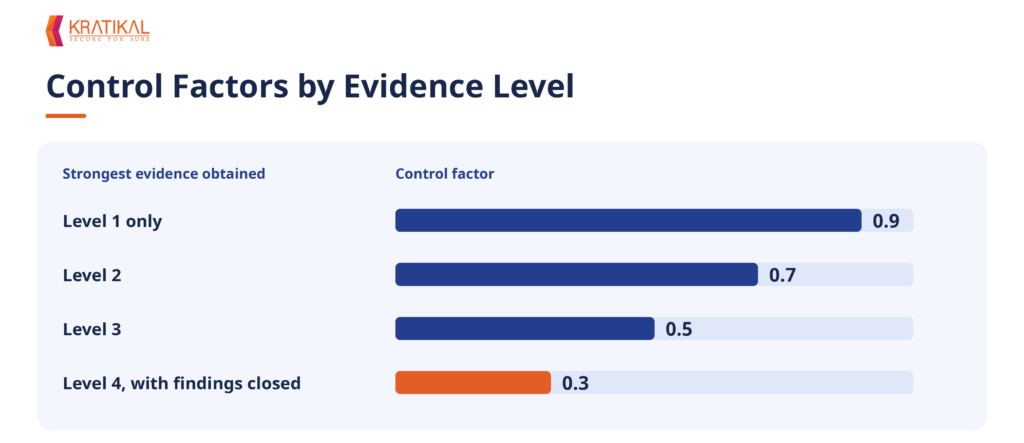
Picture two payroll vendors, each with an inherent score of 20 out of 25. The first shares only a questionnaire, so it scores 18 (20 × 0.9) and stays above most risk appetites.
The second shares a clean SOC 2 Type II report and a recent penetration test with retested fixes. It scores 10 (20 × 0.5) and becomes acceptable with standard contract terms. The numbers are illustrative. The point is that evidence, not vendor confidence, moves the score.
Step 5: Treat the Risk and Write It Into the Contract
Every residual risk above your appetite needs one of four treatments. You can remediate it, accept it with sign-off, transfer it through contract or insurance, or avoid it. Remediation items need an owner on each side, a due date, and a way to confirm closure.
The vendor contract is where treatment becomes enforceable. Tier 1 and Tier 2 contracts should set breach notice within a fixed number of hours. They should also give you a right to audit or to receive independent reports.
They should also flow security requirements down to sub-processors, require data return and deletion on exit, and name security contacts. Indian regulators already set some of these terms for regulated entities; the regulation section below lists them.
Step 6: Monitor Continuously and Reassess on Triggers
Continuous monitoring fills the gap between scheduled reviews. Useful signals include outside-in security ratings, breach alerts, and ransomware leak-site mentions. Watch, too, for certificate and domain changes, new vulnerabilities in products the vendor ships, and changes to the OAuth scopes its integration requests. External monitoring of this kind draws on the same methods as attack surface management.
Reassess a vendor before its scheduled date when a trigger fires. Typical triggers are a breach at the vendor or its suppliers, a change of owner, and new data or new access. A new sub-processor, a critical flaw in the vendor’s product, and contract renewal also count. A trigger-based third-party risk assessment is usually shorter than a full review, because it only re-tests the controls the trigger affects.
Step 7: Offboard Cleanly
Offboarding is the step most programmes skip. When a relationship ends, revoke accounts, API keys, and OAuth tokens. Then confirm data return or certified deletion, update the inventory, and close any open findings. NIST CSF 2.0 lists this as its own outcome, GV.SC-10, which covers activities after a partnership or service agreement ends.
Stale integrations are a real attack path. A token granted to a vendor tool that nobody uses still works until someone revokes it. For this reason, compare your vendor inventory with active accounts, API keys, and OAuth grants every quarter. Treat any mismatch as an open finding.
How the TPRM Process Maps to the Assessment Steps
The TPRM process most regulators recognise has five lifecycle stages. In the US, the Federal Reserve, the FDIC and the OCC published interagency third-party guidance in June 2023. Its stages are planning, due diligence and third-party selection, contract negotiation, ongoing monitoring, and termination.
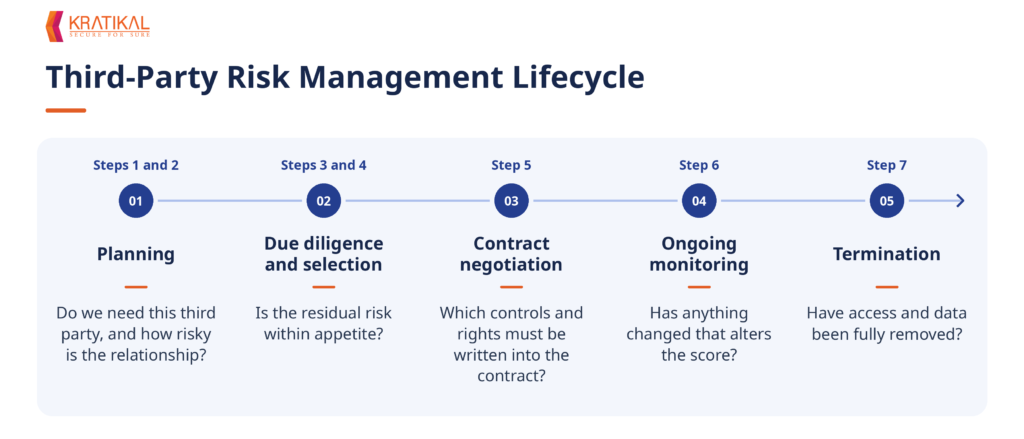
Mapping your third-party risk assessment steps to these stages helps in audits. An examiner can follow one vendor from planning to exit and see a documented decision at each stage. The same mapping also exposes gaps: if your TPRM process has no owner for termination, Step 7 will not happen consistently.
Supply Chain Risk Beyond the Direct Vendor
Supply chain risk does not stop at the vendors you contract with. Your payroll provider runs on a cloud platform, uses an email service, and depends on open-source libraries. Each of those is a fourth party, and a failure there reaches you without any change in your own vendor list.
Two questions make fourth-party risk manageable. First, ask each Tier 1 vendor for its critical sub-processors and hosting providers, and record them in your inventory. Second, look for concentration. If five critical vendors run in the same cloud region, one outage stops all five.
Regulators now track concentration at the system level. On 18 November 2025, EU supervisors designated critical ICT providers under the Digital Operational Resilience Act (DORA). They used the registers of information that EU financial firms file.
SEBI in India already asks regulated entities for SBOMs covering third-party and SaaS software. A software bill of materials (SBOM) lists the libraries inside a product. That list matters when artifact poisoning attacks target the build pipeline rather than the vendor’s servers.
Assessing AI Vendors and SaaS Integrations
AI tools and SaaS integrations change the third-party risk assessment because they ask for broad data access by design. A meeting assistant reads every call, a coding assistant reads source code, and a sales AI reads the CRM.
The data supports the concern. IBM’s Cost of a Data Breach Report 2025 looked at security incidents involving AI models and apps. Supply chain compromise, including compromised apps, APIs, and plug-ins, was the most common cause, at 30%.
Add these questions to the assessment of any AI or SaaS vendor:
- Data use: Is your data used to train or improve the vendor’s models, and can you opt out in the contract?
- Scopes: Which OAuth scopes or API permissions does the integration request, and are any broader than the feature needs?
- Token lifetime: How long do access and refresh tokens last, and can you revoke them centrally?
- Model providers: Which foundation model providers process your prompts and outputs, and where?
- Retention: How long are prompts, outputs, and logs kept, and who at the vendor can read them?
Treat the answers as Level 1 evidence until you confirm them. Most scope and token settings are visible in your own admin consoles.
Third-Party Risk Assessment Requirements by Regulation
Several regulations now require a documented third-party risk assessment. Most ask for the same elements: an inventory, risk-based due diligence, contract controls, monitoring, and an exit plan.
| Regulation or framework | Region | What it expects from third-party risk work |
| RBI Managing Risks in Outsourcing Directions, 2025 | India | Risk-based evaluation of IT service providers, an inventory of outsourced services, exit strategy, and controls that extend to material sub-contractors |
| SEBI Cybersecurity and Cyber Resilience Framework (CSCRF), August 2024 | India | Regulated entities remain responsible for third-party services; SBOMs for core and critical software, including third-party and SaaS |
| Digital Personal Data Protection Act, 2023, and DPDP Rules, 2025 | India | Data fiduciaries may engage a data processor only under a valid contract (Section 8(2)) and remain responsible for compliance; core obligations apply from 13 May 2027 |
| Digital Operational Resilience Act (DORA) | European Union | ICT third-party risk management, a register of information on ICT contracts, and direct oversight of critical ICT providers, in force since 17 January 2025 |
| Interagency Guidance on Third-Party Relationships, 2023 | United States (banking) | Risk-based management across the five lifecycle stages, scaled to criticality |
| ISO/IEC 27001:2022, Annex A controls 5.19 to 5.23 | International | Supplier relationship security, supplier agreements, ICT supply chain, monitoring of supplier services, and cloud service use |
| NIST CSF 2.0, GV.SC category | International (voluntary) | Ten supply chain outcomes, from programme strategy (GV.SC-01) to post-contract activities (GV.SC-10) |
Indian regulated entities face the most recent change from the RBI. On 28 November 2025, the RBI replaced its 2023 IT outsourcing direction with entity-specific RBI outsourcing directions. Existing agreements had to align at renewal or by 10 April 2026. Banks and NBFCs can check their wider obligations against this RBI audit checklist.
Outside regulated finance, ISO/IEC 27001 is the most common way to show supplier controls to customers. Annex A controls 5.19 to 5.23 require a supplier policy, security terms in agreements, and regular review of supplier services.
Where Questionnaire-Only Vendor Risk Management Falls Short
Questionnaire-based vendor risk management fails in a predictable way. The vendor answers “yes” to “Do you enforce MFA?”, and the answer is true for staff logins. But the service account your integration uses has no MFA, because nobody asked about service accounts. The DBIR’s 23% MFA remediation figure describes exactly this kind of gap.
The fix is to test what you can reach. Nobody should penetration-test a vendor’s systems without its written permission.
You can, however, test the integration points on your side. These include the APIs that accept vendor data, the SSO setup, the OAuth scopes granted, and the vendor-facing parts of your apps. With Tier 1 vendors, agree on a scope and commission testing of the shared surface. Then track remediation to closure, because a report on its own reduces nothing.
Kratikal’s VAPT services (vulnerability assessment and penetration testing) apply the same approach to third-party exposure. Testers scope the links between your environment and a Tier 1 vendor and prove which findings an attacker could use. They retest after fixes, so the evidence in your file is verified, not assumed.
Where development or hosting is outsourced, the AutoSecT platform includes a vendor vulnerability management hub. Findings owned by a vendor stay visible to your team until they are closed.
Metrics That Show Your TPRM Process Works
A TPRM process needs metrics that show whether risk is falling, not just whether assessments were completed. Track a small set and report them to the risk committee each quarter.
| Metric | What it tells you |
| Percentage of vendors inventoried and tiered | Coverage of the programme |
| Percentage of Tier 1 vendors with evidence under 12 months old | Freshness of your third-party risk assessment results |
| Percentage of Tier 1 vendors with Level 3 or Level 4 evidence | Quality of evidence, not just quantity |
| Median days to close vendor-owned high-risk findings | Whether treatment plans are enforced |
| Number of active OAuth grants reviewed in the quarter | Control over integrations outside procurement |
| Percentage of offboarded vendors with access revoked within 7 days | Discipline at the end of the lifecycle |
Set your own targets from a baseline quarter rather than borrowing another organisation’s numbers. A programme where every vendor completed a questionnaire but no Tier 1 vendor has technical evidence is busy, not effective. In that case, raise the share of Tier 1 vendors with Level 3 evidence before adding more questionnaires.
Turning Third-Party Risk Assessment Into a Working Programme
A third-party risk assessment in 2027 has to do more than record answers. Third parties were involved in 48% of breaches in Verizon’s 2026 dataset. The assessments that hold up rest on an accurate inventory, risk-based tiers, verified evidence, and monitoring after signature. Start with your ten most critical vendors, apply the seven steps, and measure how many have evidence beyond a questionnaire.
Need the links between your environment and your critical vendors tested, with every fix retested? Speak to us about scoping a third-party exposure assessment.
FAQs
Common examples of third-party risk include a SaaS vendor breach that exposes customer data and stolen integration tokens used to export records. A cloud outage that stops a critical service is another. The Salesloft Drift campaign of August 2025 is a recent case. Attackers used stolen tokens to export data from hundreds of Salesforce customer environments.
To perform a third-party risk assessment, build a complete vendor inventory, tier each vendor by inherent risk, and collect evidence matched to the tier. Then score residual risk from the strength of that evidence, agree treatment and contract terms, monitor continuously, and reassess when a trigger fires. Finish by offboarding cleanly, which means revoking access and confirming data deletion when the relationship ends.
A third-party risk assessment should include five elements. First comes a defined scope covering the vendor, its services, and its access. An inherent risk rating and evidence of the vendor’s controls follow. Next is a residual risk score with a decision to accept, remediate, transfer, or avoid. Last is a treatment plan with owners and dates. Without the fifth element, the assessment records a problem without resolving it.
The four core third-party risk types are cybersecurity risk, operational risk, compliance risk, and financial risk. Cybersecurity covers data access and control strength. Operational covers availability and recovery. Compliance covers legal and regulatory duties such as data protection. Financial covers vendor stability. Many 2026 programmes add a fifth type, concentration and fourth-party risk, because regulators now assess dependence on shared providers.
Third-party risk assessment frequency depends on the vendor’s tier. A common pattern is an annual full review plus continuous monitoring for critical vendors. High-risk vendors are reviewed every 18 to 24 months, and moderate ones at contract renewal. Any trigger, such as a vendor breach, an ownership change, or new data access, should start a reassessment immediately.