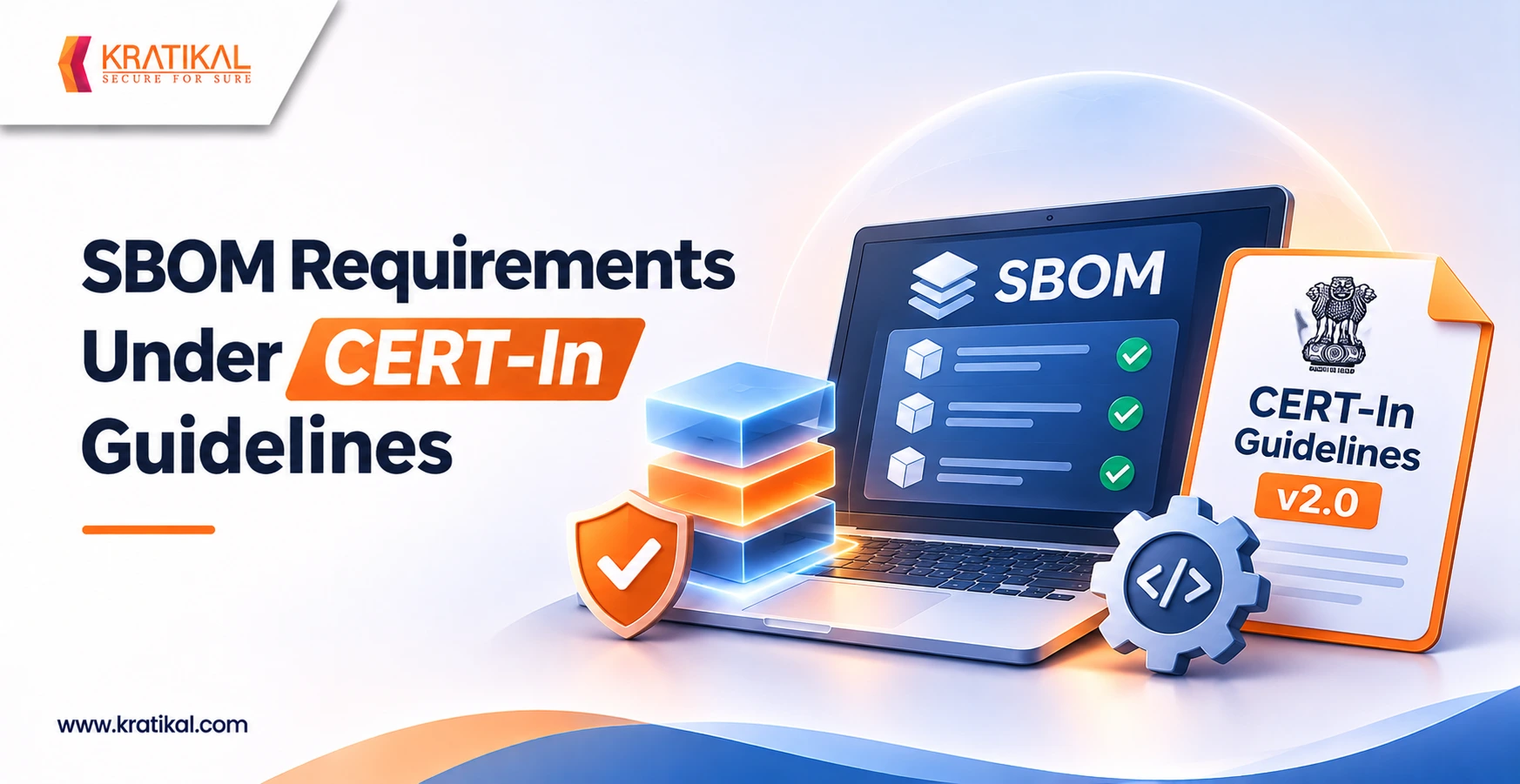
CERT-In SBOM guidelines are technical guidelines from India’s national cyber security agency on creating, sharing, and using software bills of materials. Version 2.0, dated 9 July 2025, also covers cryptographic, quantum, AI, and hardware bills of materials. Above all, software supplied to government, public sector, and essential services bodies must come with a complete SBOM.
Think of the ingredients label on packaged food. It tells you exactly what is inside. So when a supplier recalls an ingredient, you know at once whether your product is affected. A software bill of materials (SBOM) does the same for software. When a flaw appears in a popular library, for example, an SBOM quickly shows whether your systems use it.
What Is an SBOM (Software Bill of Materials)?
In short, SBOM means software bill of materials: a list of every part inside a piece of software, including open-source libraries, commercial modules, and their versions, suppliers, and licences. Most modern apps are built largely from parts that other people wrote. As a result, most teams cannot list everything their software contains without an SBOM.
That gap matters, because attackers now often target the software supply chain. Instead of attacking a company directly, they break into a library or a vendor that many companies trust. To understand the wider threat, see this guide to software supply chain attacks.
An SBOM is also the basis of software composition analysis, which scans software for third-party parts and their known flaws. In fact, the CERT-In SBOM guidelines describe the SBOM as the basis for these tools.
What the CERT-In SBOM Guidelines Cover?
The Indian Computer Emergency Response Team (CERT-In) sits under the Ministry of Electronics and Information Technology. It first published its SBOM guidelines on 3 October 2024. That first version, however, covered software bills of materials only.
Then, on 9 July 2025, CERT-In released Version 2.0. It keeps the SBOM guidance and also adds 4 more types of bills of materials: quantum (QBOM), cryptographic (CBOM), artificial intelligence (AIBOM), and hardware (HBOM). You can download CERT-In’s version 2.0 guidelines as a PDF from CERT-In’s website.
The CERT-In SBOM guidelines name the bodies they are written for: government, public sector, and essential services bodies, plus companies in software exports and software services. Within those, they also address 3 roles: software consumers, which buy software to run their operations; software developers, which build custom software; and system integrators or resellers, which sell software and add services such as setup and support.
Are the CERT-In SBOM Guidelines Mandatory?
The CERT-In SBOM guidelines are technical guidelines, not a binding legal direction. By contrast, CERT-In issued its 2022 incident reporting rules as formal directions under the IT Act. SBOM guidelines as not mandatory, though it notes that they guide both public and private sector bodies.
Even so, the guidelines use strong language for software supplied to the public sector. In particular, section 7.1 of Version 2.0 separates what bodies “must” do from what they “should” do:
| Requirement (section of Version 2.0) | Must or should |
| Software supplied to government, public sector, and essential services bodies comes with a complete SBOM (7.1.2) | Must |
| Those bodies keep SBOMs for the software they use, buy, and build (7.1.3) | Must |
| SBOMs for software supplied to government and public sector bodies include the data fields in section 4.2 (7.1.4) | Must |
| A vulnerability exploitability exchange (VEX) document uses 4 set statuses (7.1.6) | Must |
| SBOM requirements appear in software procurement (7.1.1) | Should |
| SBOMs use the SPDX or CycloneDX format (7.1.5) | Should |
| SBOM data links to flaw databases and CERT-In alerts (7.1.7) | Should |
So, in practice, the guidelines work like a buying rulebook. If you supply software to the government, public sector, or essential services in India, expect buyers to ask for an SBOM that meets these terms.
SBOM Compliance in India: SEBI and RBI
Sector regulators have gone further than CERT-In itself. SEBI’s Cybersecurity and Cyber Resilience Framework, issued on 20 August 2024, requires regulated entities to obtain SBOMs for software used in core and critical business operations. To learn more about the wider framework, see this overview of SEBI’s CSCRF framework and its testing rules.
The Reserve Bank of India has also acted. According to KPMG’s December 2025 report on SBOM in India, the RBI advised its regulated entities in November 2024 to adopt CERT-In’s SBOM guidelines.
India is also part of a wider international effort. In September 2025, CERT-In joined the US agencies CISA and the NSA, along with national agencies including those of Australia, Canada, the Czech Republic, France, Germany, and Italy, in co-signing joint guidance titled “A Shared Vision of Software Bill of Materials (SBOM) for Cybersecurity”. That signals CERT-In’s approach is aligned with the wider international one.
The 21 Minimum Data Fields
Section 4.2 of the CERT-In SBOM guidelines lists 21 data fields for each component. For software supplied to government and the public sector, section 7.1.4 also makes them a “must”. The guidelines list the fields one by one; grouped here by purpose, they are:
- Identity: component name, version, description, supplier, and origin, such as open source or proprietary, plus a unique identifier
- Risk: known vulnerabilities, patch status, criticality, release date, and end-of-life date
- Legal and use: licence, as well as usage restrictions such as export controls
- Structure and integrity: dependencies, checksums or hashes, and whether the component is executable, archived, or structured
- Record keeping: the author of the SBOM data, a timestamp, and comments or notes
The unique identifier follows a package URL pattern that starts with “pkg:”, followed by the supplier, the component name, and its version. As a result, tools can match the same component across systems and track each version update.
Join our weekly newsletter and stay updated
SBOM Levels and Formats
Not every SBOM needs the same depth. Instead, the CERT-In SBOM guidelines describe 5 levels, from a simple summary to a full inventory.
A top-level SBOM lists the parts a product uses directly, while an n-level SBOM goes deeper to any chosen number of layers. Next comes the delivery SBOM, which covers every part in a specific release. A transitive SBOM, by contrast, adds the indirect dependencies of each part. Finally, a complete SBOM lists every part, dependency, and detail.
The guidelines also suggest a 2-tier approach. First, a supplier shares a tailored SBOM with each customer, so that it meets their security needs without revealing sensitive details. At the same time, the supplier keeps a complete SBOM in-house, and then uses it to share flaw updates with customers.
On format, the guidelines recommend SPDX (Software Package Data Exchange) or CycloneDX, 2 widely used open SBOM standards. In addition, they ask for a separate SBOM for each software version. That SBOM changes only when new component details arrive or when someone corrects an error.
VEX and CSAF: How the Guidelines Handle Vulnerabilities
An SBOM tells you which parts you have. However, it does not tell you whether a new flaw actually affects your product.
To answer that, the guidelines ask suppliers to issue a vulnerability exploitability exchange (VEX) document after they find a flaw. Each VEX must then use one of 4 statuses: not affected, so no action is needed; affected, so action is advised; fixed, because these versions already contain a fix; or under investigation, because the impact is not yet known.
After the VEX, the supplier should also publish an advisory in the Common Security Advisory Framework (CSAF) format. That advisory covers the description, affected versions, severity, and suggested fixes. Back to the ingredients label: the SBOM lists what is inside, while the VEX says whether a recall affects you. Finally, the CSAF advisory explains what to do about it.
Beyond SBOM: CBOM, QBOM, AIBOM, and HBOM
Version 2.0 of the CERT-In SBOM guidelines also applies the same idea to 4 other kinds of inventory. Each one, in turn, answers a different question about what a system contains:
| Bill of materials | What it lists | Why it matters |
| SBOM (software) | Software parts, versions, suppliers, and licences | Finds flawed or outdated parts fast |
| CBOM (cryptographic) | Algorithms, keys, protocols, and certificates | Tracks weak or expiring encryption |
| QBOM (quantum) | Quantum-related parts and quantum-safe encryption | Supports the move to quantum-safe encryption |
| AIBOM (artificial intelligence) | Hardware, software, models, and data behind AI systems | Shows what went into building and training an AI system |
| HBOM (hardware) | Physical parts, sub-parts, and embedded devices | Helps trace hardware and confirm it is genuine |
For many companies, the CBOM may matter soonest. After all, encryption that is safe today may weaken as quantum computing advances. A CBOM shows where each algorithm, key, and certificate is in use, so without that list, nobody can plan a move to safer methods.
How to Prepare for the CERT-In SBOM Guidelines
Preparing for the CERT-In SBOM guidelines is mostly a process change, not a single project. A practical order follows the guidelines’ own advice:
- Assign roles. First, decide who owns SBOM creation, review, and sharing across development, buying, and security teams.
- Choose a level and format. Then pick the SBOM level each product needs, and use SPDX or CycloneDX.
- Build SBOMs automatically. Next, add SBOM creation to your build process, so that every release produces one.
- Cover the 21 data fields. Also check that each SBOM carries the fields in section 4.2, especially if you supply government or the public sector.
- Link SBOMs to flaw tracking. After that, connect component data to flaw databases and CERT-In alerts, so that new flaws trigger action.
- Set up a VEX process. Then decide who assesses new flaws and issues VEX statuses to customers.
- Protect the data. Because SBOMs reveal what your software contains, store and share them with encryption and access controls.
- Keep them current, and audit them. Finally, update SBOMs as parts change, and review the process regularly for accuracy.
Regulated companies should also test whether the controls work in practice. For example, an audit by one of the CERT-In empanelled auditors can check that SBOM processes match what regulators and buyers expect.

Book Your Free Cybersecurity Consultation Today!
Getting Ready for the CERT-In SBOM Guidelines
Picture a bank’s security team on the day a critical flaw in a popular library goes public. Without SBOMs, the team spends days asking vendors about each product. With SBOMs and VEX statements, however, it knows within an hour. In short, the CERT-In SBOM guidelines aim to make that second scenario normal.
Start with the software you supply or buy for regulated customers. Then build SBOMs in a standard format, and set up a process to keep them current. To check your SBOM and wider security practices against CERT-In’s expectations, contact Kratikal’s CERT-In security audit team.
FAQs
Teams working on SBOM compliance in India most often ask the questions answered here.
The full form of SBOM is software bill of materials. In cyber security, an SBOM is a structured list of every component in a piece of software, including open-source libraries, commercial modules, versions, suppliers, and licences. It helps organisations find vulnerable components quickly and manage software supply chain risk, as CERT-In’s guidelines describe.
The difference between SBOM and CBOM is what each one lists. An SBOM, or software bill of materials, lists software components, versions, and suppliers. A CBOM, or cryptographic bill of materials, lists cryptographic assets such as algorithms, keys, protocols, and certificates. CERT-In’s Version 2.0 guidelines cover both, along with QBOM, AIBOM, and HBOM.
The difference between SBOM and SCA is that one is a document and the other is a practice. An SBOM is an inventory of components in a piece of software. Software composition analysis (SCA) is the process and tooling that scans software, finds its third-party components, and checks them for known vulnerabilities and licence issues. SCA tools often generate SBOMs.
CERT-In recommends SPDX (Software Package Data Exchange) or CycloneDX for SBOMs of software supplied to government and public sector organisations. Both are widely used open standards, and many SBOM tools can produce either format. The guidelines also recommend a separate SBOM for each software version.
VEX, or vulnerability exploitability exchange, is a document that tells customers whether a known vulnerability actually affects a specific product. CERT-In’s guidelines ask suppliers to issue a VEX after a vulnerability is discovered, using one of 4 statuses: not affected, affected, fixed, or under investigation. It helps customers focus on the flaws that matter.