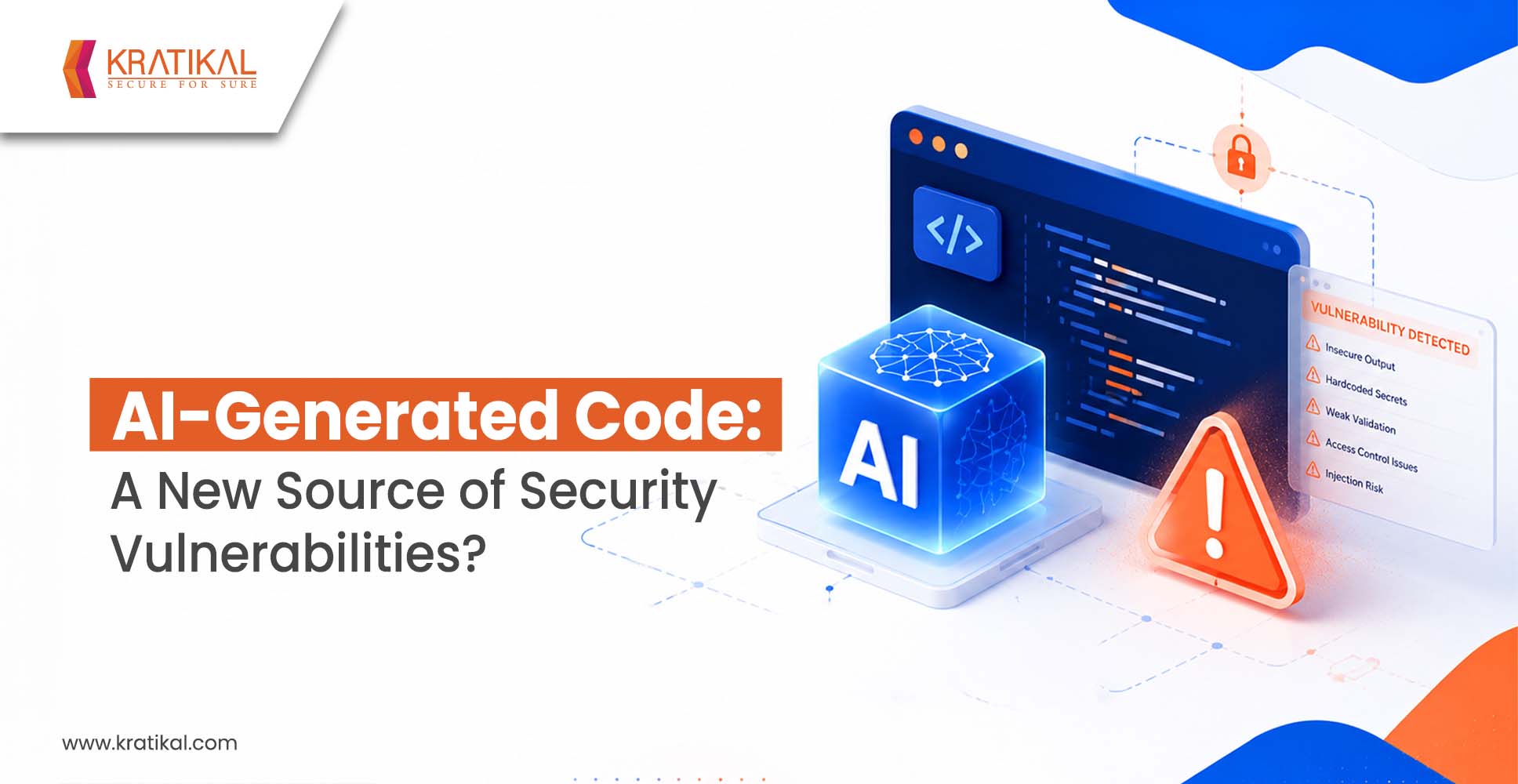
AI-powered coding assistants like GitHub Copilot, ChatGPT, Amazon CodeWhisperer, and Claude have transformed how developers write software. What once took hours of manual coding can now be generated in seconds. But as organizations race to adopt AI-assisted development, a critical question is being overlooked: can AI-generated code introduce security vulnerabilities?
The short answer is yes, and the risks are more widespread than most development teams realize. AI coding tools boost productivity, but they learn from massive datasets of publicly available code that often contain outdated practices, insecure patterns, and unpatched flaws. Without careful review, these vulnerabilities can silently make their way into production environments, exposing organizations to breaches, compliance failures, and reputational damage.
In this blog, we break down how AI-generated code introduces security vulnerabilities, real-world evidence of the problem, and what enterprises can do to secure their AI-assisted development pipelines.
Why Is AI-Generated Code Prone to Security Vulnerabilities?
Several factors make AI-generated code more likely to contain Security Vulnerabilities, especially when developers use it without thorough review and security testing.
1. Training Data Reflects Historical Insecure Practices
Large language models learn from repositories, forums, and open-source projects scraped from the internet. As a result, AI models often reproduce:
- Hardcoded credentials and API keys
- Weak or deprecated cryptographic algorithms (e.g., MD5, SHA-1)
- Missing input validation and sanitization
- Insecure default configurations
2. Lack of Contextual Security Awareness
AI models generate code based on pattern recognition, not genuine understanding of an application’s architecture, threat model, or business logic. This means the AI cannot inherently know whether a function will process untrusted user input, handle sensitive financial data, or sit behind a public-facing API, all of which dramatically change the security requirements.
3. Blind Trust and “Autocomplete Fatigue”
Developers under deadline pressure often accept AI suggestions without fully reviewing them, a phenomenon researchers call “autocomplete fatigue.” A widely cited Stanford University study found that developers using AI coding assistants were more likely to introduce security vulnerabilities into their code, even as they believed their code was more secure. This false sense of confidence is one of the most dangerous side effects of AI-assisted development.
4. Propagation of Vulnerable Dependencies
AI tools frequently suggest third-party libraries and packages to speed up development. However, they may recommend outdated, unmaintained, or even malicious packages, a growing attack vector known as “slopsquatting,” where threat actors publish fake packages with names AI models are known to hallucinate, waiting for developers to unknowingly install them.
Common Security Vulnerabilities Found in AI-Generated Code
Security researchers and application testing teams have consistently flagged the following categories of vulnerabilities in AI-generated code:
1) Cross-Site Scripting (XSS):
Generated front-end code frequently lacks proper output encoding, allowing malicious scripts to execute in a victim’s browser. AI models often suggest code that directly renders user input into the DOM or HTML templates without sanitization, making applications vulnerable to stored, reflected, or DOM-based XSS attacks. This is especially common when AI tools generate quick UI components or form-handling logic without factoring in how untrusted input will later be displayed.
2) Broken Authentication:
AI-suggested authentication flows sometimes skip critical steps like session invalidation, rate limiting, or multi-factor enforcement. AI models often generate “textbook” login or session-management code based on simplified training examples, so developers frequently omit real-world safeguards such as account lockouts after failed attempts, secure token expiry, and proper logout handling unless they explicitly request them.
3) Insecure Deserialization:
Code that deserializes untrusted data without validation can allow attackers to execute arbitrary commands. AI-generated code often uses default deserialization methods for convenience, without adding type checks, allow-lists, or integrity verification, leaving applications exposed to remote code execution and privilege escalation if an attacker can control the serialized input.
4) Command Injection:
Suggested code that passes unsanitized input directly to system shell commands creates a direct path for remote code execution. This creates particular risks in AI-generated automation scripts, file-handling utilities, and DevOps tooling, where developers may overlook how seemingly simple os.system() or shell exec() calls can become critical attack vectors when they fail to properly escape or validate user input.
5) Hardcoded Secrets:
API keys, tokens, and passwords embedded directly in code, often left over from example snippets in training data. Since AI models learn from public repositories where developers sometimes accidentally commit credentials, generated code can inadvertently mirror this bad practice, creating a serious risk if the code is pushed to a public repository or left unaudited before deployment.
6) Improper Access Control:
Missing or misconfigured authorization checks that allow privilege escalation. AI tools frequently generate functional code that satisfies the immediate request (e.g., “fetch user data by ID”) without adding role-based checks or ownership validation, allowing one user to access or modify another user’s data simply by changing a parameter.
Join our weekly newsletter and stay updated
Evidence of the Security Risk
Multiple independent studies have reinforced these concerns:
- Stanford University Study (2022–2023)
The most frequently cited research in this space is the Stanford study titled “Do Users Write More Insecure Code with AI Assistants?” by Neil Perry, Megha Srivastava, Deepak Kumar, and Dan Boneh. Researchers conducted a controlled study, splitting participants into two groups: one with access to an AI coding assistant based on OpenAI’s Codex and one without. They asked both groups to complete security-relevant programming tasks involving string encryption, SQL query generation, file path handling, and other areas.
Key Findings:
- Participants who used the AI assistant were significantly more likely to write insecure code compared to the control group, particularly in tasks involving cryptography and safe handling of user-controlled input.
- Perhaps more concerning: participants with AI assistance were more likely to believe their code was secure than those who wrote it unaided, a risky gap between perceived and actual security.
- The effect was consistent across multiple task types, suggesting the issue isn’t isolated to one category of vulnerability but reflects a broader pattern in how AI-suggested code gets trusted and shipped.
- Snyk 2023 AI Code Security Report
Snyk, an application security company, surveyed software developers on their use of AI coding tools like GitHub Copilot and ChatGPT as part of its AI Code Security Report. The report focused less on controlled testing and more on real-world developer behavior and sentiment.
Notable Data Points:
- A large majority of respondents said they used AI coding tools regularly, but a significant portion admitted to bypassing security review on AI-generated code due to time constraints.
- Developers frequently acknowledged knowingly shipping code they suspected contained vulnerabilities, citing deadline pressure over confidence in the code’s safety.
- Organizations also failed to establish formal policies for reviewing and testing AI-generated code before deployment.

Book Your Free Cybersecurity Consultation Today!
How Can Organizations Mitigate AI-Related Security Vulnerabilities?
Organizations can reduce AI-related security risks by combining secure development practices, continuous testing, strong access controls, and ongoing monitoring.
1. Treat AI-Generated Code Like Third-Party Code
Every line of AI-generated code should go through the same scrutiny as code pulled from an external source, including peer review, static analysis, and security testing.
2. Integrate Security Testing into the SDLC
Combining Static Application Security Testing (SAST), Dynamic Application Security Testing (DAST), and regular VAPT (Vulnerability Assessment and Penetration Testing) ensures vulnerabilities are caught before deployment, regardless of whether the code was written by a human or an AI.
3. Establish AI Usage Guidelines
Organizations should define clear policies on where and how AI coding tools can be used, particularly restricting their use in security-critical modules like authentication, payment processing, and access control.
4. Conduct Regular Code Reviews and Threat Modeling
Human oversight remains essential. Security-aware code reviews and threat modeling exercises help catch context-specific risks that AI models cannot assess on their own.
5. Verify Third-Party Dependencies
Before integrating any AI-suggested library or package, validate its authenticity, maintenance status, and reputation to avoid supply chain attacks like slopsquatting.
Conclusion
AI-generated code is reshaping software development, but speed should never come at the cost of security. As adoption grows, so does the responsibility of development and security teams to proactively identify and remediate the security vulnerabilities that AI tools can unintentionally introduce. Secure coding practices, rigorous testing, and human oversight remain non-negotiable, no matter how advanced the AI writing the code becomes.
Organizations that pair AI-driven development speed with continuous security validation will be the ones best positioned to innovate safely in an increasingly AI-powered world.
FAQs
- Why can AI-generated code be insecure?
AI tools generate code based on learned patterns and may not fully understand an application’s architecture, business logic, security requirements, or threat model. This can result in code that works functionally but contains security weaknesses.
- Can security testing detect vulnerabilities in AI-generated code?
Yes. Security testing methods such as SAST, DAST, SCA, secret scanning, API security testing, and penetration testing can help identify vulnerabilities in AI-generated code. Combining automated tools with expert manual testing provides broader coverage.
- Does AI-generated code increase the risk of vulnerable dependencies?
It can. AI tools may suggest outdated or vulnerable libraries and packages. Organizations should use dependency scanning tools and maintain an up-to-date software inventory.
- Can AI-generated code pass security tests and still be vulnerable?
Yes. Automated tools may miss complex business logic flaws, authorization issues, and other vulnerabilities. Manual security reviews and expert testing are important for identifying risks that automated tools may overlook.
- Who is responsible for the security of AI-generated code?
The organization and development team remain responsible for the security of the final application. Using an AI coding assistant does not transfer responsibility for reviewing or securing the generated code.
- What types of applications are most at risk from insecure AI-generated code?
Any application can be affected, but web applications, APIs, mobile applications, and cloud-based systems may face significant risks when AI-generated code handles authentication, user input, sensitive data, or access controls.