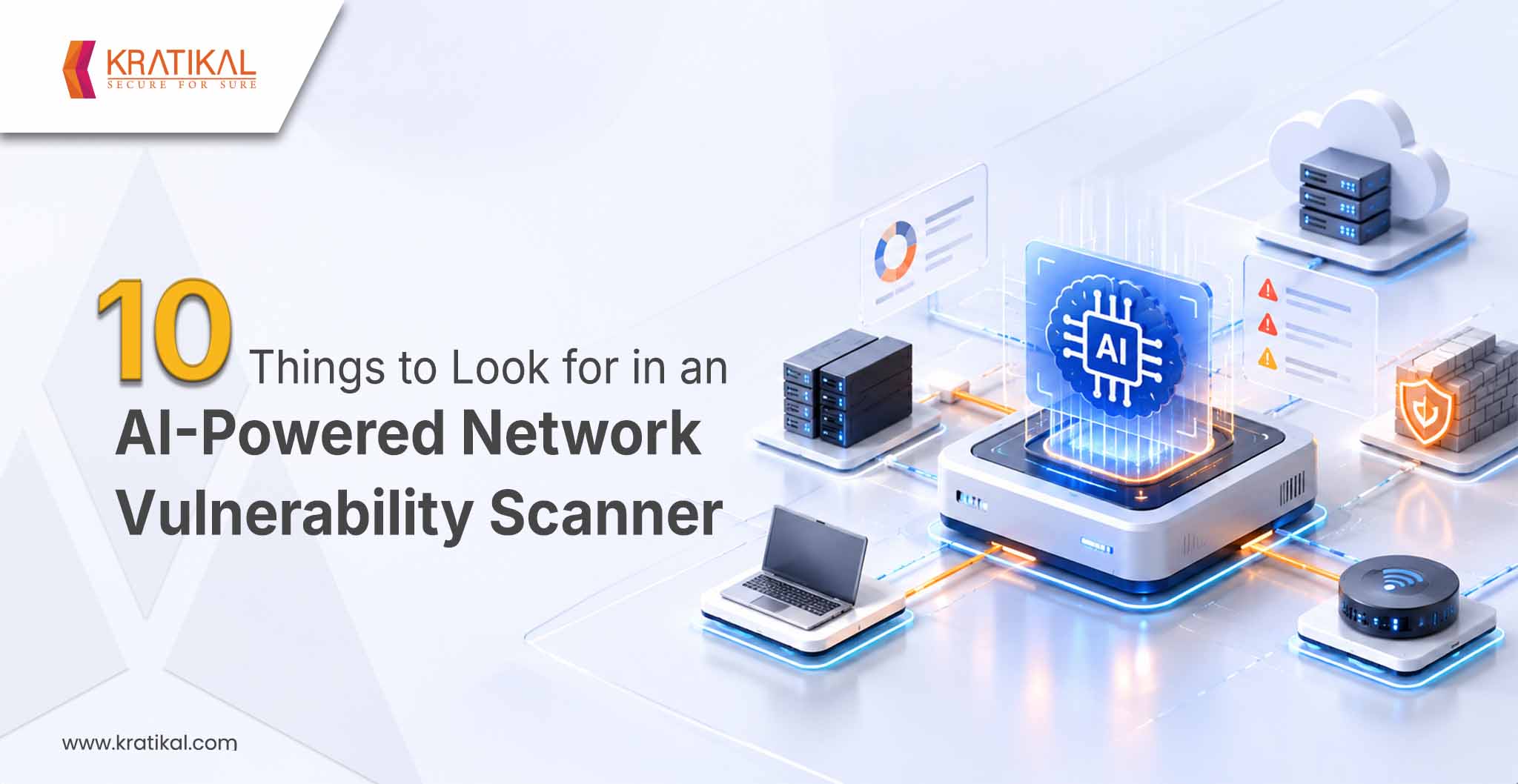
We have the solution to the problem what every security team knows. Your scanner finishes its job and the outcome – you get a long list of findings. Some are real, some are guesses, some are not relevant to your organization and only a few comes with enough context to act on. This is what has been the ‘compliants’ of every security team over the years. The world is AI and speed has been its biggest contribution. When it comes to cybersecurity, another factor that adds up with speed is accuracy, meaning ‘less false poisitives’ in security terminology. Choosing an AI-powered network vulnerability scanner is not about adding “AI” to an old network vulnerability assessment workflow. It is about getting visibility you can trust and findings you can defend, which AutoSecT gives you.
Prior to what our network vulnerability scanner, let’s go through the 10 things to look for, so you can differentiate a scanner that produces evidence from one that produces noise.
What Is an AI-Powered Network Vulnerability Scanner?
An AI vulnerability scanner for network discovers hosts, ports and services across a network, identifies the software running on them, and checks for known vulnerabilities. It then uses AI to add context, such as interpreting ambiguous banners, extracting versions and guiding remediation. The strongest tools pair AI with real evidence like network probes, vendor advisories, CVE intelligence and exploit signals.
Top 10 Things to Look For In A Network Vulnerability Scanner Powered by AI
Here are the 10 things to look for –
1. IP-Based Discovery That Covers Devices Apart From Named Assets
You cannot protect what you cannot see. A good scanner starts by mapping the network: hosts, ports, protocols and the services in scope. Look for IP-based discovery that identifies devices and hosts across the network, not only the assets someone remembered to list. It should also let you define scope flexibly, whether that is IP ranges, domains, cloud environments, on-prem networks or specific assets.
2. Accurate Identification of the Software Stack
Discovery tells you something is listening. Identification tells you what it is. The scanner should recover products, versions and operating systems from banners and response headers, because every later step depends on getting this right. This is where AI can help. Banners are often ambiguous, and AI-based service interpretation can extract product and OS hints that rigid patterns miss.
3. Reliable Version Extraction
Version-based CVE lookup is only as good as the version it starts with. Ask what happens when pattern matching leaves a gap. A capable network vulnerability scanner can use AI to read version text from supported endpoints and fill that gap, which supports version-based CVE lookup.
4. Broad Detection Beyond a Single Check Type
Vulnerabilities do not all look alike. Look for a mix of CVE and template checks alongside TLS, SSH and service audits. Rules and checks should form the dependable base of detection, with AI adding context on top.
5. Coverage of Both Internal and External Network Vulnerability Assessment
Exposure exists inside the perimeter and on the internet-facing edge. Your scanner should handle both. AutoSecT’s network scanner covers internal network assessments (inside the perimeter) and external assessments (internet-facing exposure), so one tool supports both views of risk.
6. Evidence-Based Assessment, Not Guesswork
A version string alone can mislead. A vendor may have patched a flaw without changing the visible version number, so a scanner needs more to go on. Look for evaluation that uses vendor and package context along with platform and backport checks.
Ask whether the scanner can use installed-package data. Credentialed collection, when configured, gives it a much clearer picture than network probes alone.
7. Real-Time Exploit Validation With Confirmed Proofs-of-Concept
This is the criterion that changes how teams work. A theoretical finding starts an argument about whether it matters. A demonstrated one ends it. Look for a scanner that validates exploitability in real time and produces confirmed proofs-of-concept (PoCs) for what it finds. AutoSecT’s scanner does this, so findings are demonstrated rather than merely theoretical.
8. AI That Reasons Over Real Vulnerability Data
Static, rule-based signatures are only as current as their last update. Ask how the AI actually works. AutoSecT is positioned as an advanced, RAG-powered, AI-agentic network vulnerability scanner. An AI Orchestrator coordinates specialist agents for planning, scanning, analysis and threat intelligence, and the system learns and improves with every scan. In plain terms, its AI reasons over real-world vulnerability data instead of relying solely on static signatures. Ask any vendor to explain this clearly.
9. Risk-Based Vulnerability Prioritization
A flat list of findings is not a plan. The scanner should help you focus the response using severity and exploit signals, rank the findings, and group related fixes so one change can close several issues. Look for a scanner that enriches findings with threat intelligence such as CVE, EPSS and KEV data, so ranking reflects real-world risk. That keeps scarce engineering time on what matters most.
10. Specific Remediation Guidance, Used Responsibly
Finding a problem is half the job. Every finding should be paired with intelligent remediation guidance specific to that vulnerability, turning the finding and its vendor context into administrator steps, including how to verify the fix. AutoSecT generates this guidance with AI for each finding.
Also look at how AI is deployed. The best designs are transparent about it. Service interpretation and version extraction are optional enrichment, and remediation guidance is requested on demand in the app. You stay in control of where AI is used.
How AutoSecT Network Vulnerability Scanner Helps
AutoSecT’s Agentic AI vulnerability scanner for network is built around intelligent discovery, autonomous scanning and actionable security intelligence. It works in four stages.
1. Define scope. You tell AutoSecT what to scan: IP ranges and CIDR blocks, domains, cloud environments, on-prem networks, specific assets, or compliance requirements.
2. AI discovery. AutoSecT maps your attack surface. It discovers assets, identifies services and maps the relationships between them, across branch offices, cloud infrastructure, data centers and remote assets.
3. Coordinated AI agents. An AI Orchestrator plans and coordinates the work, adapts its strategy in real time, and learns and improves with every scan. It directs four specialist agents:
- Scan Planning Agent: creates the optimal scan strategy.
- Scanning Agent: executes multi-engine scans.
- Analysis Agent: analyzes results and validates findings.
- Threat Intel Agent: enriches findings with global threat intelligence, including CVE, EPSS, KEV and emerging threats.
4. Actionable intelligence and action. You get a clear vulnerability prioritization (Critical, High, Medium, Low), prioritized findings that focus on real risks, and remediation guidance with clear, actionable steps. From there, you can fix vulnerabilities, track progress, get reports, and export and integrate the results.
Beyond this flow, the scanner validates exploitability in real time and produces confirmed proofs-of-concept. It covers both internal and external network assessments, and every finding is paired with AI-generated remediation guidance specific to that vulnerability. All of it rests on one evidence foundation: network probes, installed packages (credentialed collection when configured), vendor advisories, CVE intelligence and exploit signals.
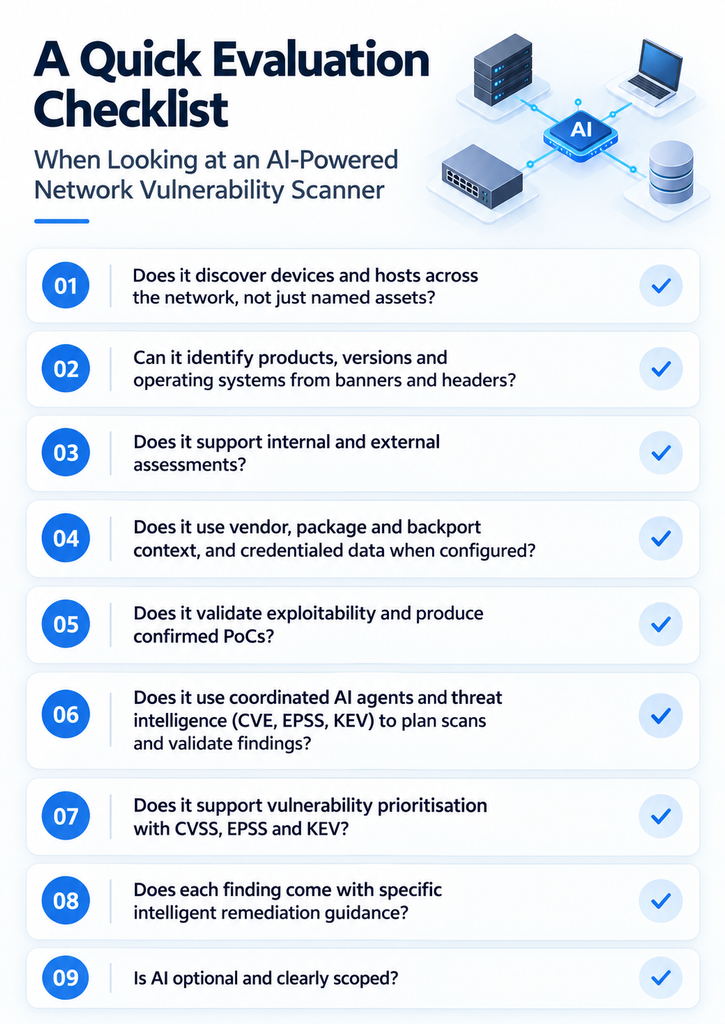
Checklist When Looking AI-Powered Network Vulnerability Scanner
When you compare scanners, ask:
- Does it discover devices and hosts across the network, not just named assets?
- Can it identify products, versions and operating systems from banners and headers?
- Does it support internal and external assessments?
- Does it use vendor, package and backport context, and credentialed data when configured?
- Does it validate exploitability and produce confirmed PoCs?
- Does it use coordinated AI agents and threat intelligence (CVE, EPSS, KEV) to plan scans and validate findings?
- Does it support vulnerability prioritization with CVSS, EPSS and KEV?
- Does each finding come with specific intelligent remediation guidance?
- Is AI optional and clearly scoped?
Ready to see evidence-led network scanning in action? Talk to us about AutoSecT Network Vulnerability Scanner.
FAQs
- What is an AI-powered network vulnerability scanner?
It is a scanner that discovers hosts and services, identifies software and versions, and checks for vulnerabilities, then uses AI to add context. That context can include interpreting banners, extracting versions and guiding remediation.
- How is AI different from a traditional rule-based scanner?
Rule-based tools depend on static signatures. A RAG-powered, agentic scanner such as AutoSecT reasons over real-world vulnerability data instead of relying solely on those signatures.
- What does “agentic” mean in a network scanner?
It means specialist AI agents handle different parts of the job, such as planning, scanning, analysis and threat intelligence, while an orchestrator coordinates them and adapts the strategy as the scan progresses.
- Why does exploit validation matter?
Validation turns a theoretical finding into a demonstrated one. Confirmed proofs-of-concept show that a vulnerability can be exploited, which helps teams prioritize and act with confidence.
- Can a network scanner assess internal and external exposure?
Yes. AutoSecT covers internal network vulnerability assessments inside the perimeter and external assessments of internet-facing exposure.
- Does every finding include remediation guidance?
With AutoSecT, every finding is paired with AI-generated remediation guidance specific to that vulnerability.