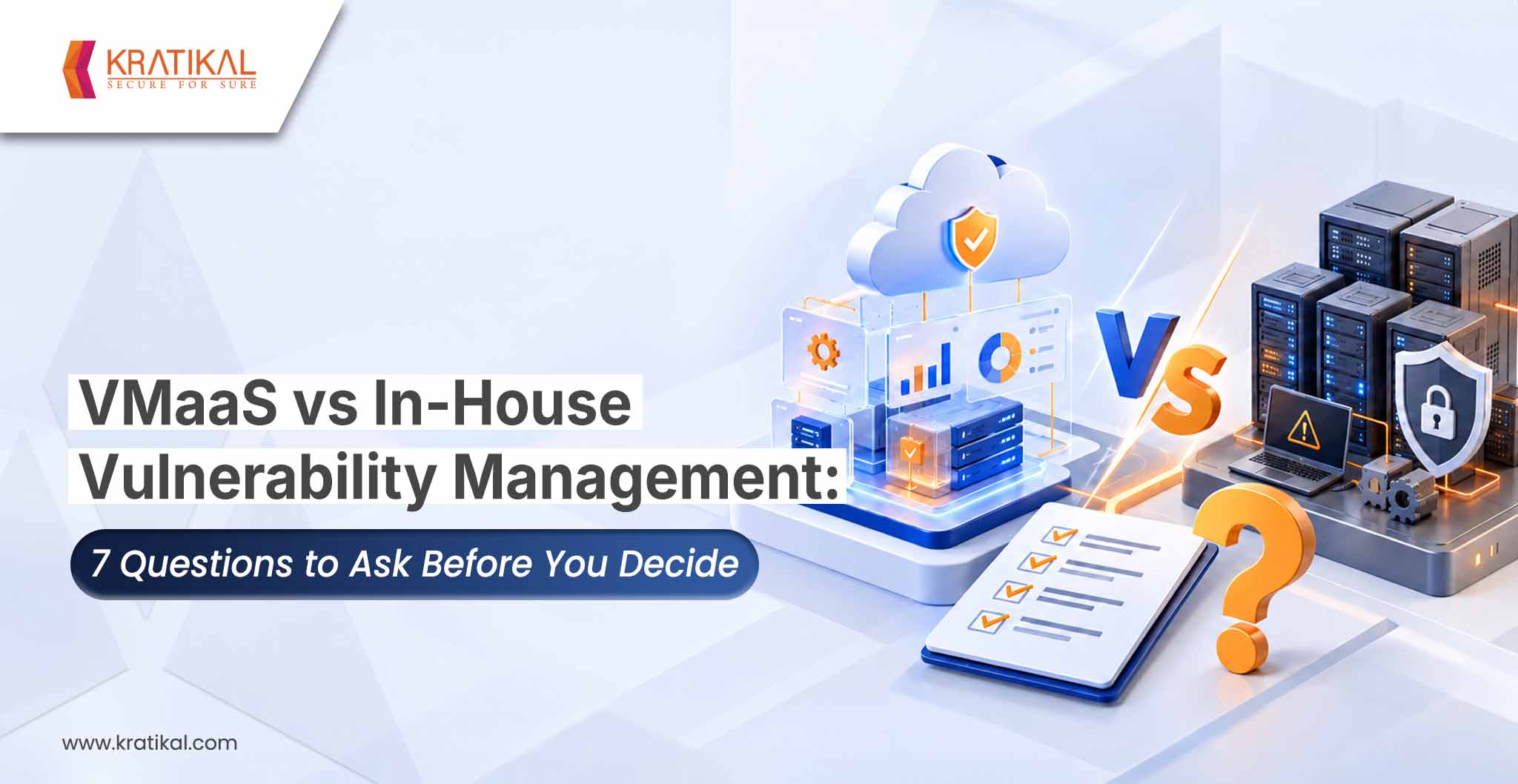
This blog explains seven practical questions that expose which model fits your team – VMaaS or in-house vulnerability management. Choosing between the two is a decision almost every security team faces sooner or later: keep building the vulnerability management tool or programme yourself, or hand the heavy lifting to a service. It looks like a budget question. It is really a speed question. Mandiant’s M-Trends 2026 estimates that the mean time to exploit has dropped to about minus seven days, which means attackers often strike before a patch even exists. Your enemy is not hunting for a big breakthrough. It is hunting for the one flaw you have not found yet.
So the real question is simple: which model finds, validates, and closes your real risks before an attacker gets there?
What Is VMaaS, and How Is It Different from In-House Vulnerability Management?
Vulnerability Management as a Service (VMaaS) is a subscription model in which a provider supplies the platform, expertise, and workflows to continuously discover assets, scan for vulnerabilities, validate and prioritize findings, and track remediation.
In-house vulnerability management means your own team buys or builds the vulnerability management tool and runs every step of the VM lifecycle itself.
Both models follow the same lifecycle: discover assets, scan, validate, prioritize, remediate, re-scan, and report. What changes is who owns the effort at each step. One point is often misunderstood. In most VMaaS models, the provider finds, verifies, prioritizes, and guides.
The fixing part, which includes patching a server, changing a configuration, correcting code, still belongs to your IT and engineering teams. A good service makes that handoff faster and easier to track. It does not remove your accountability.
7 Questions to Ask Before You Decide – VMaaS or In-House Vulnerability Management
Here are the seven questions that you need to answer before you open your financial vault for security:
1. How fast do attackers move compared to how fast your team can respond?
The gap is widening. The median time to patch rose from 32 to 43 days, and organizations fully remediated only 26% of the vulnerabilities in CISA’s Known Exploited Vulnerabilities (KEV) catalog. Meanwhile, M-Trends 2026 reports that exploits were the top initial infection vector for the sixth year running, at 32% of intrusions.
Ask yourself: Can we scan continuously, triage the same day, and track every fix to closure? A once-a-quarter scan cannot keep pace with that timeline.
An in-house vulnerability management team can get there, but only with enough people and automation behind it. VMaaS gives you scheduled, recurring scanning and workflow tracking from day one.
2. Do you have the skills, not just the headcount, to run it end to end?
Running a scanner is the easy part. The real work is validating results, removing duplicates, deciding what matters, finding the asset owner, and chasing the fix. The 2025 ISC2 Cybersecurity Workforce Study found that 95% of respondents reported at least one skills gap, and 88% had experienced at least one significant incident or operational issue linked to a skills shortage.
Ask yourself: If our one VM analyst resigns next month, does the program stop?
A VMaaS gives you access to a bench of expertise without hiring for every skill. That matters most for lean teams in Indian mid-market firms and US SMBs.
3. What does it really cost, and what does a mistake cost?
Count the whole in-house bill: scanner licences, scanning infrastructure, tuning, analyst time, training and the coverage you cannot afford to build. Then count the downside. IBM’s 2026 Cost of a Data Breach Report puts the global average at $4.99 million and the US average at $11.5 million. In India, the average reached a record Rs 25.5 crore, up 15.9% from Rs 22 crore last year.
IBM’s India findings also point to what helps. Organizations with no AI and security automation paid an average of Rs 31.6 crore per breach, against Rs 21.3 crore for those with extensive deployment. Offensive security work, including red teaming and penetration testing, delivered the largest average saving, at Rs 2.47 crore. These are correlations, not guarantees, but the direction is clear: automation and proactive testing are associated with lower breach costs.
Ask yourself: Is our in-house vulnerability management tool cost predictable, or does it grow every time we add an asset type?
4. Can you see and cover your entire attack surface?
Modern estates span web applications, mobile apps, APIs, cloud accounts, and networks. Many in-house setups stitch together a separate tool for each, which creates blind spots and five dashboards. Depth matters as much as breadth. PCI DSS v4.0.1 requires internal vulnerability scans to be authenticated, because unauthenticated scans miss much of what matters.
Ask yourself: Do we have one view of risk across web, mobile, API, cloud, and network, or do we assemble it by hand?
5. Will you get validated, prioritized findings or just a long list?
More than 48,000 CVEs were published in 2025, a record and a 20.6% rise on 2024, according to Jerry Gamblin’s annual CVE review. Much of that growth reflects how vulnerabilities are reported, and most of those CVEs will not affect any given environment. The job is to find the ones that do, and that are exploitable.
That is why prioritization has moved beyond raw severity scores. CERT-In’s July 2025 Comprehensive Cyber Security Audit Policy Guidelines call for findings to be ranked by severity with mitigation timelines, and reference scoring models such as CVSS combined with EPSS. Validation matters just as much: every false positive costs your engineers time they do not have.
Ask yourself: Does every finding arrive with proof, a priority, and a fix, or do my engineers have to work that out?
6. How will you prove compliance when the auditor asks?
Regulators want evidence of a repeatable process, not a one-off scan.
- PCI DSS v4.0.1: internal and external vulnerability scans at least every three months, plus after significant changes. External scans must be performed by a PCI SSC Approved Scanning Vendor (ASV), so check this if you plan to outsource.
- CERT-In (India): the July 2025 guidelines expect a comprehensive cyber security audit at least once a year and standardized reporting of findings.
- DPDP Rules, 2025 (India): notified on 13 November 2025, with the core obligations, including reasonable security safeguards, applying from May 2027. Penalties for failing to maintain safeguards can reach Rs 250 crore.
- NIST CSF 2.0 (US): outcome ID.RA-01 asks that vulnerabilities in assets are identified, validated and recorded.
Ask yourself: Can we produce dated scan history, remediation timelines, and audit-ready reports in minutes, not weeks?
7. Who holds your vulnerability data, and how safe is it?
A list of your unpatched weaknesses is a roadmap for an attacker. In-house gives you full control, along with full responsibility for securing that data. With VMaaS, you are trusting a provider with it, so due diligence is non-negotiable. Verizon’s 2026 DBIR found third-party involvement in 48% of breaches, up from 30% a year earlier.
Ask yourself: Does the provider offer role-based access, protected reports, and clear data-handling terms, and can we export our data if we ever leave?

Book Your Free Cybersecurity Consultation Today!
VMaaS vs In-House Vulnerability Management at a Glance
| Factor | In-House Vulnerability Management | VMaaS |
| Time to Start | Longer: procure, deploy, and tune | Faster onboarding on a ready platform |
| Skills | You hire and retain them | Provider supplies expertise |
| Coverage | Often one tool per asset type | Typically unified across assets |
| Cost model | Licences, infrastructure and staff | Subscription, more predictable |
| Validation and prioritization | Depends on your analysts | Built into the service |
| Compliance evidence | Assembled manually | Reports and history on demand |
| Data control | Full control, full responsibility | Shared; depends on provider controls |
Which Model Fits Your Organization?
In-house fits when you run a mature security operations team with dedicated VM staff, operate air-gapped or tightly restricted environments, or have strict rules that keep scan data inside your perimeter.
VMaaS fits when your team is lean, your estate spans web, mobile, API, cloud, and network, audits are driving your timelines, and you need scanning to run continuously instead of quarterly.
A hybrid approach can work well: the provider runs scanning, validation, and reporting, while your team keeps ownership of risk decisions and remediation. That keeps context in-house and effort outsourced.
How does AutoSecT deliver Vulnerability Management as a Service?
If your answers to the seven questions lean towards a service, here is what that looks like in practice. AutoSecT by Kratikal is an AI-driven pentest and VMDR platform that pairs Kratikal’s VAPT expertise with a full vulnerability management lifecycle on one dashboard.
- One view across assets: web apps, mobile apps (APK and IPA), APIs, cloud (AWS, GCP, and Azure through CSPM), and networks are managed in a single place, with a Smart Scan Scheduler for recurring scans.
- AI-verified findings: AutoSecT validates vulnerabilities with proof-of-concept evidence, so your team works on confirmed risks rather than raw scanner output.
- Risk-based prioritization: findings are ranked as Critical, High, Medium, Low, or Informational, with customizable remediation SLAs.
- AI-based patch guidance: each finding comes with a summary and a step-by-step remediation guide.
- Workflow integration and access control: AutoSecT connects with Jira, Slack, Microsoft Teams, Google Chat, and Zoho Cliq, and role-based access keeps findings visible only to authorized people.
- Dashboards and audit evidence: A CISO dashboard and an Analytics dashboard serve leadership and DevSecOps, respectively, and password-protected reports and verifiable VAPT certificates support audits. Compliance mapping covers ISO 27001, NIST CSF 2.0, and SOC 2.
Join our weekly newsletter and stay updated
Way Forward
The choice between VMaaS and in-house vulnerability management comes down to speed, skills, coverage, cost, validation, compliance, and data control. Neither model is right for everyone. An in-house vulnerability management tool suits mature teams with strict data boundaries. VMaaS suits teams that need continuous, validated, and audit-ready vulnerability management without building every capability themselves. A hybrid is a practical middle path. Run the seven questions honestly, and the answer usually becomes clear.
FAQs
- What is the difference between VMaaS and in-house vulnerability management?
VMaaS is delivered by a provider as a subscription, covering the platform, expertise and workflows. In-house means your team buys or builds the tools and runs the full lifecycle itself.
- Is VMaaS cheaper than in-house vulnerability management?
Not always, and no single number applies to everyone. VMaaS replaces separate licence, infrastructure and staffing costs with a subscription, which is usually more predictable. A mature, large team may find in-house cost-effective at scale. Compare the total cost of ownership, not just the licence price.
- Does VMaaS fix vulnerabilities for you?
The provider discovers, validates, prioritizes, and recommends fixes. Your IT or engineering teams normally apply the patches or code changes.
- Is VMaaS secure enough for enterprise use?
If the provider enforces role-based access, protects reports, and handles data transparently. Ask about access controls, data handling, and export options before you sign. Yes, AutoSecT is secure for enterprise use.
- Can VMaaS replace penetration testing?
No. They are complementary. Vulnerability management gives continuous breadth, while penetration testing gives deeper, attacker-style assessment.
- How often should vulnerability scans run?
PCI DSS sets a minimum of every three months for internal and external scans, plus scans after significant changes. Given how quickly exploitation now follows disclosure, continuous or scheduled recurring scanning is the stronger practice.
- Can a hybrid model work?
Yes. A common split is to outsource scanning, validation and reporting while keeping risk decisions and remediation in-house.