Penetration Testing as a Service (PTaaS) transforms traditional penetration testing from a periodic engagement into a continuous security process. It combines expert-led security assessments with automated testing through a centralised platform, allowing organisations to request tests on demand, access validated vulnerabilities in real time, and initiate retesting as soon as they deploy fixes. This approach ensures continuous security visibility, faster remediation, and ongoing coverage as the organisation’s attack surface evolves.
The traditional model looks tidy on paper. One scope, one test, one report, once a year. But most applications now change every week, and a report finished in March describes a system that no longer exists by June. That gap is what PTaaS was built to close. The testing is not a different kind. The way you buy and run it is.
What Is Pentest as a Service?
PTaaS stands for penetration testing as a service. The testing itself is the same work a traditional penetration test involves: skilled testers attack your applications, APIs, networks, or cloud environments with your permission, and prove which weaknesses an attacker could exploit. What changes is the delivery.
A PTaaS engagement usually has 4 parts:
- A platform where you define scope, request tests, track findings, and download reports, instead of exchanging emails and PDFs.
- Human testers who carry out the manual work: exploitation, chained attacks, access control, and business logic.
- Automated testing that runs between manual engagements and flags new exposure as your systems change.
- Retesting on request, so each fix is verified by a tester before the finding is closed.
Think of a traditional penetration test as a photograph. The picture is sharp, detailed, and accurate on the day it was taken. A PTaaS engagement works more like a video. The automated layer keeps recording between tests, and whenever something important changes, you can ask a tester for a full, sharp frame of that moment. You see what changed, and when, instead of waiting a year for the next picture.
For the testing fundamentals underneath, see this guide to VAPT testing.
How Pentest as a Service Works
A pentest as a service engagement follows the same phases as any penetration test, but each one runs through the platform rather than through meetings and email threads.
1. Scope on the platform. You list the assets to test, such as web applications, APIs, mobile apps, or network ranges, along with test credentials and any rules of engagement. Changing the scope later is a request, not a new contract.
2. Kick off quickly. Because contracts and scoping are already in place, a new test can usually start within days instead of the weeks a new procurement cycle takes.
3. See findings as they are confirmed. Testers post each exploitable finding as soon as they verify it, with proof of concept and remediation guidance. Your developers can start fixing a critical issue on day 2 instead of waiting for the final report.
4. Fix through your own tools. Most platforms push findings into the ticketing and delivery tools your team already uses, so security work sits in the same queue as other engineering work.
5. Retest each fix. When a fix ships, you request a retest from the platform. The tester confirms it, and only then is the finding closed. This step is where much of PTaaS’s value sits, because a finding is not fixed until someone has checked. The case for that step is set out in remediation over reports.
6. Report for auditors. The platform produces the formal report, and often an attestation letter, when you need evidence for customers or regulators.
PTaaS vs Traditional Pentest
The difference between PTaaS and a traditional pentest is mostly about timing, visibility, and retesting. Testing depth can be the same in both.
| Criterion | Traditional pentest | Pentest as a service |
| Engagement model | One-off project | Ongoing service |
| Time to start | Weeks, after procurement and scoping | Days, once the service is in place |
| When findings arrive | In a report at the end | As each one is confirmed |
| Retesting | Often extra, or a single retest window | Requested per fix, usually included |
| Collaboration | Email and calls through a project manager | Direct, through the platform |
| Coverage between tests | None | Automated testing keeps running |
| Fits release cadence | Annual or quarterly | Weekly or continuous releases |
| Reporting | One static PDF | Live dashboard plus formal reports |
| Cost model | Per engagement | Subscription or credits |
A traditional pentest is still the right choice in some cases. A stable system that changes once a year, a one-time due diligence check before an acquisition, or a narrow compliance test with a fixed scope may not need an ongoing service. The comparison is about fit, not about one model being better in every case.
The quality of the testing still depends on the testers, in both models. A platform with a polished dashboard and a thin manual effort is a scanner with a better interface. This comparison of manual and automated testing shows what only human testers find.
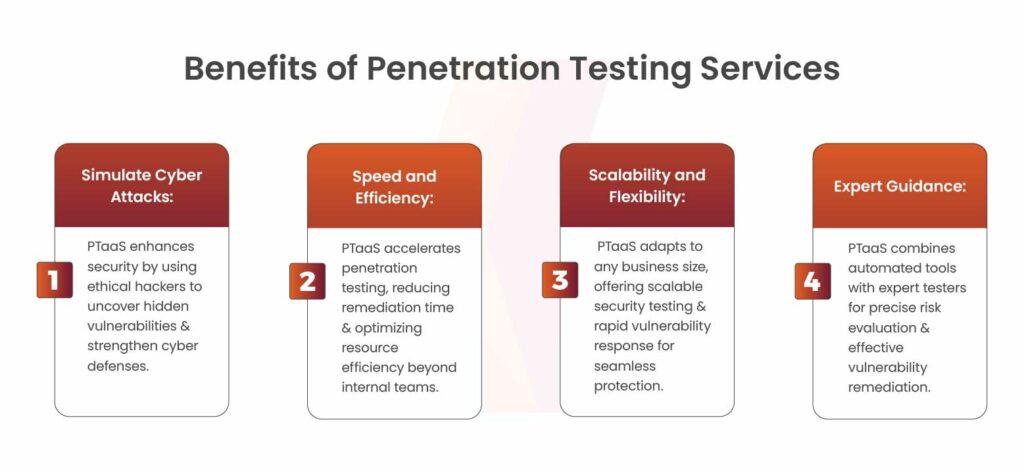
Continuous Penetration Testing and On-Demand Pentests
Most providers deliver PTaaS in 2 ways, and most organisations use both.
Continuous penetration testing keeps a layer of testing running all the time. Automated checks run on a schedule and after each deployment, and testers return to critical systems at regular intervals. The aim is that no change goes untested for long. This post on continuous penetration testing explores the method in greater depth and explains how it differs from routine scanning in the comparison of continuous scanning versus pentesting.
On-demand pentests are triggered by events. You request a full manual test when something significant changes: a new product launch, a rebuilt login or payment flow, a major cloud migration, or a new API for partners. Because the contract and platform are already in place, the test starts in days.
The 2 modes answer different risks. Continuous testing catches the steady drift that every release introduces. On-demand testing gives a deep look at the moments when the risk jumps. A programme with only one of them leaves a gap the other would cover. This post on why continuous pentesting matters more than annual assessments makes the case for running both.

Book Your Free Cybersecurity Consultation Today!
What PTaaS Does Not Change
The service model fixes the timing and the workflow of penetration testing. Not everything, though, and a buyer should know where the limits are.
Depth still needs time. A tester who has 2 days for an application finds less than one who has 10, whatever the platform looks like. Ask how many tester-days the service includes for each critical system, not just how many tests you can request.
Automation still produces noise. The continuous layer is automated, so it brings the usual false positives and generic severity scores with it. Someone has to validate those findings before developers act on them, which is why manual validation still matters even inside a PTaaS model.
The video still needs sharp frames. The automated layer records continuously, but its picture is blurry by design. The deep manual test is the sharp frame. NIST’s security testing guide, NIST SP 800-115, notes that the cost and risk of penetration testing are why annual testing may be enough for many organisations. A service model lowers the cost of each test, but the need for that depth remains.
Scope discipline still matters. Easy test requests make it tempting to test whatever is newest rather than whatever carries the most risk. Set priorities by business impact first, then use the platform to act on them.
Where PTaaS Fits Compliance
Compliance frameworks rarely mention PTaaS by name, but several of their requirements are easier to meet with it.
| Requirement | What it asks for | How PTaaS helps |
| PCI DSS v4.0.1, requirement 11.4 | Internal and external penetration tests at least every 12 months and after significant changes, with exploitable findings corrected | On-demand tests after each significant change; retests show the corrections |
| SEBI CSCRF (2024) | VAPT by a CERT-In empanelled auditor, with findings closed within 3 months and the closure revalidated | Retests on the platform document each closure |
| CERT-In audit guidelines (2025) | Follow-up audits after findings are closed; solely tool-based testing discouraged | Retests cover follow-up; the manual layer keeps testing from being tool-only |
| RBI IT Master Direction (2023) | Penetration testing at least every 12 months for critical and DMZ systems | Scheduled manual tests meet the cadence; continuous testing covers the gaps |
The “after significant changes” clause in PCI DSS is the one that traditional annual testing handles worst, as this summary of PCI DSS requirement 11 shows. CERT-In’s 2025 audit guidelines put follow-up audits in the expected scope, which a retest workflow covers by design. For SEBI-regulated entities, this breakdown of SEBI’s VAPT guidelines covers the timelines, and the RBI’s IT Master Direction sets its cadence in clause 26.
One caution for regulated buyers: if a regulator requires a CERT-In empanelled auditor, the PTaaS provider itself must be on CERT-In’s list. A platform built abroad and resold locally may not be.
Join our weekly newsletter and stay updated
How to Choose a PTaaS Provider
Choosing a PTaaS provider comes down to the human testing behind the platform, because the dashboards look alike. Ask each provider these questions, in writing:
- How many tester-days are included per critical system, and how much of that is manual? A specific number is the only useful answer.
- Who are the testers, and what are their certifications? A provider that will not name them before signing is likely to staff the work afterwards.
- Are retests included, and how quickly are they done? Retests are the core of the model, so they should not be extras.
- Which standards drive each test type? Expect named methodologies such as the OWASP Testing Guide, not “OWASP Top 10 coverage” alone.
- Will the reports satisfy your auditors? Ask for a redacted sample report and attestation letter.
- Is the provider CERT-In empanelled? This matters if SEBI or your own customers require it.
- Where is your data stored, and how is it deleted? Test data includes credentials and your weakest points.
For a wider checklist, including how to verify CERT-In empanelment, see this list of top VAPT companies in India.
Kratikal’s PTaaS combines manual exploitation by its testers with automated testing through AutoSecT, its AI-driven pentesting platform. Findings appear on a central dashboard, retests are requested on demand, and results feed into CI/CD pipelines. Coverage spans web and mobile applications, APIs, networks, and cloud infrastructure, so a release goes from fix to verified closure without waiting for the next annual test.
Is Pentest as a Service Right for You?
The last pentest passed. Its report sits in the compliance folder, and the finding count reads zero. But every release since then is a change no tester has looked at. Pentest as a service exists for exactly that gap. The model keeps the depth of a manual penetration test and changes how often, how fast, and how visibly that testing happens.
The model fits best if you release often, need evidence of testing after significant changes, or want every fix verified before a finding is closed. A traditional test may still be enough for a stable system with a fixed annual cycle.
If you are weighing the switch, Kratikal’s PTaaS testing services can scope your critical systems and show a redacted sample of findings and retest records before you commit.
FAQs
Buyers comparing pentest as a service with traditional testing most often ask the questions answered here.
- What Does PTaaS Stand For?
PTaaS stands for penetration testing as a service, also written as pentest as a service. It describes penetration testing delivered as an ongoing service through a shared platform, rather than as a one-off project that ends in a single report. Human testers still do the exploitation work, while the platform handles scoping, live findings, retest requests, and reporting, with automated testing running between manual tests.
- How Is PTaaS Different From a Traditional Penetration Test?
PTaaS differs from a traditional penetration test in timing, visibility, and retesting, not in testing depth. A traditional test is a one-off project that delivers one report at the end. PTaaS is an ongoing service where tests start within days, findings appear as each one is confirmed, and fixes are retested on request. Automated testing also keeps running between manual tests, so coverage does not stop.
- What Is the Difference Between PTaaS and a Vulnerability Scanner?
The difference between PTaaS and a vulnerability scanner is that PTaaS includes human testers who prove which weaknesses can be exploited. A vulnerability scanner is an automated tool that lists likely weaknesses by matching systems against known patterns, often with false positives. PTaaS may use scanning in its automated layer, but its manual testing finds access control flaws, business logic issues, and chained attacks that scanners miss.
- Is PTaaS Continuous or On-Demand?
PTaaS is usually both continuous and on-demand. The continuous part is automated testing that runs on a schedule and after deployments, plus regular returns by testers to critical systems. The on-demand part lets you request a full manual pentest when something significant changes, such as a new product, a rebuilt payment flow, or a cloud migration. Most organisations use both together.
- Should I Still Buy an Annual Manual Pentest If I Use PTaaS?
You should not need a separate annual manual pentest if your PTaaS service includes scheduled manual testing of each critical system. Check that it does. Some services lean heavily on automation and offer little manual depth. Standards such as PCI DSS and the RBI’s IT Master Direction expect penetration testing at least every 12 months, so the manual tests in your PTaaS plan must meet that cadence.
- What Should I Look for When Choosing a PTaaS Provider?
When choosing a PTaaS provider, look past the platform to the testing behind it. Ask how many tester-days are included per critical system, who the testers are, whether retests are included, and which methodologies drive each test. Request a redacted sample report and attestation letter. If SEBI or your customers require a CERT-In empanelled auditor, confirm the provider appears on CERT-In’s list.