
In India, the amount of money spent on cybersecurity is growing annually. Businesses are spending on cloud security, endpoint protection, security awareness, and compliance to ensure the security of their digital assets. The main parts of most of these engagements are Vulnerability Assessment and Penetration Testing (VAPT), a service that is specifically designed to evaluate and verify security vulnerabilities before they can be exploited by hackers. However, with increased investment, a significant error is being committed by most organizations. They are turning VAPT to a document procurement practice instead of a process of security improvement. It is no longer about mitigating cyber risk but about getting the report that satisfies auditors, customers, regulators, or procurement requirements. This strategy puts a false illusion of security. Vulnerabilities may be confirmed by a report, however, it does not remove them. That can be met only through remediation and continuous security improvement However, the unfortunate thing is that most businesses purchase VAPT services in India, get the final report, distribute it to stakeholders and move on without correcting the problems detected. This mindset exposes organizations to unnecessary risks as cyber threats evolve. VAPT is not all about creating paperwork. It is aimed at decreasing the risk and impact of cyberattacks.
What VAPT Is Actually Designed To Do
Vulnerability Assessment and Penetration Testing is a formal security practice which assists companies in recognizing vulnerabilities in their digital infrastructure. Vulnerability assessment determines security vulnerabilities, misconfigurations, old software versions, weak passwords, and other vulnerabilities that can be used by attackers.
Penetration testing goes a step further by trying to replicate real-life attacks to learn whether the vulnerabilities can be exploited and the damage they would cause.
Modern VAPT Services In India Typically Cover:
- Web applications
- Mobile applications
- APIs
- Cloud environments
- Internal networks
- External networks
- IoT devices
- Enterprise systems
The Rise Of Compliance-Driven Security
One of the biggest reasons organizations fail to realize the full value of VAPT is compliance-driven decision-making. A lot of companies carry out assessments due to the necessity to do it. Common Drivers Include:
- ISO 27001 certification
- PCI DSS compliance
- RBI security guidelines
- Vendor onboarding requirements
- Government regulations
- Customer security assessments
While compliance is important, problems arise when it becomes the only objective. Instead of asking: “How can we reduce cyber risk?” Organizations begin asking: “How quickly can we get the report?”
There is a shift towards documentation rather than protection. In these situations, providers are often selected according to speed and cost instead of how good the testing, support of remediation and long term security results are. The result is a report that satisfies a requirement but fails to improve actual security.
Why Businesses Become Obsessed With Reports
There are several reasons why organizations prioritize reports over risk reduction.
1. Reports Are Easy To Measure
Executives tend to like measurable outcomes. A completed VAPT report is easy to track. It may be shown in auditing, compliance reviews and board meetings. The mitigation of risk, however, requires continued work, teamwork, and investment.
2. Security Is Often Viewed As A Cost Center
Cybersecurity is still viewed by many organizations as an operational expense and not a business enabler. As a result, security initiatives are frequently limited to minimum compliance requirements.
3. Lack Of Internal Expertise
Most companies lack security teams that are committed to analyze results and develop remediation strategies. Unless it has a clear ownership, the vulnerabilities are not resolved.
4. Resource Constraints
Development teams are subject to competing priorities. Product releases, customer requests, and operational demands may take precedence over security fixes. Consequently, vulnerabilities that have been detected by VAPT services in India take months or years to be addressed.
The Dangerous Consequences Of Ignoring Findings
A VAPT report that is never acted upon offers little protection. In most instances, companies end up exposing key vulnerabilities without the knowledge and without having written records of their existence. The consequences can be severe.
1. Data Breaches
Attackers often take advantage of the known vulnerabilities that have not been properly addressed by the organizations. Possible exposures of sensitive customer data, financial records and intellectual property may occur.
2. Financial Losses
The recovery cost of a cyber attack is usually higher than the prevention and remediation costs. Businesses May Face:
- Incident response expenses
- System restoration costs
- Legal fees
- Regulatory fines
- Revenue losses due to downtime
3. Reputational Damage
Trust is hard to earn and is simple to lose. A single security breach can greatly affect customer trust and business relations. It is difficult to gain trust and it is easily lost. Just one security incident can have a significant impact on customer trust and business relationships.
4. Regulatory Compliance
With the ever-changing nature of data protection regulations, companies might be subject to greater scrutiny in the event of security breaches caused by vulnerabilities known to them. Ignoring findings identified through VAPT services in India may create legal and compliance issues, which are not limited to technical ones.
The Gap Between Finding And Fixing
The vulnerability gap between vulnerability remediation and vulnerability discovery is one of the least recognized issues in cybersecurity. Most organizations are able to pass through the testing exercises but struggle to implement fixes.
Common Obstacles Include:
- Security team finds issue
- Development team backlog
- No ownership assigned
- Vulnerability remains open
- Risk accumulates
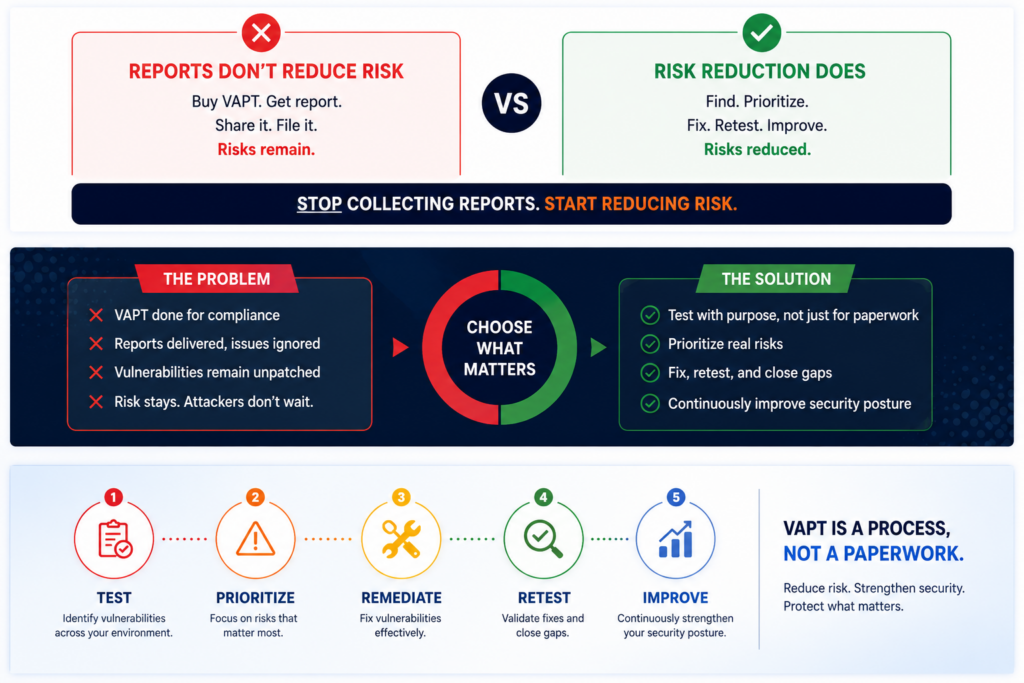
It is in this gap where the bulk of cyber risk lies. Finding a vulnerability does not reduce risk. Fixing the vulnerability does.
What Effective VAPT Looks Like
Those companies that realize a high security benefit do so in a different direction. Their sense of VAPT is a continuous security lifecycle, and not a single project.
1. Comprehensive Testing
The process starts with comprehensive evaluations covering all critical systems and applications.
2. Risk-Based Prioritization
All vulnerabilities do not need an immediate response. Organizations need to concentrate on vulnerabilities that:
- Expose sensitive data
- Enable unauthorized access
- Affect critical business functions
- Create significant financial or operational risk
3. Structured Remediation
Security teams collaborate closely with developers and IT teams to respond to findings depending upon risk and business impact.
4. Retesting
After vulnerabilities are mitigated, they should be re-tested to ensure the remediation process was successful.
5. Continuous Improvement
The most mature organizations also perform regular evaluations and constantly check their surroundings in regard to new threats. This is where high-quality VAPT services in India provide the greatest value.
Why Annual Testing Is No Longer Enough
Cyber threats evolve continuously. Applications are updated frequently, cloud environments change daily, and new APIs, integrations, and software releases introduce fresh attack surfaces. A VAPT assessment conducted once a year provides only a point-in-time view of security. Vulnerabilities introduced shortly after the assessment may remain undetected for months.
To address this gap, organizations are moving toward continuous security validation rather than relying solely on annual testing.
Continuous Vulnerability Scanning enables organizations to identify newly introduced vulnerabilities as they appear. Automated scans continuously monitor applications, servers, cloud assets, and endpoints, helping security teams detect risks much earlier and reduce exposure windows.
However, finding vulnerabilities is only part of the challenge. VMDR tool helps organizations prioritize based on risk and provide AI-driven remediation vulnerabilities. Instead of treating every finding equally, VMDR focuses attention on vulnerabilities that are exploitable, internet-facing, or capable of causing significant business impact.
Another growing trend is Automated Penetration Testing. Traditional pentesting remains valuable for uncovering complex attack paths and business logic flaws, but it is often conducted only periodically. Automated pentesting allows organizations to simulate attacker behavior more frequently, validate exploitability, and continuously assess their security posture between manual assessments.
Platforms such as AutoSecT further enhance this approach by combining continuous vulnerability monitoring, automated security assessments, attack surface visibility, and risk prioritization in a single solution. Rather than waiting for annual audits, organizations gain ongoing visibility into security weaknesses, remediation progress, and emerging threats.
The reality is that attackers do not operate once a year, and security testing should not either. Organizations that adopt continuous scanning, VMDR, automated pentesting, and continuous security validation platforms are better positioned to identify vulnerabilities early, reduce cyber risk, and maintain a stronger security posture throughout the year.
Measuring The Right Outcomes
Many organizations measure VAPT success using the wrong metrics. Common metrics include:
- Number of reports delivered
- Number of systems tested
- Compliance certificates obtained
While useful, these metrics do not indicate whether security has actually improved. More meaningful measurements include:
- Number of critical vulnerabilities resolved
- Average remediation time
- Reduction in attack surface
- Percentage of findings closed
- Security posture improvements over time
Organizations focused on these outcomes gain significantly more value from VAPT services in India.
Choosing The Right VAPT Partner
Value is not consistent across providers. In assessing VAPT services in India, businesses may take into account:
1. Technical Expertise
Find providers that have experienced security professionals who can do both automated and manual testing.
2. Remediation Support
The best providers help organizations understand how to fix vulnerabilities rather than simply listing them.
3. Retesting Services
To verify successful remediation, verification is crucial.
4. Industry Experience
Those providers that are conversant with industry-specific threats can be in a better position to present more relevant recommendations.
5. Long-Term Partnership Approach
Providers who are concerned about keeping risks down are best suited to organizations as opposed to those who engage in single engagements.
Why Choose Kratikal for VAPT Service?
At Kratikal, we do more than find security gaps. We help businesses fix them before they turn into real problems. Our team works with you to understand the risks, focus on what matters most, and improve your overall security.
We believe a VAPT report should lead to action. That is why we support you beyond testing. From fixing critical issues to checking that they are resolved, we help you build stronger protection for your systems and data. With Kratikal as your security partner, you can reduce cyber risks, stay prepared for new threats, and create a safer digital environment for your business.
Conclusion
The cybersecurity industry does not require additional reports that are lying in common folders awaiting to be read. It needs organizations that are committed to reducing risk. The companies that treat VAPT services in India as a box to be passed during scrutiny of the audit may pass but at the same time they may be exposed to real attacks. Organizations using VAPT to attain continuous improvement have higher defenses, resilience, and confidence in their security posture. The difference between the two approaches is simple. One collects reports. The other lessens risk.
FAQs
- What are VAPT services in India?
VAPT services consist of Vulnerability Assessment and Penetration Testing to identify, validate and remediate security weaknesses in applications, networks, cloud applications, and digital infrastructure.
- Why is a VAPT report not enough?
Vulnerabilities are only identified in a report. These vulnerabilities are mitigated with remediation and retesting to reduce the risks.
- How often should businesses conduct VAPT?
Most organizations should do VAPT at least once a year, but in high-risk environments, it may have to be done regularly or on a continual basis.
- Which businesses need VAPT services?
Any company with a history of dealing with customer data, financial data, cloud applications, or other systems of importance can be subject to VAPT testing.
- What is the difference between vulnerability assessment and penetration testing?
Vulnerability assessment defines a vulnerability and penetration testing tries to find ways of taking advantage of the vulnerability to test its practical implications.
- Can VAPT help with compliance requirements?
Yes. The VAPT helps in achieving the requirements and standards such as the ISO 27001, PCI DSS, RBI and other customer security requirements.
- What should businesses look for when choosing a VAPT provider?
Critical aspects are technical skills, counseling on remediation, retesting, industry experience, and long-term security plan.
- What is the biggest mistake businesses make after VAPT?
The greatest error is treating the report as a final product rather than addressing weaknesses and mitigating the actual cybersecurity threat.