
Cyberattacks today are rarely random. They are planned, staged, and executed with the same precision a military operation would demand. Yet many organizations still test their defenses using outdated checklists or one-dimensional vulnerability scans that bear little resemblance to how real attackers actually operate. This is the gap that adversary emulation is built to close.
As security assurance matures from “find the vulnerabilities” to “prove we can survive a real attack,” adversary emulation has become one of the most valuable and most misunderstood disciplines in offensive security. It is also the engine that powers effective red teaming, making the two concepts inseparable in any serious security assurance strategy.
Looking at Cyber Security Through an Attacker’s Lens
Cyber security assurance is no longer limited to identifying vulnerabilities or checking compliance requirements. Organizations increasingly need to understand how their defenses would perform against the tactics of real-world threat actors.
This is where Adversary Emulation brings a different perspective. Rather than testing generic attack scenarios, it recreates the behavior patterns of specific adversaries that are relevant to an organization’s industry, technologies, and risk landscape.
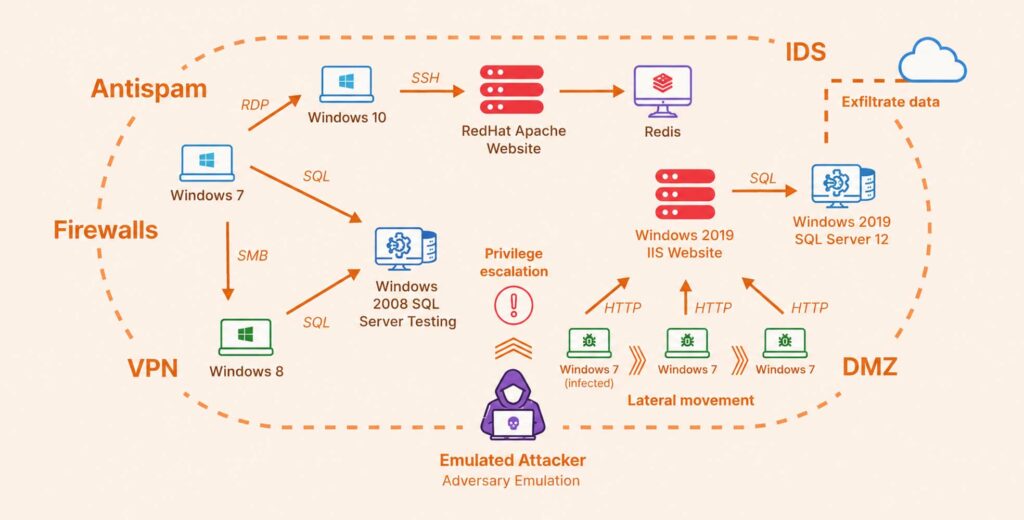
What makes this approach particularly valuable is its focus on realism:
- It is intelligence-driven. Assessments are designed around the tactics and objectives of actual threat actors that organizations are likely to face.
- It mirrors real attack progression. Simulations follow the same stages attackers typically use, from gaining initial access to moving laterally and targeting critical assets.
- It evaluates security operations in action. The objective is not merely to determine whether systems can be compromised, but whether security teams can detect, investigate, and respond effectively.
- It enables continuous measurement and improvement. Because exercises are based on documented attacker behaviors and frameworks, organizations can repeatedly assess their readiness and track improvements over time.
Attack simulation uses realistic, intelligence-driven simulations to replicate the tactics of real-world threat actors. This enables organizations to assess how effectively their defenses can withstand sophisticated cyber threats.
Why Are Organizations Turning to Adversary Emulation?
The focus of cybersecurity is shifting from simply deploying controls to proving that those controls can withstand real attacks. This shift is driving the growing adoption of adversary emulation:
- Attackers have professionalized.
Ransomware groups and advanced threat actors now use structured attack methods and proven techniques, making it possible to replicate their behavior in controlled security exercises.
- Compliance frameworks are catching up.
Industries such as BFSI, healthcare, and critical infrastructure are increasingly expected to conduct realistic security testing instead of relying only on periodic vulnerability assessments.
- Detection capability needs validation.
Organizations invest heavily in technologies like SIEM, EDR, and SOC solutions. Adversary emulation helps determine whether these tools can actually detect and respond to a real attack.
- Board-level risk reporting demands clarity.
Executives and boards want to know how prepared the organization is for cyber threats. Demonstrating that a known threat scenario was simulated and response capabilities were measured provides far greater confidence than simply stating that vulnerabilities were patched.
Kratikal’s red teaming exercises don’t just uncover vulnerabilities; they validate whether your people, processes, and technologies can withstand cyber attacks.

Book Your Free Cybersecurity Consultation Today!
Adversary Emulation and Red Teaming: Two Sides of the Same Coin
This is where the connection between red teaming and adversary emulation becomes important. Red teaming is a broader security exercise that simulates real attacks to test an organization’s people, processes, and technologies, often without the knowledge of the defending team. Adversary emulation adds realism to these exercises by replicating the tactics and techniques of actual threat actors.
This relationship matters for security assurance because:
- Makes Red Teaming more Structured:
Without adversary emulation, a red team exercise can become a generic attempt to break into systems. Attack simulation adds direction by ensuring the exercise follows the techniques used by real-world attackers.
- Provides more meaningful outcomes:
Findings based on real threat actor behaviors and recognized frameworks are easier for security leaders to explain to executives, demonstrate to auditors, and use for improving security programs.
MITRE’s Perspective on Adversary Emulation
The effectiveness of Adversary Emulation lies in its ability to replicate the behaviors of real-world threat actors, and the MITRE ATT&CK framework serves as a critical foundation for making these simulations realistic and actionable. Rather than relying on hypothetical attack scenarios, MITRE ATT&CK provides a structured repository of documented tactics, techniques, and procedures (TTPs) used by cyber adversaries across different stages of an attack.
This enables organizations to design intelligence-driven exercises that closely mirror the methods of actual attackers and tailor simulations to their specific industry, technologies, and risk profile. These exercises also provide security teams with practical experience in handling realistic attack scenarios, helping improve incident response procedures, strengthen collaboration between teams, and build confidence in their ability to manage sophisticated threats.
Ultimately, MITRE ATT&CK enables organizations to move beyond theoretical security assessments and adopt a more resilient, threat-informed approach to continuously validating and improving their defenses.
Want to get the most out of your adversary emulation and red teaming exercises? Read our blog, “10 Questions Enterprise Leaders Should Ask Before Running a Red Teaming Exercise.”
Join our weekly newsletter and stay updated
Best Practices for Implementation
Organizations looking to build adversary emulation into their security assurance strategy should:
- Start with threat intelligence specific to their industry rather than generic adversary templates.
- Run emulation exercises on a recurring cadence, not as a one-time event.
- Use results to update detection rules, not just to file a report.
- Partner with experienced red teaming providers who can responsibly emulate high-risk TTPs without operational disruption.
Conclusion
Organizations no longer rely solely on vulnerability assessments and compliance checklists to measure their security posture. They need evidence that their defenses can withstand the tactics, techniques, and procedures used by real-world adversaries. This is where Adversary Emulation plays a critical role. By replicating realistic attack scenarios and validating how effectively people, processes, and technologies respond under pressure, adversary emulation helps organizations move from assumed security to proven resilience. When combined with red teaming, it provides a practical and intelligence-driven approach to continuously testing defenses, uncovering hidden weaknesses, and strengthening incident response capabilities.
At Kratikal, we help organizations leverage adversary emulation and red teaming to validate security controls against real-world threats and build cyber resilience that keeps pace with an evolving threat landscape.
FAQs
- What outcomes can organizations expect from adversary emulation exercises?
Organizations can identify hidden security gaps, validate detection and response capabilities, improve incident response procedures, and gain greater confidence in their overall cyber resilience.
- How often should organizations conduct adversary emulation exercises?
Adversary emulation should be performed regularly as part of a continuous security assurance program. The frequency depends on factors such as the organization’s risk profile, threat landscape, and changes to its technology environment.
- What security gaps can adversary emulation uncover?
Adversary emulation can reveal weaknesses in detection capabilities, incident response procedures, security monitoring, access controls, and coordination between security teams that traditional assessments may overlook.
- What role does threat intelligence play in adversary emulation?
Threat intelligence provides insights into the tactics, techniques, and procedures used by relevant threat actors, allowing organizations to design realistic and industry-specific emulation exercises.
- Why is continuous adversary emulation important?
The cyber threat landscape evolves constantly. Conducting adversary emulation regularly helps organizations continuously validate and strengthen their defenses against emerging threats.
- How do adversary emulation and red teaming complement each other?
Red teaming simulates realistic attacks to test an organization’s defenses, while adversary emulation adds context and realism by replicating the behaviors of specific threat actors, making the exercise more targeted and meaningful.
- What should organizations consider before conducting an adversary emulation exercise?
Organizations should define clear objectives, identify critical assets, understand relevant threat actors, establish rules of engagement, and ensure stakeholder alignment.