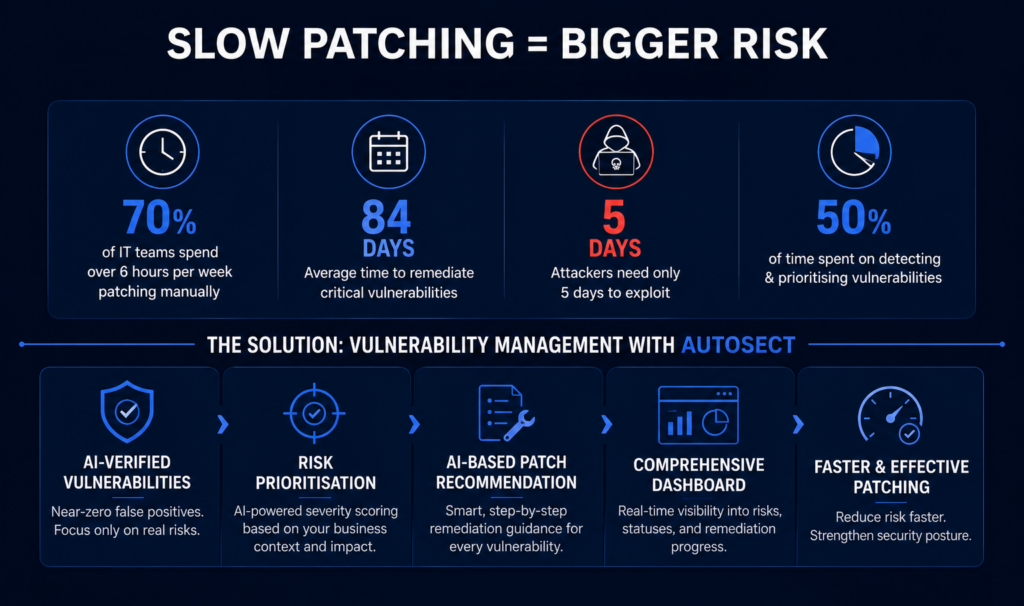
Patch management is a must. Given the conventional patching method, the process is long and tiring; on top of that, ensuring it ends efficiently takes twice as long. Testifying to the claim, there have been many studies. It was found that almost 70% of IT teams spend over 6 hours per week patching the flaws manually. With 9 hours of corporate working hours, the dedicated hours accumulate to one full working day at most. Remediating critical vulnerabilities takes 84 days on average. Not only that, once a vulnerability is disclosed, a hacker needs only 5 days to exploit it, even less. The added assistance comes from the consistently increasing sophistication of attack techniques. Such circumstances call for vulnerability management, along with two non-negotiable adjectives: fast and effective.
So, how can you speed up your patching process and also be effective? The direct answer to it is incorporating vulnerability management as a solution in your pipeline. Let’s understand it in detail, starting with some more analysis on the ‘why’ part, followed by the ‘how’ part!
Why ‘Speed’ is a Must for Patch Management?
When speed increases, the time spent on patching decreases. Most of the time is wasted in doing tasks manually. IT teams spend 50% of their time detecting and prioritising vulnerabilities. For those organisations that use automation, not taking advantage of the right vulnerability management as a solution increases the possibility of false positives.
After detecting and prioritising, comes patch testing. This means ensuring that patching does not cause any operational downtime or compromise the existing software configurations. Research says that time spent equals around 19% of working time per month. Next comes the deployment stage. After the patch testing is done, it takes up over two weeks of an organisation’s time to completely deploy the fixes across the inventory.
This happens because they are not provided with the right patching recommendations for a given vulnerability. It implies that vulnerability management in place is not effective, leading to more time consumption than required.

Book Your Free Cybersecurity Consultation Today!
How To Speed Up The Patch Management Process?
In this new era of automation, the conventional methods cannot compete. Human expertise is a must when it comes to taking up vulnerability management as a solution, but with AI-driven validation, it becomes fast and effective.
Here’s a scenario:
Imagine the best minds of your IT team or a cybersecurity service provider perform the pentesting of your inventory or any one asset. An AI-driven vulnerability management tool records the vulnerabilities found. The tool goes through it, validates the vulnerabilities with AI-generated proof, and categorises each of the vulnerabilities found based on their severity as per your organisation’s structure, business logic, and other non-negotiable factors. Next, it provides an AI-based patching recommendation for each vulnerability found, in a step-by-step process.
What’s the outcome in this scenario?
- The platform validates every identified vulnerability, ensuring near-zero false positives. This saved the time spent on segregating the real vulnerabilities from the unimportant ones.
- Once the vulnerabilities are verified, the tool categorises them based on their severity automatically. This speeds up the process by allowing IT teams to get the list of vulnerabilities that need the most attention.
- Against each vulnerability, a summary and step-by-step remediation guide is provided. The concerned person can directly get into the patching process as per the guide. This significantly reduces the time required to patch vulnerabilities.
Best Vulnerability Management As A Solution For Effective Patch Management
When we talk about vulnerability management, the patching process takes up the most time. Thus, a dedicated solution for the time-consuming factor in this area is necessary. We have a solution that perfectly blends with the requirements of the highly automated business domain.
AutoSecT by Kratikal is perfect for organizations who are struggling with the speed and efficiency factor when it comes to validating, prioritising, and remediating vulnerabilities. In simple words, all the crucial steps in the patch management process. Not only that, the impact on the security cost, the manual labour cost and the operation cost are also reduced at a broader level.
How Can AutoSecT Help Speed Up Patch Management?
Here are a few features of AutoSecT, which, when blended with human expertise, give you the perfect output every time and in a few hours, not months –
AI-Verified Vulnerabilities
AutoSecT, the AI-driven vulnerability management platform, provides accurate exposure validation of security threats, prioritising only true risks, thus ensuring near-zero false positives. Time spent on looking for the true vulnerabilities is reduced to a great extent.
Risk Prioritisation
The platform prioritises the vulnerabilities in five categories – Critical, High, Medium, Low and Info. The CVSS score is listed against each vulnerability. The score is determined based on your organisation’s structure, business logic, and business impact. This helps teams get a clean picture of where to start with the patching process.
AI-Based Patch Recommendation
Once the vulnerabilities are categorised, remediation suggestions through intelligent automation are displayed against each vulnerability. It includes both a summarised version and a step-by-step guide. The IT teams can directly start with the patching, instead of looking for remediation steps or using generic patching guidelines.
Comprehensive Dashboard
With AutoSecT, all vulnerabilities are displayed in a single dashboard based on your needs. Filtering out the vulnerabilities found based on the organisation’s requirements usually takes up a lot of time.
AutoSecT’s CISO dashboard displays the high-risk vulnerabilities with remediation status, vulnerability dwell time, vulnerability patching status by inventory type and many more. AutoSecT’s Analytics dashboard displays the vulnerability patching status based on severity, fixed and unfixed vulnerabilities list by asset types, critical vulnerabilities list from last scans, vulnerabilities in each asset type on project basis and many more.
Unpatched vulnerabilities are a risk in themselves. All these features mentioned above help speed up the patching process. Not only that, the efficiency is also ensured with AI-verified vulnerabilities, unique intelligent fix recommendations for each risk, along with a dashboard that provides in-depth details of the remediation status.
Join our weekly newsletter and stay updated
AutoSecT is currently on a free 15-day trial. Get a complete product tour of the platform here – kratikal.com/autosect/pricing.
Vulnerability Management FAQs
- How to speed up the patch management process?
By automatically validating vulnerabilities, prioritising them based on risk, and providing step-by-step remediation guidance. This reduces manual effort, eliminates false positives, and helps IT teams deploy patches faster for the most critical security issues.
- What is the best solution for faster patch management?
The best vulnerability management as a solution combines AI-driven validation, risk-based prioritisation, and intelligent patch recommendations. These capabilities help organisations reduce remediation time while improving patching accuracy and operational efficiency.
- Why is vulnerability management important for effective patch management?
It helps organisations identify, validate, prioritise, and remediate security weaknesses before attackers can exploit them. Focusing on the highest-risk vulnerabilities first enables faster, more effective, and risk-driven patch management.
- How does AI improve the patching process?
By verifying real vulnerabilities, reducing false positives, prioritising risks based on business impact, and generating intelligent remediation recommendations.
- What features should you look for in a vulnerability management solution?
AutoSecT offer AI-verified findings, automated risk prioritisation, intelligent patch recommendations, comprehensive dashboards, asset-based reporting, and vulnerability tracking. These features streamline the entire remediation lifecycle.
- Can vulnerability management as a solution reduce false positives during patch management?
Yes. AutoSecT use AI-assisted validation and contextual analysis to distinguish genuine security risks from false positives. This allows IT teams to focus only on exploitable vulnerabilities and reduces unnecessary remediation efforts.
- How does risk-based prioritisation improve patch management?
Risk-based prioritisation ranks vulnerabilities according to severity, exploitability, asset criticality, and business impact. This helps organisations address the most dangerous vulnerabilities first, reducing overall cyber risk while accelerating the patch management process.
- What are the benefits of using vulnerability management as a solution instead of manual patch management?
VMaaS helps organisations automate vulnerability validation, reduce manual workload, accelerate patch deployment, minimise operational downtime, improve remediation accuracy, strengthen security posture, and lower overall security and operational costs.