
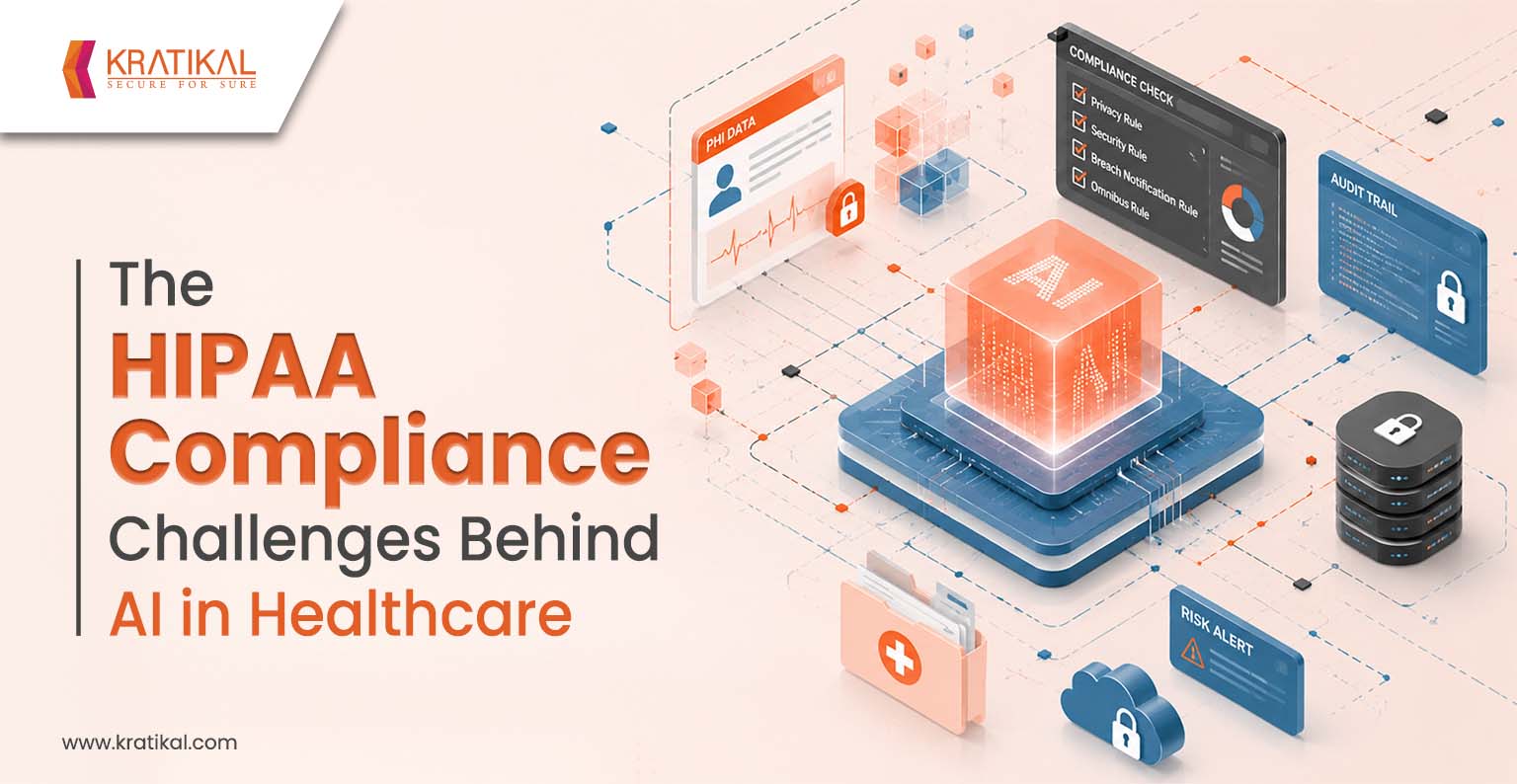
The healthcare industry is rapidly embracing artificial intelligence to improve patient outcomes, streamline operations, and support clinical decision-making. From AI-powered diagnostic tools and virtual health assistants to predictive analytics and automated administrative workflows, AI in Healthcare is transforming how organizations collect, process, and use sensitive health information.
However, the rapid adoption of AI is also creating new challenges for organizations responsible for protecting patient data. Healthcare providers, insurers, technology vendors, and business associates must now consider whether their AI systems are being deployed in ways that align with existing privacy and security obligations.
This is where HIPAA compliance becomes increasingly complex. Traditional security controls may not fully address the unique risks introduced by AI models, large datasets, third-party platforms, and automated decision-making. Organizations must therefore rethink their approach to data governance, access management, risk assessments, and security monitoring as AI becomes embedded in healthcare environments.
Growing Role of AI in Healthcare
AI is being adopted across multiple areas of the healthcare ecosystem. Organizations are using AI to analyse large datasets, identify patterns, automate repetitive tasks, and support healthcare professionals.
Common applications include:
- Medical diagnosis: AI systems can assist clinicians in analysing medical images, test results, and patient records.
- Predictive analytics: Machine learning models can help identify potential health risks and support early intervention.
- Virtual health assistants: AI-powered chatbots can answer patient queries and assist with basic healthcare guidance.
- Drug discovery: AI can accelerate research by analysing biological and pharmaceutical data.
- Administrative automation: AI can automate scheduling, billing, documentation, and claims processing.
- Personalised care: AI models can analyse patient information to support more personalised treatment approaches.
While these applications can improve efficiency and patient care, they often depend on large volumes of Protected Health Information (PHI). This creates significant privacy and security considerations for organizations operating under HIPAA requirements.
Join our weekly newsletter and stay updated
Key HIPAA Compliance Challenges
AI systems introduce a different data lifecycle compared with traditional healthcare applications. Data may be collected from multiple sources, transferred to cloud platforms, processed by third-party AI services, stored for model improvement, and accessed by different users or systems. Each Stage creates Potential Compliance Risks.
1) Increased Exposure of Protected Health Information
AI models often require extensive datasets for training, testing, and inference. These datasets may contain sensitive information such as:
- Patient names and identifiers
- Medical histories
- Diagnoses and treatment information
- Prescription details
- Insurance information
- Biometric data
If PHI is uploaded to an AI platform without appropriate safeguards, organizations could unintentionally expose sensitive patient information.
For example, an employee might enter patient details into a public generative AI tool to summarise clinical notes. If the tool is not approved for handling PHI or lacks appropriate contractual and security controls, this could create a serious HIPAA compliance risk.
The rise of generative AI has made it easier for employees to access and use AI tools without formal approval from IT or security teams.
This phenomenon, often referred to as Shadow AI, can create significant visibility gaps. Organizations may not know:
- Which AI applications employees are using
- What healthcare data is being entered
- Where that data is processed or stored
- Whether third-party providers retain the information
- Who can access the data
Organizations need clear policies governing AI usage and must establish controls to prevent sensitive data from being shared with unauthorised platforms.
3) Lack of Explainability in AI-Driven Decisions
HIPAA’s Security Rule requires organizations to maintain accountability over how PHI is accessed and used. AI complicates this because:
- Clinical or administrative decisions influenced by AI outputs may not have a clear, auditable rationale
- Patients have rights under HIPAA to access records and understand how their data was used, which is difficult when AI logic isn’t transparent
- Incident investigations become harder when it’s unclear which data points influenced an AI-generated outcome
4) Expanded Attack Surface and New Threat Vectors
AI systems introduce technical risks that traditional HIPAA risk assessments often miss:
- Prompt injection attacks against AI chatbots and virtual health assistants that could expose PHI
- Data poisoning, where attackers manipulate training data to corrupt model behavior
- API vulnerabilities in AI integrations that connect to Electronic Health Records (EHR) systems
- Shadow AI, where staff use unsanctioned AI tools (like public chatbots) to summarize or process patient information without organizational approval
How Can Organizations Address These Challenges?
To manage these evolving risks, organizations should adopt a proactive approach that combines strong governance, robust security controls, and continuous compliance monitoring.
- Strengthen Vendor Due Diligence
- Require signed BAAs with every AI vendor that touches PHI, with explicit clauses on model training use
- Ask vendors for SOC 2 reports, security certifications, and details on data residency and encryption
- Clarify contractually whether PHI can be used to improve or fine-tune models used by other customers
- Conduct AI-Specific Risk Assessments
- Extend HIPAA Security Rule risk assessments to explicitly cover AI systems, not just traditional IT infrastructure
- Map every point where PHI enters, is processed by, or exits an AI system
- Include AI-specific threats such as prompt injection and data poisoning in the risk register.
- Implement Strong Access Controls and Monitoring
- Apply role-based access control (RBAC) to AI systems just as strictly as to EHRs.
- Log and monitor all AI system interactions involving PHI, including prompts submitted and outputs generated
- Set up alerts for anomalous access patterns, such as bulk queries against patient data
- Conduct Regular VAPT and Compliance Audits
- Perform Vulnerability Assessment and Penetration Testing (VAPT) specifically targeting AI integrations and APIs
- Test AI chatbots and virtual assistants for prompt injection and data leakage vulnerabilities
- Schedule periodic HIPAA compliance audits that explicitly include AI systems in scope, not just legacy infrastructure

Book Your Free Cybersecurity Consultation Today!
The Road Ahead
Regulators are still catching up to the pace of AI adoption in healthcare, but that doesn’t mean organizations can wait. The Department of Health and Human Services (HHS) and the Office for Civil Rights (OCR) have already signaled increased scrutiny of AI-related PHI breaches, and enforcement actions are expected to grow as AI adoption scales.
Healthcare organizations that treat AI in healthcare and HIPAA compliance as interconnected priorities, rather than separate workstreams, will be better positioned to innovate safely. This means embedding privacy and security considerations into AI deployment from day one, rather than retrofitting compliance after a breach or audit finding.
Conclusion
AI is transforming healthcare delivery, but it is also rewriting the rules of PHI protection. Organizations that continue applying legacy HIPAA compliance approaches to modern AI systems are leaving significant gaps in their security posture. A proactive strategy, covering vendor management, risk assessments, access controls, data governance, and regular VAPT, is essential to harness the benefits of AI in healthcare while staying firmly within HIPAA’s boundaries.
If your organization is deploying AI tools that touch patient data, a structured compliance and security audit is the safest place to start before, not after, an incident occurs.
FAQs
- Does using AI automatically create HIPAA compliance risks?
Not necessarily. The risk depends on how the AI system is designed, deployed, and used. However, AI can introduce additional risks related to data exposure, third-party vendors, access control, and data governance.
- How can healthcare organizations protect PHI when using AI?
Organizations can protect PHI by implementing encryption, access controls, data loss prevention, data masking, de-identification, secure APIs, and strong data governance practices.
- Can third-party AI vendors affect HIPAA compliance?
Yes. If third-party AI vendors process or access PHI, organizations must carefully assess their security practices, data handling procedures, contractual obligations, and applicable Business Associate Agreement requirements.
- What security risks can AI introduce in healthcare?
AI systems may face risks such as prompt injection, data poisoning, sensitive data leakage, insecure APIs, model manipulation, and unauthorised access.
- How can organizations detect unauthorised AI usage?
Organizations can use network monitoring, data loss prevention tools, application controls, identity management, and employee awareness programmes to identify and prevent unauthorised AI usage.
- What happens if PHI is accidentally shared with an AI tool?
Accidental disclosure of PHI should be treated as a potential security or privacy incident. The organization should investigate the event, assess the risk, and follow its established breach response and notification procedures.