
Vulnerability Management 2026 needs a detour! Attackers are well-versed with the conventional routes and their drivers. For nineteen straight years, stolen credentials topped the list of how attackers got in. That changed in 2026. Verizon’s 2026 Data Breach Investigations Report, drawn from more than 31,000 security incidents, found that vulnerability exploitation now accounts for 31% of breaches, surpassing credential theft for the first time in the report’s history. Such a drastic change in hacking speed is concerning, given that it takes 5+ days to patch risks, and many organizations do not quantify their Mean Time to Patch (MTTP). This alarming statistic came through the Automox 2026 State of Endpoint Management report.
Claiming that most vulnerability management initiatives at present are moving at quarterly-scan speed is not entirely false. Closing that gap is the central problem that 2026 hands over to every CISO and security leader. This blog shares a deep analysis of not ‘all AI’ but years of expert experience and AI, each doing the part they’re actually good at in unison to save your organization from getting listed in the next breach report.
Human-Led Pentesting and Continuous AI-Led Validation – Why is Everyone Talking About It?
What is the easiest way to stop the attackers? Fix the vulnerabilities before them! This was always the answer.
But the approach changed over the years. Standing at 2026, PTaaS (Penetration Testing as a Service) is now a strong enough solution to fix the vulnerabilities before the malicious actors finish their cup of coffee! This model leads with certified human experts running the penetration test, probing business logic, chaining findings into real attack paths, and confirming exploitability the way a real attacker would. Continuous AI validation then picks up where the engagement ends, rescanning the environment so newly disclosed CVEs and configuration drift don’t sit unnoticed until the next test.
This means human judgment sets the baseline, and AI keeps it current.
Note that this isn’t a new philosophy so much as a new necessity. PTaaS is the delivery model built specifically around it: expert-led testing as the foundation, with continuous automated validation layered on top, instead of a single annual pentest report that goes stale within weeks. It’s not long before what we talk about in weeks will be transitioning into ‘days or hours’ if not done what is demanded.
Why 2026 Might Be the Inflection Point?
The following numbers explain the urgency. Check Point’s 2026 Exposure Gap Report found vulnerabilities made up 42.6% of all critical exposures this year. More than double the 18.7% recorded the year before.
Fewer than one in twelve proved urgent enough to trigger immediate action. Seems like a relaxing point, yet with a ‘but’! It might not look like a detection problem, but definitely a triage problem, and triage is exactly where volume outruns human capacity.
It’s also a supply problem. First, the body that tracks global vulnerability disclosures now projects roughly 66,000 CVEs for 2026. A jump that attributes largely to AI tools that have started hunting for software flaws on their own.
Industry research backs automation as the response: Kiteworks’ State of AI Cybersecurity 2026 report found 47% of security teams already see AI delivering measurable impact specifically in vulnerability management, and two-thirds have deployed some form of agentic AI into security operations.
Vulnerability Management in 2026 – When Human-Led Approach?
Human-led pentesting is essential when –
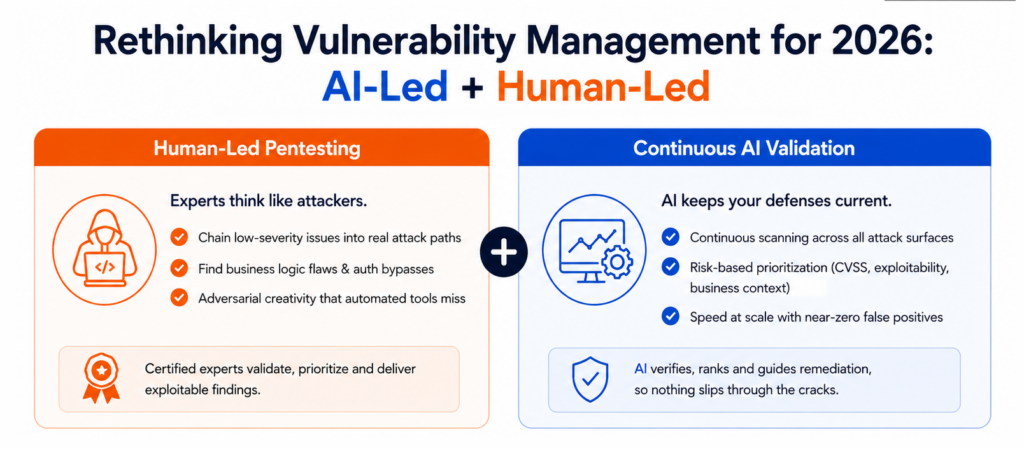
- Chaining together several low-severity findings into the kind of real, exploitable attack path an automated scan reports as “low risk” in isolation
- Business logic flaws and authentication bypass are the classic blind spots for anything pattern-matching against known signatures
- Adversarial creativity. Because attackers are directed by humans, even when they use AI tools. Testing needs to think the same way.
In practice, that means experts who’ve actually broken into infrastructure assets for a living, not just run a scanner against one. Kratikal’s CREST-aligned, OSCP-, CRTP-, eWPTX-, CRTA- and CEH-certified pentesters run these engagements manually and deliver results through AutoSecT as they’re found, validated, prioritized, and paired with AI-assisted remediation guidance. Whether the need is application security, network security, cloud security, offensive security, advisory security, IoT, OT and device security, our principle holds: the value is in catching what pattern-matching alone would miss, and getting the fix to the team while the exposure window is still open.
Hop on to our VAPT Service Suite here – https://kratikal.com/vapt-services

Book Your Free Cybersecurity Consultation Today!
Vulnerability Management in 2026 – When AI-Led Approach?
Where continuous AI validation extends that work:
- Continuous scanning across web, mobile, cloud, network and API surfaces, so the confirmed baseline doesn’t go stale between engagements.
- Risk-based prioritization weighing CVSS score, exploitability, and business context together, thus cutting through false positives.
- Speed at scale, correlating exposure data across inventory attack surfaces faster than any manual process between tests.
That volume is where the platform earns its keep. AutoSecT doesn’t hand a security team a raw vulnerability count. It returns a list of what’s actually exploitable, AI-verified, and ranked by CVSS score, business impact, and organization-specific parameters. This is what ensures near-zero false positives. Every finding lands pre-sorted by severity, from critical down to informational, and comes with two layers of AI-generated remediation guidance. A quick summary for triage and a step-by-step walkthrough for whoever’s doing the fix.
A CISO dashboard gives leadership an exploitable-risk overview. A separate analytics dashboard gives the security team the operational details. It includes fixed status by severity and asset type, remediation SLA progress, and inventory risk trends, without anyone manually sorting a spreadsheet first. Centralized access through SSO, synced automatically with the tools teams already use. It helps keep vulnerabilities moving through remediation instead of sitting in a queue waiting to be infiltrated.
To AutoSecT’s 15-day free trial, visit – https://kratikal.com/autosect/requestdemo
What This Means for CISOs and Security Leads
There’s a real financial case for getting this right.
IBM’s 2025 Cost of a Data Breach Report found the global average breach cost fell to $4.44 million. The first decline in five years, largely due to faster, AI-assisted detection. The US average moved in the opposite direction, climbing to an all-time high of $10.22 million. Organizations using AI and automation extensively saved $1.9 million per breach. Furthermore, it shortened the breach lifecycle by 68 days, as per the same report. The catch? 63% of organizations studied had no AI governance policy at all. A stern reminder that AI needs the same rigor as any other control on your attack surface.
This is exactly the model behind Kratikal’s approach: PTaaS with human-led pentesting and continuous AI validation. A must for vulnerability management in 2026!
Join our weekly newsletter and stay updated
FAQs
- What is the best approach to vulnerability management in 2026?
The most effective vulnerability management 2026 strategy combines human-led pentesting with continuous AI validation. Human experts uncover complex attack paths, business logic flaws, and authentication issues, while AI continuously scans for new vulnerabilities, validates exploitability, prioritizes risks, and accelerates remediation between penetration tests.
- Why is human-led pentesting still important if AI can scan vulnerabilities?
AI is excellent at identifying known vulnerabilities at scale, but it cannot fully replicate human creativity. Human-led pentesting discovers business logic flaws, chained attack paths, privilege escalation opportunities, and authentication bypasses that automated scanners often miss. Together, human expertise and AI provide stronger security coverage.
- What is PTaaS (Penetration Testing as a Service)?
Penetration Testing as a Service (PTaaS) is a modern security model that combines expert-led penetration testing with continuous testing and reporting. Unlike traditional annual pentests, PTaaS delivers ongoing visibility into vulnerabilities through continuous AI validation, making security testing more proactive and effective.
- How does continuous AI validation improve vulnerability management?
Continuous AI validation continuously scans your applications, cloud infrastructure, APIs, networks, and endpoints to detect newly disclosed CVEs, configuration drift, and emerging risks. It also prioritizes vulnerabilities based on exploitability, business impact, and threat intelligence, enabling faster remediation and reducing false positives.
- When should organizations use human-led pentesting instead of automated scanning?
Organizations should prioritize human-led pentesting when assessing business-critical applications, testing authentication workflows, identifying business logic vulnerabilities, validating exploitability, or simulating real-world attacker behavior. Automated scanning should complement not replace these expert assessments.
- How often should organizations perform penetration testing in 2026?
Annual penetration testing is no longer sufficient for today’s threat landscape. Organizations should conduct human-led penetration testing after major infrastructure or application changes while using continuous AI validation throughout the year to monitor for new vulnerabilities and configuration changes.
- What are the benefits of combining AI with human-led vulnerability management?
Combining AI with human expertise enables organizations to detect vulnerabilities continuously, validate real exploitability, reduce false positives, prioritize risks based on business impact, accelerate remediation process, and improve overall security posture without overwhelming security teams.
- How can organizations improve vulnerability management in 2026?
Organizations should move beyond periodic scanning by adopting a strategy that combines PTaaS, human-led pentesting, and continuous AI validation. This approach helps identify exploitable attack paths, reduces remediation time, improves risk prioritization, and provides continuous visibility into an organization’s evolving attack surface.