Artificial Intelligence is making a faster penetration into several industries, automating decision-making and operations as well as research on a wide scale. AI can not only impact decisions but also create ethical concerns and potential errors faster. This is the reason organizations need a clear framework to manage AI risks. Organizations should manage their systems with efficient risk management and transparency throughout the AI lifecycle. ISO 42001 is the first international standard for an Artificial Intelligence Management System (AIMS). It helps organizations analyze AI risks, improve transparency, monitor AI systems, and assign clear responsibilities. In this way, it allows businesses to use AI safely with confidence.
Understanding ISO 42001 and AI Risk Management
More organizations are using AI to improve business operations, automate tasks, and support decision-making. In fact, it has become a part of daily business operations. But poor governance, inaccurate data, and AI decisions can create security, compliance, and reputational risks. ISO 42001 provides a structured way to manage these challenges and build responsible AI practices across the organization.
ISO 42001 focuses on areas such as:
- Clear roles and responsibilities for AI governance
- AI risk assessment and management
- Data quality and model performance
- Transparency in AI decisions
- Regular monitoring and continuous improvement
- Support for meeting AI compliance requirements
By following ISO 42001, organizations can reduce AI risks, improve trust, and make better use of AI across the business.

Book Your Free Cybersecurity Consultation Today!
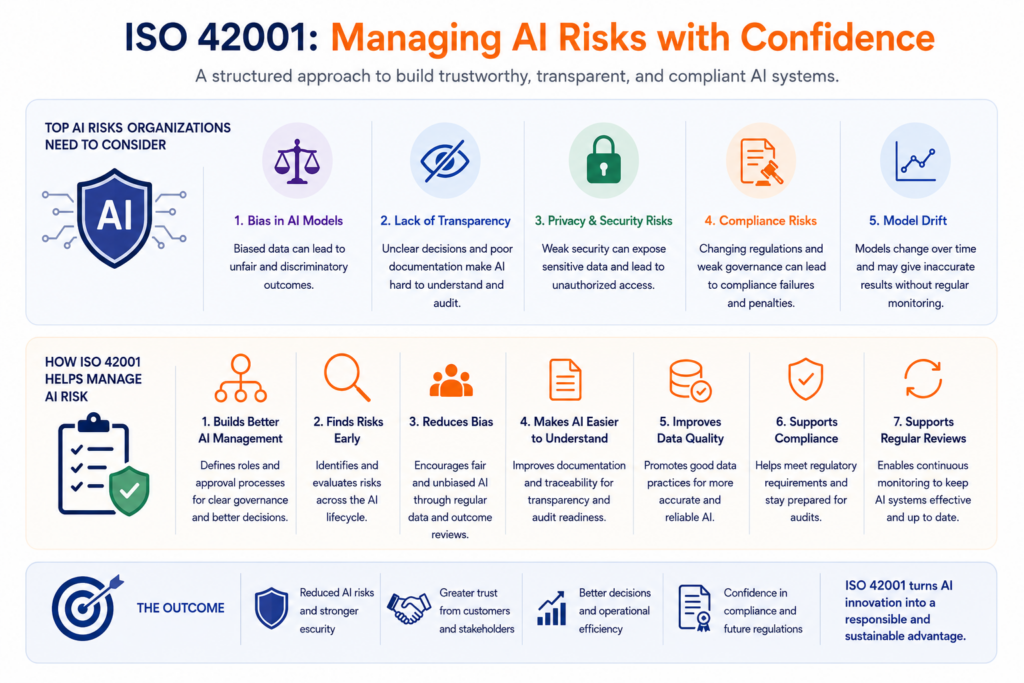
Top AI Risks Organizations Need to Consider
Today, AI is helping businesses save lots of time and make better decisions. From customer service to fraud detection, AI can help. But it also comes with different risks, and if organizations ignore these risks, they can face different issues such as compliance issues, lack of security, loss of customer trust, etc. Understanding these challenges early makes it easier to manage them before they affect the business.
1. Bias in AI Models
AI learns from historical data, and if it contains biased data, then it can give repetitive results. This is a serious concern in areas such as hiring, banking, healthcare, and insurance.
Regular reviews can help organizations identify:
- Biased training data
- Unfair outcomes
- Unequal treatment of users
Finding Bias early helps build greater confidence in AI systems.
2. Lack of Transparency
AI systems are not fully transparent, as some AI systems still don’t provide the source of their answers. This makes it difficult for business leaders, customers, and regulators to understand the decision.
Organizations need proper documentation for:
- Training data
- AI models
- Decision logic
- Model updates
Clear records make AI easier to understand and support audits to meet compliance requirements.
3. Privacy and Security Risks
AI systems manage a large amount of data. Weak security controls may allow attackers to get access to your sensitive information.
Some common security risks include:
- Data leakage
- Unauthorized access
- Weak access controls
- Prompt injection attacks
To minimize these risks, organizations should use strong access controls and regular security reviews.
4. Compliance and Regulatory Risks
AI rules face continuous change. So, organizations should understand how their AI systems work. Without proper governance, meeting compliance and rules becomes complex.
Some common compliance risks include:
- Changing AI regulations
- Weak AI governance
- Missing documentation
5. Model Drift and Continuous Monitoring
AI models change over time as they process new data, and this also changes their performance. A model that works well today may not give the same results a few months later.
It helps organizations:
- Detect performance issues
- Review model accuracy
- Identify new risks
- Improve AI reliability
Being ISO 42001 compliant is a must. Regular monitoring keeps AI systems effective and reliable. It also helps organizations find risks before they impact the business.
How ISO 42001 Helps Organizations Manage AI Risk
AI risks can appear at every stage. Risks may be seen while training models, collecting data, or making decisions. Without proper governance, organizations can lose customer trust, business performance, and compliance security. ISO 42001 offers a structured way that assists organizations in identifying, managing, and reducing such risks.
1. Builds Better AI Management
Many organizations use AI across different teams. But not everyone knows who is responsible for managing it. This can create confusion when problems appear. ISO 42001 creates a clear governance framework. It defines roles and approval processes for AI systems. It helps business leaders, security teams, and developers work under a single governance model. This reduces operational risks and improves decision-making.
It helps organizations:
- Define team responsibilities
- Set clear approval steps
- Improve teamwork
- Make better decisions
2. Finds Risks Early
AI problems are easier to fix before the system goes live. Waiting until customers complain or regulators ask questions can increase business risk. ISO 42001 helps organizations review AI systems from the beginning and continue checking them over time.
It reviews areas such as:
- Data quality
- Model accuracy
- Security
- Privacy
- Business impact
- Legal requirements
3. Reduces Bias
Bias is one of the biggest issues in AI. AI models learn from existing or historical data. And if the data contains Bias, it may create incorrect decisions. ISO 42001 helps organizations review their data and test AI results on a regular basis.
Key focus areas include:
- Training data
- AI results
- Fair decisions
- Regular reviews
4. Makes AI Easier to Understand
Many AI models work like a “black box. They generate decisions, but users don’t know how these decisions are created. This becomes a serious challenge during regulatory reviews and audits.
ISO 42001 helps organizations in better documentation throughout the AI lifecycle. So, organizations record how models are developed, what data is used, and why important design decisions are made.
It makes AI decisions easier to understand. Leaders can also explain these decisions to customers, regulators, and auditors.
This helps improve:
- AI records
- Decision tracking
- Audit preparation
- Customer confidence
5. Improves Data Quality
Good AI starts with good data. Poor data can lead to poor results. It can also affect business decisions and customer experience. ISO 42001 helps organizations manage data in a better way before AI systems are used. It enhances clear processes for data operations and supports stronger compliance with privacy and data protection requirements.
It supports:
- Better data quality
- Accurate results
- Better decisions
- Stronger compliance
6. Supports Compliance
AI rules continue to change. Businesses now face increasing pressure for proper AI adoption and its governance. So, organizations need a simple way to keep up with new requirements. ISO 42001 helps teams maintain records, review risks, and prepare for audits. It helps organizations stay ready for audits and meet compliance needs.
It helps organizations:
- Meet compliance needs
- Prepare for audits
- Keep proper records
- Respond to new rules
7. Supports Regular Reviews
AI systems change as they process new data. Due to this, they need regular checks. ISO 42001 helps in continuous monitoring throughout the AI lifecycle. It further assists organizations in assessing new risks and updating controls when required. This continuous process keeps AI systems aligned with business goals and reduces operational risks.
Regular reviews help organizations with:
- Check AI performance
- Find new risks
- Improve reliability
- Keep AI up to date
Join our weekly newsletter and stay updated
Conclusion
In today’s AI-driven competitive world, responsibility is a big advantage. It is not just about avoiding penalties because ISO 42001 also ensures your AI system is transparent and reliable. Ignoring ISO 42001 means losing customer and stakeholder trust and increasing legal trouble. Adopting it means securing your business reputation and enabling safe innovation.
At Kratikal, we help organizations implement ISO 42001 with practical guidance and security expertise. From risk assessments to compliance support, our team helps you build a stronger AI management system that is ready for today’s risks and tomorrow’s regulations.
FAQs
- How does ISO 42001 differ from other AI governance frameworks?
Unlike principle-based AI guidelines, ISO 42001 is a more structured way of management, which outlines the process, roles, approach to risk assessment, documentation, and continual improvement practices. It helps organizations implement AI responsibly.
- Which AI risks does the standard help organizations manage?
The framework helps to find and resolve the threats of data privacy and model bias, cybersecurity, erroneous outputs, regulation adherence, lack of transparency, and failures.
- Can ISO 42001 be integrated with existing governance and security programs?
Yes. Organizations can map the ISO 42001 standard to the current information security, privacy, compliance, and enterprise risk management programs.
- Is implementing the standard slow AI innovation?
Not necessarily. Clear governance allows the teams to innovate more confidently through the creation of a clear approval process, accountability, and risk controls. This minimizes uncertainty and assists organizations in rolling out AI solutions more consistently and responsibly.
- Is ISO 42001 relevant for organizations using third-party AI solutions?
Absolutely. Organizations remain responsible for the risks associated with the third-party AI systems. The framework assists in evaluating the vendors, setting the expectations of governance and performance, and managing the risks of third-party AI throughout the relationship.
- What are the long-term business benefits of adoption?
The impact of this standard on organizations enhances the confidence of stakeholders, gaps in governance are minimized, operational stability is attained, and a patterned approach to responsible AI control is developed. These advantages promote innovation and resilience of the business over time.
- How should organizations prepare before pursuing ISO 42001?
Before its implementation, organizations should undertake the current uses of AI, the state of governance and policies in existence, risk management- related agreements, and mandatory adherence. Developing an awareness of these areas can determine the gaps and provide a realistic roadmap for embracing ISO 42001.