Vulnerability Scanning helps you find possible weaknesses in your assets, whereas autonomous pentesting dives deeper, taking the role of an expert pentester, along with vulnerability scanning and vulnerability management, all in a single platform. Now, the question that gives birth to it – ‘We perform VAPT once or twice a year, so which tool or platform should we go for so that it does not conflict with our security balance sheet?’ What if you get all in one platform? We will discuss more about it in the later section of the blog. Let’s dive into more details on – “Autonomous Pentesting vs Vulnerability Scanning”
Autonomous Pentesting and Vulnerability Scanning – An Overview
Your scanner reports a long list of vulnerabilities. Which five could an attacker use to reach your most critical assets this week? A vulnerability scanning misses that. That gap sits at the heart of autonomous pentesting vs vulnerability scanning, and it is why many organizations look secure on paper but stay exposed in practice. The pressure is rising: Picus Security reports 36,971 CVEs were published in Q3 2026, more than three times the prior year. Counting problems is no longer enough. You need to know which ones matter.
Flaws are being published faster than teams can fix them, so proof matters more than volume. The smartest approach is layered:
- Vulnerability Scanning or DAST for breadth.
- Autonomous pentesting for depth.
- Expert-led Pentesting (PTaaS) for judgment.
Kratikal combines all three in one program through its AI-Driven Pentest and VM Platform, AutoSecT.
Difference Between Autonomous Pentesting and Vulnerability Scanning?
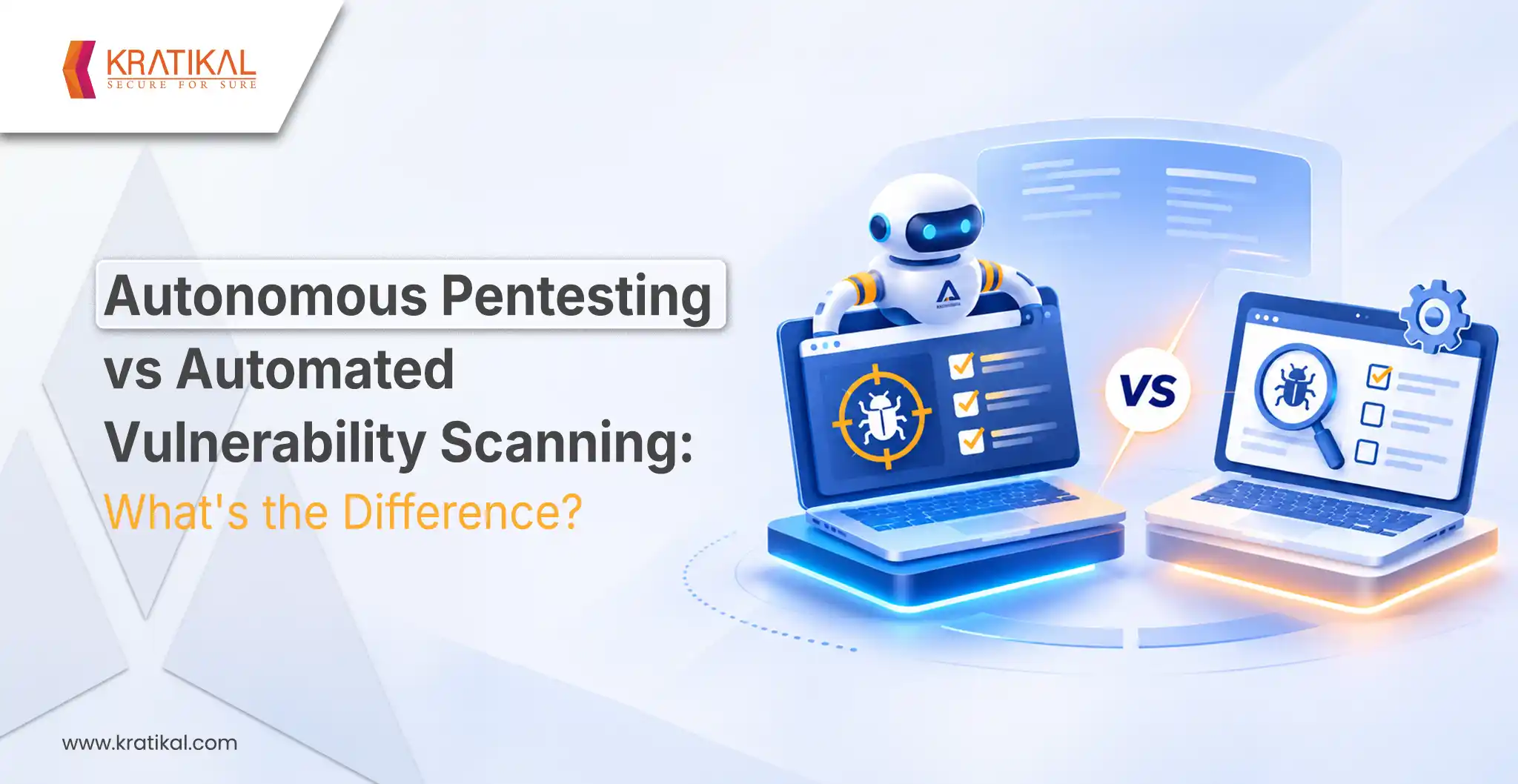
Automated vulnerability scanning checks your inventory against a database of known flaws and reports what might be exploitable. Autonomous pentesting uses AI agents to plan and carry out real attack steps, chain weaknesses together, and prove which ones lead to actual damage. Scanning finds possible problems. Autonomous pentesting proves real ones.
How Vulnerability Scanning Works and Where It Stops
A vulnerability scanner is like a security guard walking the building with a checklist. It tries every door, notes which locks look old, and writes a report. It is fast, cheap and repeatable, and it should run all the time.
But it only knows what is on its list. It compares software versions and settings against known vulnerabilities, so it flags a flaw without confirming anyone can use it. Three things follow:
- Findings that look serious but cannot be exploited in your setup waste your team’s hours.
- Flaws in your own application logic are not in any database, so they go unseen.
- A scanner rates each issue alone. It will not notice that a “Medium” flaw plus a “Low” flaw hands an attacker your cloud credentials.
How Autonomous Pentesting Works
Autonomous pentesting behaves less like a guard with a checklist and more like a junior ethical hacker who never sleeps. AI agents map your environment, choose their next move based on what they find, try the exploit, and keep going. Each step builds on the last.
A typical run looks like this:
- Discover your assets, services and entry points.
- Probe them for weaknesses, including misconfigurations and weak credentials.
- Exploit the flaws, safely.
- Chain the results into a path toward sensitive assets or data.
- Report only what was proven, with evidence and fix guidance.
The output changes from “here are 4,000 possibilities” to “here are the five paths that lead to your crown jewels, and here is the proof.”

Book Your Free Cybersecurity Consultation Today!
Autonomous Pentesting vs Vulnerability Scanning – A Comparative Analysis
| Particulars | Vulnerability Scanning | Autonomous Pentesting |
| Core question | What might be wrong? | What can an attacker actually do? |
| Method | Matches against known-flaw databases | AI agents plan, exploit and provide remediation suggestion |
| Output | Long list of findings | Proven attack paths with evidence |
| False Positives | Possible | Near-zero |
| Best for | Broad, frequent coverage | Depth and prioritisation |
| Frequency | Daily or weekly | Continuous or on every major change |
AutoSecT for Vulnerability Scanning and Autonomous Pentesting
The layered approach above works best when it lives in one platform, not two disconnected tools. AutoSecT, Kratikal’s AI-driven pentesting and vulnerability management platform, brings vulnerability scanning, autonomous pentesting and expert-led testing together.
Scanning that arrives pre-verified.
AutoSecT scans web applications, mobile apps, APIs, cloud environments and networks. Before a finding reaches an analyst, AI verification checks it, so teams stop triaging noise. Purpose-built small language models trained on real-world penetration tests work with retrieval-augmented, agentic AI. The platform ranks findings by actual risk, confirms they are exploitable, and recommends a specific fix for each.
- Web DAST: Start from a single URL. AutoSecT tests live pages, forms, scripts and in-app APIs, including authenticated scans of logged-in workflows.
- API DAST: It actively probes REST APIs and pairs this with static analysis. Validated, pipeline-native findings can gate a build without slowing delivery.
Autonomous pentesting that works like a team.
AI agents run in sequence, each handing its output to the next: reconnaissance, attack vector mapping, exploitation, validation, recommendation and reporting. Every confirmed finding comes with a proof of concept. Network autonomous penetration testing is agentless and IP-based, so you can test internal and external networks without installing anything.
From finding to fix.
Vulnerabilities move through discovery, prioritisation, assignment, remediation and retesting in one place, tracked by severity (Critical, High, Medium, Low), owner and status. The Vendor Vulnerability Management Hub brings third-party vendors into the same workflow. Integrations with Jira, Slack, Microsoft Teams, Google Chat, Zoho Cliq and Zoho Sprint put issues inside the tools your engineers already use.
Audit-ready by default.
Password-protected PDF and Excel reports and digitally verifiable VAPT certificates map findings to ISO 27001, NIST CSF 2.0, SOC 2, etc. Security leaders also get one centralized view of risk instead of scattered scan reports.
Humans stay in the loop.
Automation brings consistency and speed, while expert-led manual testing keeps the accuracy that business logic flaws demand. AutoSecT is built to give you both.
Join our weekly newsletter and stay updated
Conclusion
Vulnerability scanning and autonomous pentesting answer two different questions. A scanner tells you what might be wrong. Autonomous pentesting tells you what an attacker can actually do. With CVEs being published faster than most teams can patch, knowing which flaws matter is now more valuable than counting them all.
The best approach is layered. Use vulnerability scanning or DAST for breadth, autonomous pentesting for depth, and expert-led pentesting (PTaaS) for judgment on complex business logic. Running all three through separate tools adds cost and gaps, so Kratikal’s AutoSecT brings them together in one AI-driven platform. You get verified findings, a clear remediation path, and audit-ready reports, all in a single view.
FAQs
- What is the difference between autonomous pentesting and vulnerability scanning?
Vulnerability scanning checks your assets against a database of known flaws and reports what might be exploitable. Autonomous pentesting uses AI agents to carry out real attack steps, chain weaknesses together, and prove which ones lead to actual damage.
- Can autonomous pentesting replace vulnerability scanning?
No. Scanning gives fast, frequent, wide coverage, while autonomous pentesting adds depth and prioritisation. They work best together, which is why a layered approach is recommended.
- Can autonomous pentesting replace manual penetration testing?
Not entirely. Automation brings speed and consistency, but business logic flaws still need the judgment of an expert tester. AutoSecT pairs autonomous testing with expert-led PTaaS so you get both.
- How often should organizations run vulnerability scans and autonomous pentests?
Run vulnerability scans daily or weekly, and autonomous pentests continuously or after every major change, such as a new release, a new asset or a configuration update. This replaces the old pattern of testing once or twice a year.
- What does AutoSecT offer for vulnerability scanning and autonomous pentesting?
AutoSecT scans web applications, mobile apps, APIs, cloud environments and networks. Its AI agents then verify and exploit findings and attach proof of concept. The platform also manages remediation from discovery to retest, integrates with tools like Jira, Slack and Microsoft Teams, and produces audit-ready reports and VAPT certificates