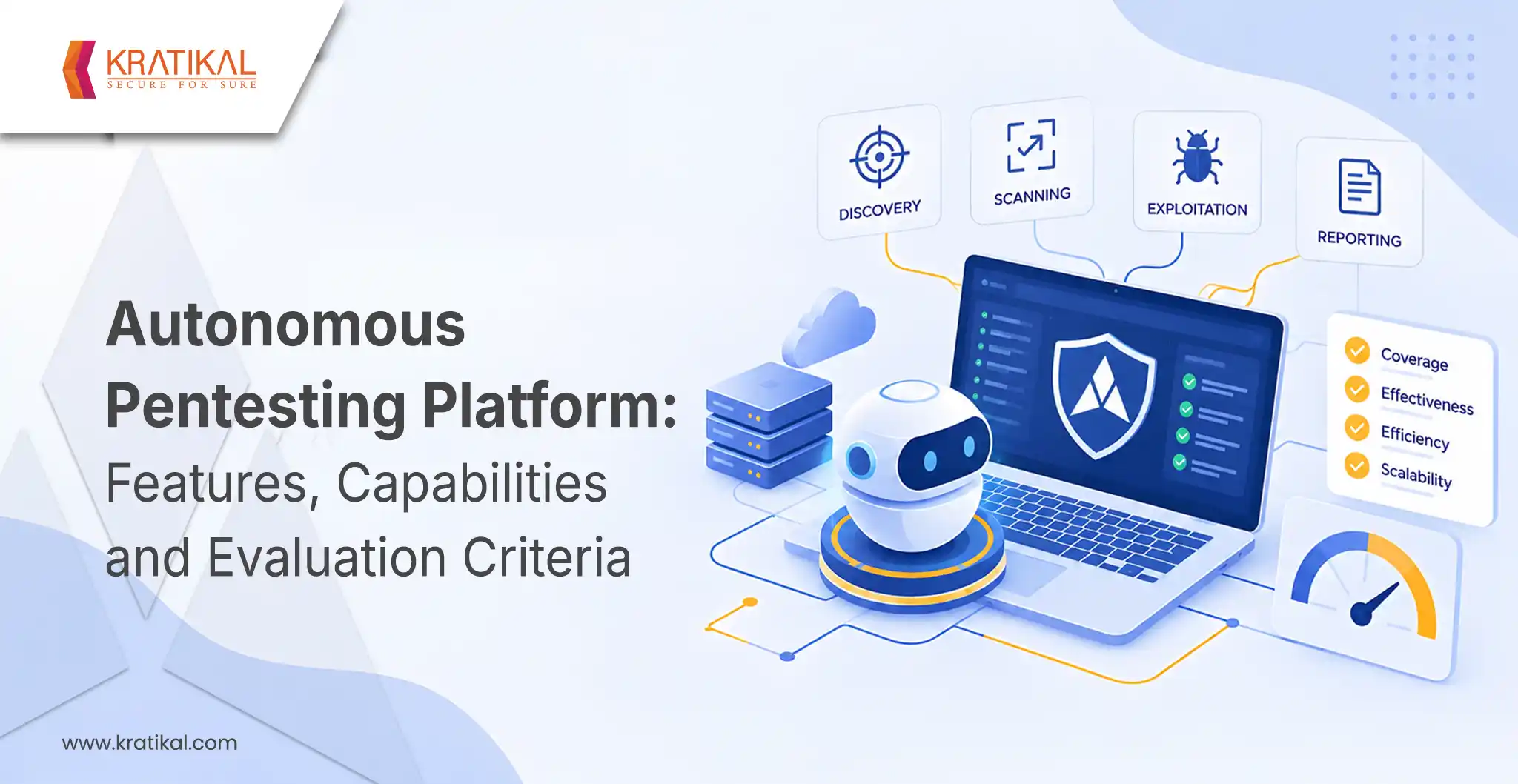
An autonomous pentesting platform uses AI agents to find, exploit and verify security weaknesses on its own, the way a human penetration tester would, but faster and on a schedule. AutoSecT does this for web applications and networks along with PTaaS for app sec(web app, mobile app, API), cloud and network as well as DAST. It then ranks the confirmed findings and suggests fixes your engineers can act on. In this post, we’ll walk through AutoSecT, Kratikal’s AI-driven pentest and VM platform, covering its autonomous pentesting feature, what it does, how it works, and what to ask when you evaluate it.
Autonomous Pentesting Platform AutoSecT Features
AutoSecT is closer to a fire inspector who checks whether there’s a real fire, how bad it is, and what to do about it. Let’s dive into the autonomous pentesting feature for web and network in detail:
Autonomous Web Application Pentesting
Someone has to map every page, form and login flow before testing starts. AutoSecT skips that step. You point it at a single URL and it maps the rest of the application itself. It also doesn’t stop at the public pages. It runs deep, authenticated pentests, which means it can log in and test the screens and workflows a real user or attacker would reach only after signing in. That matters because many serious bugs hide behind the login page.
Here’s what you get from the web scanner:
- Coverage of dynamic pages, forms, scripts, server-side pages and in-app APIs
- Both front-end and back-end risk assessed in one pass
- Prioritized findings, so developers fix what matters first instead of working through an unranked list
- Results structured for hand-off straight into a development workflow
Every finding also comes with AI-generated remediation guidance specific to that vulnerability, so developers aren’t left googling what to do next.
Agentless Autonomous Pentesting for Network
AutoSecT’s network autonomous scanner does IP-based discovery and scanning across both internal networks (inside your perimeter) and external networks (your internet-facing exposure). Because it works from IP addresses, it finds devices and hosts across the network, not just the assets you’ve already named.
The part that stands out is that it validates exploitability in real time and produces confirmed proofs-of-concept (PoCs). In plain terms, it shows you the weakness can be exploited instead of saying it might be. That changes the conversation with a busy engineering team: a demonstrated problem gets fixed faster than a theoretical one.
It is a RAG-powered, agentic AI pentesting for networks. That means the AI reasons over real-world vulnerability data instead of relying only on static, rule-based signatures.

Book Your Free Cybersecurity Consultation Today!
Other Important AutoSecT Features
AutoSecT PTaaS
AutoSecT’s PTaaS pairs expert-led manual testing with the AutoSecT platform. It covers eight asset types: web applications, including authenticated workflows; Android and iOS mobile apps, from source code to running binaries; internal and external networks; AWS, GCP and Azure cloud configurations; REST APIs; blockchain smart contracts; AI and LLM systems; and standalone manual secure source code review.
Web DAST
Dynamic Application Security Testing (DAST) for web applications. Give it just one URL, and it tests your live application from the outside, covering pages, forms, scripts, and in-app APIs. It also runs deep, authenticated scans that go through logged-in workflows. You get back prioritized findings that are ready for DevSecOps teams to act on.
API DAST
APIs are where a lot of modern application logic lives, so AutoSecT’s API DAST module (Dynamic Application Security Testing) is worth a closer look. It tests REST APIs by actively calling and probing them, and pairs this with static analysis for broader coverage. The aim is to surface real, exploitable issues and deliver validated, pipeline-native findings. Your results can then gate a build without slowing delivery.
Autonomous Pentesting Platform AutoSecT Capabilities
AutoSecT is a full AI-driven vulnerability management platform, not just a scanner. A few capabilities that makes it one-of-a-kind are:
- Centralized dashboard: every project in one place, with an overall risk-score view.
- Smart Scan Scheduler: set start times and recurrence so scanning happens consistently without anyone remembering to click “run.”
- CI/CD integrations: automatically trigger DAST scans so security keeps pace with releases.
- Verifiable online VAPT certificate: a completion certificate that can be checked online once a testing cycle closes.
- Co-branded reports: reports that carry your organization’s identity alongside AutoSecT’s.
- Multi-asset project management: organize assets, projects and assignments in one place.
- SSO-based access: sign in through your existing identity setup.
- Scalable and customizable: configurable for teams from growing startups to large enterprises.
Problems Autonomous Pentesting Platform AutoSecT is Built to Solve
Here’s how the platform maps to the ones security teams complain about most:
- Alert fatigue: the AI verification step filters out false positives before they reach an analyst.
- Scattered tools: instead of separate tools for web, mobile, API, cloud and network testing, everything lives in one inventory and one dashboard.
- Slow triage: AI analysis and recommendations shorten the gap between finding a vulnerability and fixing it, which reduces mean time to remediation.
- Messy tracking: a structured lifecycle (Critical, High, Medium, Low) with ownership and status keeps fixes accountable from discovery through retest.
- Third-party blind spots: the Vendor Vulnerability Management Hub brings development, network and cloud vendors into the same remediation workflow.
- Audit overhead: password-protected PDF and Excel reports, plus digitally verifiable VAPT certificates, align findings to frameworks like ISO 27001, NIST CSF 2.0 and SOC 2.
- Disconnected workflows: integrations with Jira, Slack, Microsoft Teams, Google Chat, Zoho Cliq and Zoho Sprint put vulnerabilities inside the tools engineers already use.
Autonomous Pentesting Platform AutoSecT Evaluation Criteria: The AI Agent Pipeline
This is the core of the platform. AutoSecT runs six AI agents in sequence, and each one hands its work to the next:
- Reconnaissance: maps your app’s entire architecture to understand its business logic.
- Attack Vector Mapping: identifies attack vectors using in-house small language models (SLMs) plus known vulnerability intelligence.
- Exploiting: exploits the attack parameters found in step two and checks the impact.
- Validating: performs AI-based false-positive vetting.
- Recommending: provides AI-driven remediation for each verified finding.
- Reporting: generates detailed reports with PoCs in the formats your clients or auditors need.
How to Evaluate an Autonomous Pentesting Platform?
Whether you’re considering AutoSecT or comparing it with other tools, these are the questions worth asking:
| Questions | What to Look For | Does AutoSecT Qualify? |
| Does it prove exploitability? | Look for confirmed PoCs, not just a list of possible issues. | Yes |
| How does it handle false positives? | Ask whether verification happens inside the platform before findings reach your team. | AI-based false-positive vetting |
| Can it test behind the login? | Authenticated scanning is where many real risks sit. Check that the tool handles logged-in workflows, not only public pages. | Yes |
| How much setup does it need? | Single-URL onboarding means less manual mapping before your first scan. | Single-URL onboarding |
| Does it cover all your assets? | Web, API and network in one view beats juggling separate tools. | Yes |
| Does it fit your engineering workflow? | Check for CI/CD triggers and integrations with the tools your developers use daily. | Yes |
| Are the fixes specific? | Generic advice slows teams down. Remediation guidance should be tied to each individual finding. | Yes |
| Will it satisfy your auditors? | Look for audit-ready reports and certificates that map to the frameworks you’re held to. | Yes |
| Does it track the full lifecycle? | Severity, ownership, status and retest should all live in one place. | Yes |
Join our weekly newsletter and stay updated
Key Takeaways
AutoSecT autonomous pentesting combines web and network testing in one platform, with an AI pipeline that ends in verified findings and PoCs. Its biggest practical benefit is cutting false positives, so teams spend time fixing real issues. Integrations, CI/CD triggers and audit-ready reports make it easier to fit into existing workflows and compliance programs. When evaluating any platform, ask about exploit validation, authenticated scanning, asset coverage and workflow fit.
Book a demo to see AutoSecT in action!
FAQs
- What does AutoSecT stand for in practice?
It’s Kratikal’s autonomous pentesting and vulnerability management platform, covering web, API and network testing with AI-verified findings.
- Can it scan internal networks?
Yes. The network scanner covers both internal and external assessments.
- Can it test applications that need a login?
Yes. It runs deep, authenticated scans of logged-in workflows.