
Business expansion creates new opportunities, but it also brings new responsibilities. With organizations scaling to new markets, switching to cloud solutions, and handling increased volumes of customer data, privacy management becomes much more complicated. What works for a small organization may no longer work as the business grows. A majority of organizations believe that compliance with GDPR is primarily a legal obligation. In reality, it has become a business-critical governance issue. Compliance gaps can reveal sensitive customer data, interfere with operations, and initiate regulatory inquiries. As digital ecosystems continue to get more connected, small gaps in data management can have significant operational and financial consequences. This article presents a GDPR compliance audit checklist that is used by growing businesses to develop a more robust privacy framework and stay ready to meet the changing regulatory requirements.
GDPR Compliance Audit Checklist for 2026
An effective GDPR compliance audit looks beyond policies and documentation. It determines the consistency of privacy principles among people, processes and technology. The checklist below can help pinpoint those areas that every developing business must evaluate frequently.
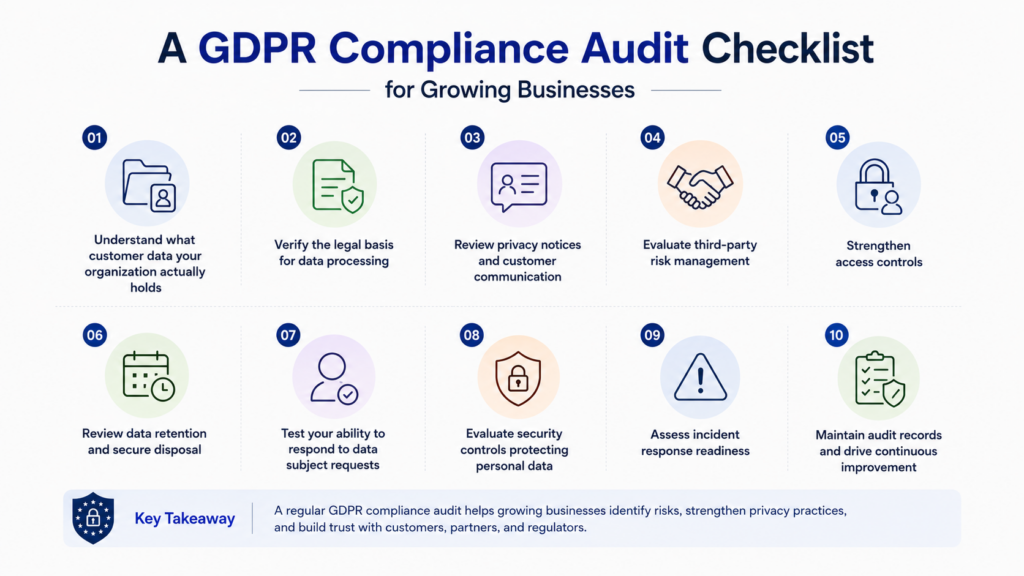
- Understand What Customer Data Your Organization Actually Holds
Most companies consider themselves aware of the location of customer data until they start mapping out data during an audit. When a business grows, customer data ends up being distributed throughout CRM systems, human resource software, cloud-based applications, marketing software, customer service applications, and third-party programs. Such a fragmented data environment complicates the implementation of uniform privacy controls or quick responses to regulatory calls.
A GDPR compliance audit should begin with a comprehensive review of the organization’s data inventory. Business leaders are advised on what customer data is gathered, why it is done, where it is stored, whether it can be viewed by other parties and how long it is kept. Without this visibility, compliance to GDPR requirements would be much more challenging. Proper documentation of processing operations enables businesses to determine unnecessary data collection, removal of duplicate entries, and enhance data management.
- Verify the Legal Basis for Data Processing
A significant amount of compliance gap occurs when organizations expand their service without reevaluating the purpose of collecting customer data. New products, marketing campaigns, and online services tend to add more processing activities that might no longer comply with the conditions of GDPR.
As part of a GDPR audit, companies must consider whether every data processing activity has a valid legal basis. This review is useful in ensuring that personal information can only be gathered when it has a justifiable business or regulatory reason. Businesses also need to reconsider whether they are gathering excess information or not. Adherence to the principle of data minimization will lessen compliance requirements and decrease cybersecurity risks.
- Review Privacy Notices and Customer Communication
Privacy notices are usually prepared at an initial stage of GDPR implementation but are not updated regularly when the business changes. Nevertheless, businesses routinely roll out new services, add new third-party integrations, and enter new markets, so obsolete privacy notices are a widespread compliance challenge.
A GDPR compliance audit must ensure that privacy notices reflect the current data processing practices and clearly convey:
- What sensitive information is collected
- Why it is collected
- Who is the recipient of the information
- How long it is retained
- The rights available to individuals
Clear and transparent communication enhances customer confidence and supports regulatory compliance.
- Evaluate Third-Party Risk Management
Businesses are becoming more reliant on cloud platforms, SaaS services, payroll firms, payment platforms, and marketing consultancies to store and handle sensitive information. Although such partnerships enhance efficiency in operations, they present more compliance obligations. Most businesses believe that vendors have the sole duty to safeguard customer information. Under GDPR, however, companies are responsible when third parties process any customer data on their behalf.
Vendor security controls, contractual obligations, and operating compliance monitoring should thus be the subject of a GDPR audit. Frequent vendor reviews help to mitigate supply chain risks and enhance the overall privacy governance.
- Strengthen Access Controls
As an organization increases in size, the issue of access control by users becomes complicated. Employees switch positions, contractors finish work, and vendors are given temporary authorizations. Unless periodically reviewed, these unnecessary privileges accumulate with time and become more of a security risk for the organization.
A GDPR compliance audit must consider whether access controls still facilitate valid business objectives. The concept of least privilege will make sure that employees have access to the minimum information necessary to perform their duties. Privileged accounts should also be reviewed by the companies on a regular basis since they pose some of the greatest risks in the case of security incidents.

Book Your Free Cybersecurity Consultation Today!
- Review Data Retention and Secure Disposal
With the growth of a business, old customer records build up over time, employee data, marketing databases, and archived documents across various systems. Storing redundant sensitive information raises storage expenses, complexity in operations, and regulatory risk. A GDPR audit is supposed to check whether the organization has well-set retention periods for various categories of personal data. Businesses should retain information as long as it is viable to suit legitimate business purposes or comply with legal requirements.
Businesses should also assess whether:
- Utilization of retention policies.
- Legacy applications do not store any unnecessary customer data.
- Backup environments comply with the same retention requirements.
- Restore deleted information only with permission from the concerned authority.
- Test Your Ability to Respond to Data Subject Requests
As businesses grow, customer data spreads across different systems and teams. This makes it complex to find and manage sensitive information when someone requests access, correction, deletion, or data transfer. Delays can lead to compliance issues and increase regulatory risk. A GDPR audit checks whether your teams, processes, and systems can respond to these requests within the required timelines. This helps businesses stay compliant, improve customer trust, and prepare for regulatory reviews. A GDPR compliance audit must assess the presence of workflows that allow the teams to find personal information promptly, confirm requests, and address statutory deadlines. Effective request management improves compliance and customer trust.
- Evaluate Security Controls Protecting Personal Data
Without effective cybersecurity measures, there can be no privacy. A GDPR audit should enable businesses to determine whether the security controls that are currently in place can protect sensitive information against new cyber threats. Special focus must be on security measures that would directly mitigate the risk of unauthorized access or loss of data.
A good review must cover:
- Vulnerability assessments
- Penetration testing
- Encryption controls
- Security monitoring
- Backup and recovery measures
- Assess Incident Response Readiness
Many organizations invest in preventing cyberattacks but spend less time preparing to respond. Late breach detection or an incomplete process of communication usually adds regulatory and financial implications. A GDPR compliance audit must consider whether the incident response procedures have explicitly defined responsibilities in advance, during, and after a data breach. Companies must also ensure that regulatory notification specifications can meet GDPR reporting timelines.
Why Choose Kratikal for GDPR Compliance Services?
Kratikal is a CERT-In Empanelled security auditor with deep, hands-on experience with the regulatory challenges organizations face under GDPR. Our certified compliance experts have a strong command of international IT frameworks and data protection laws. Rather than offering generic checklists, Kratikal builds a tailored GDPR roadmap around your organization, starting with data discovery, moving through Data Protection Impact Assessments, and continuing into full program implementation covering breach management, privacy by design, and third-party risk.
Our engagement doesn’t end at go-live: ongoing monitoring, regular audits, staff training, and compliance documentation ensure your GDPR posture stays current as regulations and your business evolve. With Kratikal, GDPR compliance becomes a sustained capability, protecting your organization from regulatory penalties and reputational risk alike.
Join our weekly newsletter and stay updated
Conclusion
As the business expands, the complexity of personal information management will rise. Privacy governance is an ongoing process. A periodic GDPR compliance audit can help an organization detect new risks and avert regulatory fines, business disruptions, or negative publicity. More to the point, it also assists the business leaders in developing enhanced governance, making better decisions, and building trust with customers, partners, and regulators.
FAQs
- What is a GDPR compliance audit?
A GDPR audit is used to determine the extent to which the data protection practices within a particular organization are compliant with the General Data Protection Regulation. It may be applied to identify the gaps in compliance, strengthen the privacy settings, and reduce regulatory risks.
- Why do growing businesses seek to perform GDPR audits on a regular basis?
The expanding companies continuously require new technologies, suppliers and data processing operations that may bring about compliance risks. Regular audits provide assurance that the privacy controls are functioning as intended and promote business development.
- Who should perform a GDPR compliance audit?
Internal assessments are possible in organizations, but independent cybersecurity and compliance experts offer more objective assessments. External audits assist in uncovering neglected risks and suggest feasible remediation measures.
- What are the most challenging aspects when conducting a GDPR audit?
The most prevalent issues are missing data inventories, ineffective vendor management, outdated privacy notice and inconsistent documentation. Maintaining compliance presents a challenge to many organizations as business activities and technologies keep on changing.
- How is a GDPR compliance audit going to improve cybersecurity?
A GDPR compliance audit takes into account the efficiency of the security controls in relation to protecting the customer data against any form of unauthorized access, loss, or misuse. It also helps organizations to become more governance-driven, reduce vulnerability and enhance incident preparedness.
- What is the frequency of organizations conducting a GDPR compliance audit?
Organizations are advised to carry out a GDPR audit at least once per year or whenever there is a significant change in operations, technology or in the regulatory environment. One can maintain compliance, through periodic reviews, and reduce privacy threats that may occur.
- How can Kratikal help organizations achieve GDPR compliance?
Kratikal assists companies in enhancing their privacy programs with GDPR compliance audits, security testing, policy reviews, and employee training. Its cybersecurity professionals offer feasible remediation advice to facilitate long-term regulatory compliance.