
Cybersecurity reports consistently show that application-layer flaws remain one of the leading causes of enterprise breaches, with OWASP Top 10 (2021) ranking Software and Data Integrity Failures (A08), which includes insecure deserialization, among the most critical web application risks. At the core of this category lies CWE-502 (Insecure Deserialization), a well-documented weakness that continues to be widely exploited in the attack chains.
Enterprise systems today run on highly distributed architectures, microservices, APIs, cloud-native applications, and multiple third-party integrations working in sync. While this ecosystem improves scalability, speed, and flexibility, it also significantly broadens the potential attack surface. Among the many security risks that emerge in such environments, one of the most overlooked yet severe is Insecure Deserialization.
This vulnerability can allow attackers to manipulate serialized data streams to execute unauthorized actions, escalate privileges, or even achieve remote code execution, making it a high-impact risk in enterprise application security.
Breaking Down Insecure Deserialization
To understand Insecure Deserialization, we first need to understand serialization. Serialization is the process of converting complex objects (like user sessions, configuration data, or API responses) into a format that can be stored or transmitted, such as JSON, XML, or binary formats.
Deserialization is the reverse process: reconstructing the object back into its original form when needed. Insecure Deserialization occurs when untrusted or tampered data is deserialized without proper validation or integrity checks. When this happens, attackers can manipulate serialized data to inject malicious objects or commands that the system unknowingly executes.
How Attackers Exploit Deserialization?
Enterprise systems are particularly vulnerable because they typically handle large volumes of serialized objects across distributed architectures. Java, PHP, Python, Ruby, and .NET applications all serialize objects differently, but each has its own history of critical deserialization vulnerabilities that attackers actively exploit.
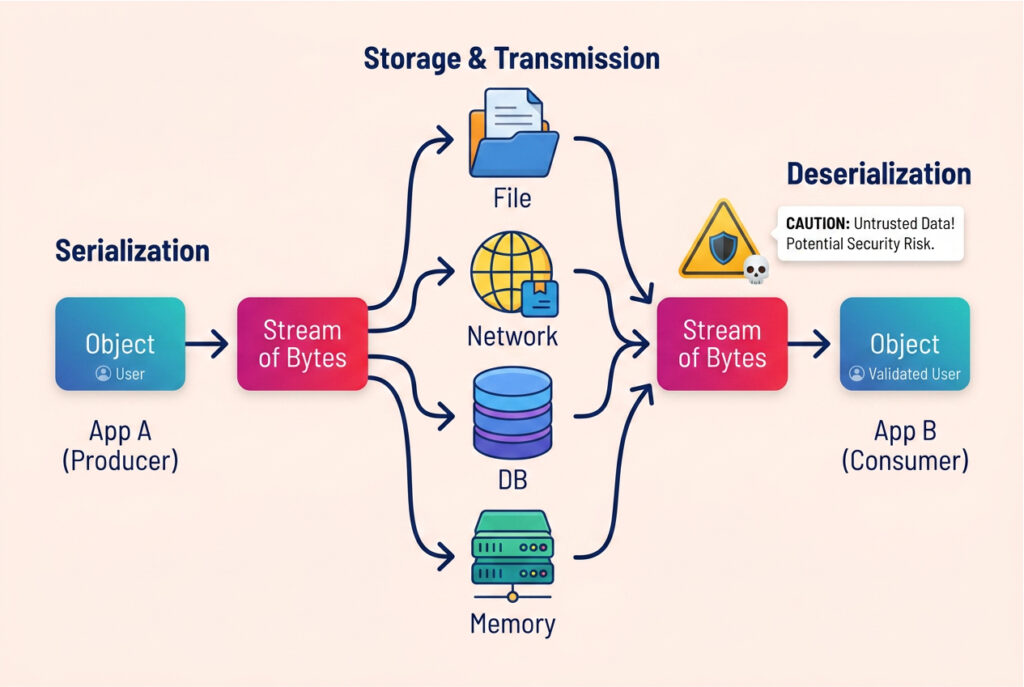
Consider a Java enterprise application that stores session tokens as serialized objects. When a user logs in, the application serializes their session and sends it as a cookie. If the application blindly deserializes this cookie on each request, an attacker can craft a malicious serialized payload, sometimes called a “gadget chain,” using libraries already on the server’s classpath. The deserialization process itself triggers a chain of method calls that ultimately executes attacker-controlled commands.
| Kratikal helps organizations identify insecure deserialization flaws, simulate attack scenarios, and validate whether existing controls are strong enough to prevent exploitation. This strengthens the overall application security posture before attackers can take advantage. |
Common Enterprise Attack Vectors
Insecure deserialization in enterprise systems creates a broad and risky attack surface. The specific paths vary by language and architecture, but the following outcomes are consistently observed across breaches:
Remote Code Execution (RCE):
The most severe outcome. Attackers inject payloads that execute system commands on the server, enabling full compromise of the host machine, data exfiltration, and lateral movement across the network.
- Authentication bypass:
Tampered session objects can grant attackers administrative privileges. If role data is embedded in a serialized session cookie and trusted without server-side verification, an attacker can simply modify “role: user” to “role: admin.”
- Server-Side Request Forgery (SSRF):
Deserialization payloads can trigger internal HTTP requests, allowing attackers to probe internal services, cloud metadata endpoints (e.g., AWS IMDSv1), or access internal APIs hidden from the internet.
- Denial of Service (DoS):
Deeply nested or circular object graphs can exhaust CPU and memory during deserialization, crashing application servers and disrupting business operations at scale.
- Privilege escalation and lateral movement:
Once inside, attackers leverage deserialization flaws to move through internal microservices, targeting systems that trust serialized tokens passed between services.
Join our weekly newsletter and stay updated
Enterprise Breaches Driven by Deserialization
The consequences of insecure deserialization are not theoretical. In enterprise environments, the impact can be catastrophic:
The Equifax Breach
The Equifax breach stands as one of the most consequential cybersecurity incidents in history. Attackers exploited a vulnerability in Apache Struts, a widely used Java web framework, which carried a deserialization component that allowed untrusted object data to be processed by the server without validation.
The result was catastrophic. Attackers gained persistent access to Equifax’s internal systems over a period of 78 days, silently exfiltrating names, Social Security numbers, birth dates, addresses, and credit card data before the breach was even detected.
Oracle WebLogic Server
Oracle WebLogic Server, deployed across thousands of enterprise environments for mission-critical Java EE applications, was struck by multiple critical deserialization vulnerabilities in rapid succession. CVE-2019-2725 and CVE-2020-14882 each earned CVSS scores of 9.8 out of 10, reflecting their ability to achieve unauthenticated remote code execution with no user interaction required.
Ransomware groups and nation-state threat actors actively weaponized these flaws within days of public disclosure. Attackers deployed cryptominers, ransomware payloads, and persistent backdoors on compromised WebLogic hosts, often moving laterally into connected enterprise systems before defenses could respond.
Jenkins CI/CD Server Exploits
Jenkins, the dominant open-source CI/CD automation server in enterprise DevOps pipelines, has been a repeated target of Java deserialization attacks across multiple vulnerability cycles. Because Jenkins orchestrates build, test, and deployment workflows, it typically holds elevated permissions and broad network access to both development and production systems.
Defending Against Insecure Deserialization
Preventing Insecure Deserialization requires a layered security approach. Since this vulnerability often exists deep within application logic, it cannot be addressed with a single fix.
- Avoid native object deserialization
Where possible, avoid native deserialization mechanisms provided by programming languages. Instead, use safer formats like JSON or XML with strict schema validation. This limits the risk of complex object structures being interpreted in unintended ways by the application.
- Restrict allowed class types (allowlisting)
If deserialization is required, ensure the application only accepts predefined and trusted class types. Allowlisting prevents unexpected or malicious objects from being instantiated during the deserialization process, reducing the attack surface significantly.
- Verify data integrity using signatures
All serialized data should be protected using cryptographic signatures. Before deserialization occurs, the system must verify that the data has not been altered. Any mismatch should immediately block processing to prevent tampered payloads from entering the system
- Isolate deserialization processes
Deserialization should run in a controlled, low-privilege, sandboxed environment. This containment ensures that even if an exploit occurs, its impact remains limited and does not affect critical systems or broader infrastructure.
Book Your Free Cybersecurity Consultation Today!

Building Secure Deserialization Practices into the SDLC
Sustainable security against insecure deserialization requires integrating controls into the software development lifecycle itself. Penetration tests and red team exercises should include deserialization gadget chain testing using tools like ysoserial (Java), Pickle exploit generators (Python), and phpggc (PHP). Developer training must close the knowledge gap. Many engineers who work daily with serialization do not recognize the security implications. Teaching teams to treat all serialized input from external sources as potentially hostile, applying the same scrutiny given to SQL queries or HTML output, fundamentally changes the defensive posture.
Conclusion
Insecure deserialization is not a niche concern; it is a systemic vulnerability embedded in the foundations of how enterprise software communicates. As organizations expand their microservice architectures, increase reliance on distributed systems, and inherit deeper third-party dependency chains, the attack surface only grows.
The path forward demands treating serialized data with the same distrust given to any user input: validate, sign, restrict, and monitor. Organizations that build these controls into their architecture today will be substantially more resilient against the insecure deserialization attacks that are, without question, still actively exploited across enterprise environments worldwide.
FAQs
- What is the best way to prevent Insecure Deserialization?
Avoid native deserialization when possible, use safe data formats like JSON, and implement strict validation and integrity checks.
- Why is insecure deserialization hard to detect?
Because the payload executes within the application’s own trusted process, making it difficult for traditional filters or WAFs to identify.
- Is Insecure Deserialization listed in OWASP Top 10?
Yes. It is included under Software and Data Integrity Failures (A08:2021) in the OWASP Top 10.
- What is the impact of Insecure Deserialization?
It can lead to remote code execution, data breaches, denial of service, and full system compromise.
- Which programming languages are most at risk?
Java, .NET, PHP, and Python are commonly affected due to native or unsafe serialization features.
- Can encryption prevent Insecure Deserialization?
No. Encryption hides data but does not prevent attackers from modifying or abusing serialized structures if integrity checks are missing.
- What role does authentication play in this vulnerability?
Even authenticated users can exploit insecure deserialization if the application blindly trusts serialized input.
- How does this differ from other vulnerabilities?
Unlike injection attacks, the payload is executed through object reconstruction, making it harder to detect using standard filters.