
Banks, financial institutions and fintech companies spend a lot of time and resources during a System Audit Report, during which they evaluate the security coverage and detect vulnerabilities as well as check regarding industry standards. Theoretically, these audits create a perfect understanding of the security posture of an organization as defined by RBI and NPCI. Nevertheless, most companies have found out that even after passing an audit, they still report a security breach, data theft, system interruption, or compliance breakdown. The question arising out of this disconnect is: What is the reason why so many audits do not indicate the actual security risks? This article explores why many audit programs fail to capture genuine risk exposure, common shortcomings in traditional assessments, and how businesses can make their security reviews more meaningful and effective.
Understanding the Purpose of a SAR Audit
SAR Compliance Audit is structured to review the security controls, risk management practices, compliance policy, as well as operational safeguards of an organization, mandated by regulatory bodies like the RBI or SEBI. This is to spot the areas of weakness and eliminate them before they develop into a serious threat. Verizon reported that vulnerability exploitation surged by 180% year-over-year, showing why point-in-time audits often fail to capture emerging risks.
An effective audit is expected to provide answers to the following important questions:
- Do we have security controls working?
- Are the current processes resistant to the contemporary form of cyber threat?
- Do employees adhere to security measures?
- Are there security measures in line with business risks?
- Does it have the appropriate protection of sensitive data?

Book Your Free Cybersecurity Consultation Today!
SAR Audits Fail to Reflect Real Security Risk – Here’s Why!
A huge gap between compliance and real protection is one of the largest factors that promotes failure of a SAR Compliance Audit. The average global cost of a data breach in 2025 was $4.44 million, highlighting the financial impact of ineffective security controls and risk management failures. Minimal requirements are set by compliance frameworks. They assist organizations in being consistent and accountable. But when talking about attacks on businesses, attackers are not guided by the compliance standards.
Reason 1: Overreliance on Checklists
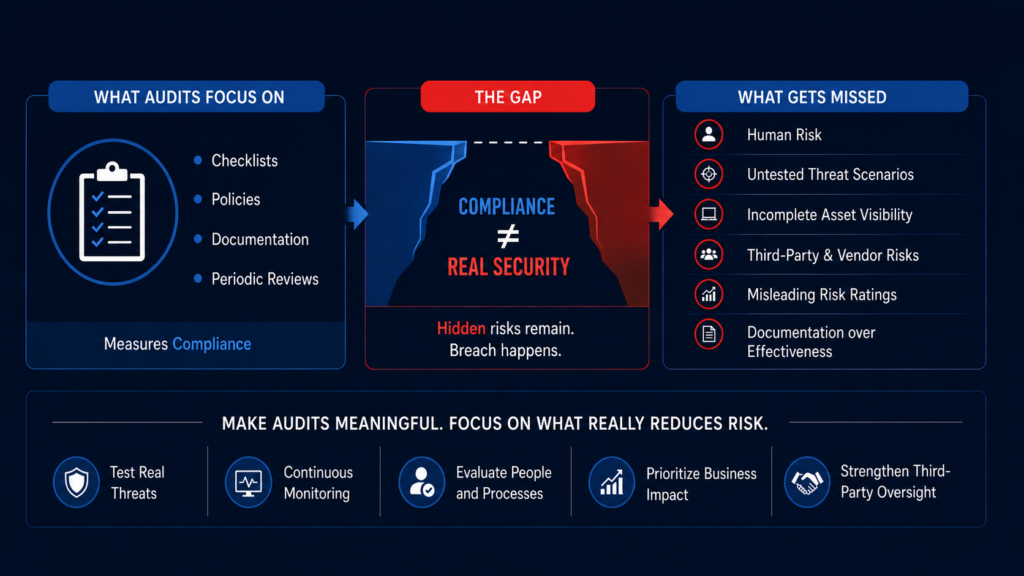
Several audit procedures are dependent on predetermined checklists. Checklists facilitate the standardization of the evaluation, yet, they may give a falsely positive impression of security. Auditors can be concerned about the existence of a control and not whether the control is effective or not.
For example:
- Is there a password policy?
- Is multi-factor authentication enabled?
- Is employee training documented?
While these items may pass review, the audit may not examine:
- Whether passwords are actually strong
- Whether MFA is enforced for all users
- Whether employees understand phishing threats
A checklist-based SAR Audit often measures documentation instead of real-world effectiveness.
Reason 2: Security Controls Are Evaluated in Isolation
Contemporary security contexts are very interlinked. An organization can be well-enpatrolled, monitored on their network, do identity management, and access control.
Nevertheless, when these systems lack efficient collaboration, there can be vulnerability. The more traditional audit methods tend to look at controls individually and not at the overall operation of controls.
For example:
- Identity systems may be secure.
- Cloud platforms may be secure.
- Monitoring systems may be secure.
Yet attackers can exploit weaknesses that appear between these systems. A comprehensive SAR Compliance Audit should evaluate the entire security ecosystem rather than isolated controls.
Reason 3: Real Threat Scenarios Are Rarely Tested
The absence of realistic threat simulation is one of the biggest flaws of most audit programs. In practice, most fintech organizations go through policies and procedures without putting them to the test within the context of realistic attack scenarios.
Some of the questions that remain open are:
- What is the speed at which the security team is able to identify an attack?
- It is possible to detect phishing attacks by employees?
- What is the effectiveness of incident response in an ongoing breach?
- What is the success rate of restoring backups?
Reason 4: Human Risk Is Often Underestimated
The emphasis of the auditing process is put mostly on technology whereas the human demeanor is given very minimal attention.
Employees are still one of the biggest security risk factors as they:
- Click malicious links
- Share citizen’s financial and personal information
- Reuse passwords
- Ignore security procedures
- Fall victim to social engineering attacks
Most audit programs indicate that there is awareness training in place, but do not determine whether the employees are able to put such knowledge into practice. The 2025 Verizon DBIR found that nearly 60% of data breaches involve human actions, including errors, credential misuse, phishing, and social engineering attacks.
Reason 5: Point-in-Time Assessments Create Blind Spots
The state of security is in a dynamic state. No day can pass without new vulnerabilities. Employees join and leave organizations. New risks are brought by software updates. Attackers create new methods of attack.
Many organizations carry out a SAR once or twice a year. This generates a big gap in visibility.
An audit done 6 months ago may no longer reflect the current security pose of the organization. Along-going monitoring is also gaining significance since yearly assessment is unable to match the fast changing threats.
Reason 6: Asset Visibility Is Incomplete
You cannot secure what you cannot see.
Many organizations struggle to maintain accurate inventories of:
- Hardware assets
- Software applications
- Cloud resources
- Third-party integrations
- User accounts
If the systems are not included in the audit scope, the related risks will be concealed.
Reason 7: Third-Party Risks Are Frequently Ignored
Businesses increasingly depend on:
- Vendors
- Contractors
- Cloud providers
- Software suppliers
- Managed service providers
Each of the external relationships exposes itself to possible security concerns. However, most audit programs put near-total emphasis on internal controls.
Vendors are often the target since this might give the attackers a backdoor into bigger organizations. A strong SAR Audit must review the security of supply chains, vendor management measures, and access control by third parties.
Reason 8: Risk Ratings Can Be Misleading
Numerous audits provide risk ratings or scores. Although these measures are handy summaries, they may simplify the complex security realities.
For example:
A medium-risk rating can be assigned to a vulnerability, according to technical criteria. But when it involves a system that contains vital business processes, the organizational risk can be even greater.
On the same note, several low-risk vulnerabilities can be linked together to form a severe attack pathway. A good audit must consider both business impact and technical severity.
Reason 9: Focus on Documentation Instead of Effectiveness
Governance and compliance can be achieved through documentation. But the presence of a documented process would not ensure successful implementation.
Examples include:
- Plans of incident response which has not been tested.
- Unknown backup practices.
- Access reviews were not done regularly.
- Unread security policies that employees seldom read
It is also true that firms are able to pass audits due to the documentation during operational efficacy weakness. This is among the most prevalent reasons why a SAR Audit does not represent true risk.
How Organizations Can Improve Audit Accuracy
To ensure a SAR Compliance Audit reflects genuine security risk and enhance IT Governance for payment service providers, organizations should adopt a more practical and risk-based approach. Evaluate how real attackers might target systems rather than merely reviewing compliance requirements.
Incorporate Security Testing
Include:
- Penetration testing
- Vulnerability assessments
- Red team exercises
- Phishing simulations
Measure Operational Effectiveness
Verify that controls work as intended under realistic conditions.
Strengthen Continuous Monitoring
Use ongoing monitoring to supplement periodic audits.
Evaluate Business Impact
Prioritize risks based on operational consequences rather than technical severity alone.
Assess Human Factors
Review employee behavior, security awareness, and social engineering resilience.
Expand Third-Party Reviews
Include vendors, suppliers, and service providers within the assessment scope.
How does Kratikal help in Compliance Audits?
Kratikal makes SAR audits simple and effective. Our experts review your security controls and find gaps that can increase risk. We help you understand what needs attention before it becomes a bigger issue.
We focus on real security challenges, not just audit requirements. Our team checks your current practices, measures them against compliance standards, and highlights areas for improvement.
Kratikal also helps you build a clear action plan. From fixing gaps, improving controls to shielding against anti-money laundering threats, implementing regulations to secure payment gateways, we guide your team through each step. This helps you stay compliant, reduce security risks, and prepare for future audits with confidence.
Join our weekly newsletter and stay updated
Conclusion
A SAR Audit is a vital part of any security program, and its worth lies in how it is done. When audits are more about compliance checklists, documentation reviews, and point-in-time checks, they do not capture the actual risk of security.
Contemporary threats demand an enhanced strategy that takes into account human behavior, operational efficiency, business impacts, third-party exposure, and realistic attack situations. Companies that go beyond compliance-based audits have a far better sense of their actual risk environment.
Finally, a SAR Compliance Audit should not be intended to get an assessment. This should aim to identify weak spots, strengthen defenses, and improve resilience to the most relevant threats.
SAR Audit FAQs
- What is a SAR Audit?
A SAR Compliance Audit is an organized security review that checks controls, processes, policies, and risk management practices. It helps shield native citizen’s financial and personal information, shield against anti-money laundering threats, implement regulations to secure payment gateways and enhance IT Governance for payment service providers.
- Why can a business pass a SAR Compliance Audit and still experience a security breach?
Passing an audit can be a good sign of how it depends on the requirements, yet it might be irrelevant to real-life threats, human mistakes, or the development of new attack techniques.
- How often should a SAR Audit be conducted?
The majority of banks, financial institutions and fintech conduct an audit once a year, though ongoing monitoring and regular testing must be used to complement formal evaluations.
- What is the biggest limitation of traditional audit approaches?
Conventional audits usually target documentation and compliance, instead of testing the controls to evaluate their effectiveness in preventing real attacks.
- How does employee behavior affect audit results?
Human factors like vulnerability to phishing, improper handling of passwords, ineffective security procedures can introduce vulnerabilities that audits can fail to identify.
- Should third-party vendors be included in a SAR Audit?
Yes. There is a tendency of vendors and suppliers to gain access to highly critical systems and data, and thus third-party risk assessment is a valuable aspect to the overall audit.
- What security testing should complement a SAR Audit?
Vulnerability assessments along with penetration testing, phishing exercises, and red team exercises may offer a more in-depth look into real security risks.
- How can organizations make their SAR Audit more effective?
By emphasizing threat-based evaluations, operational testing, ongoing evaluation, human factors, and business impact analysis instead of compliance by itself.