
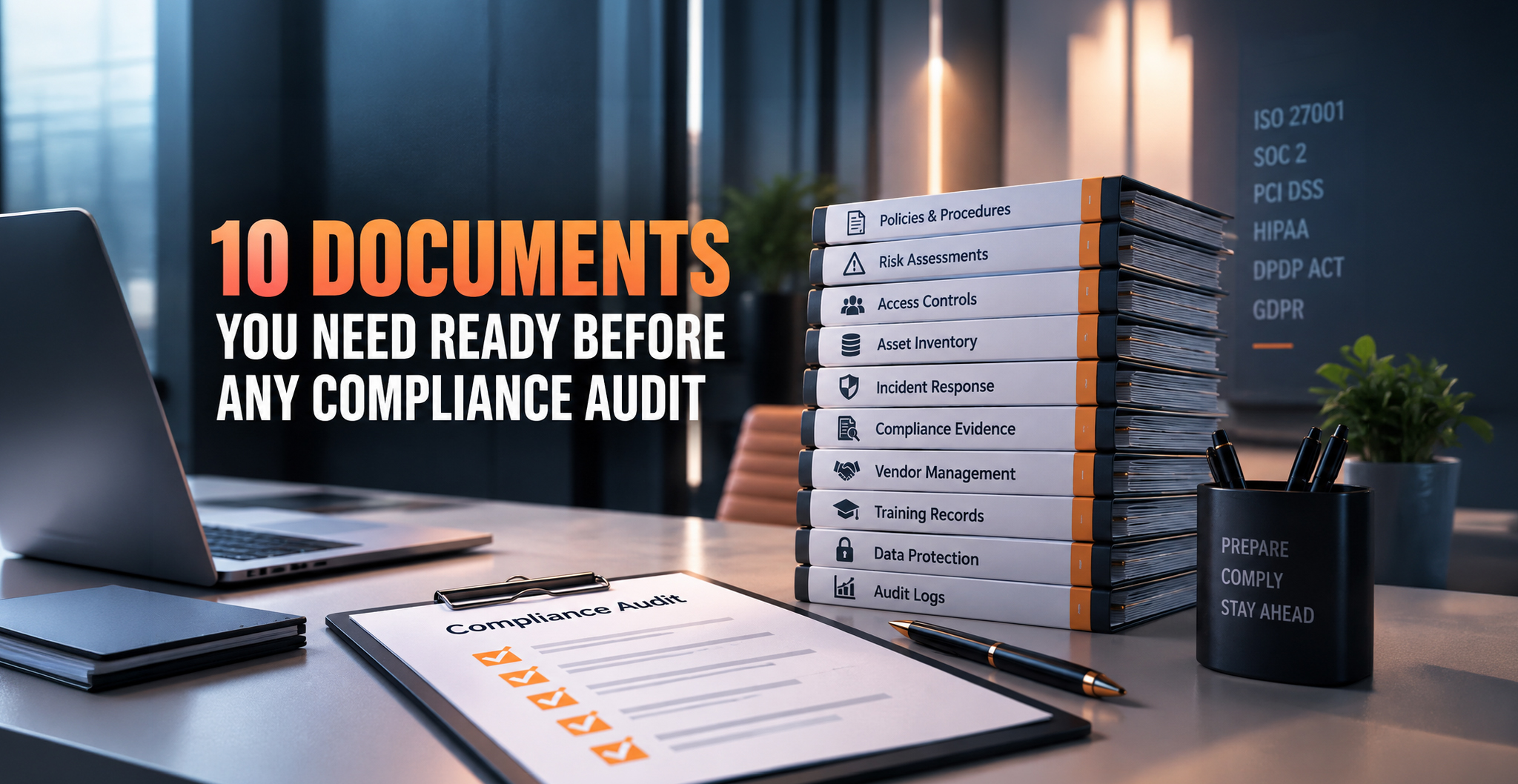
While it is important to have requisite policies and procedures, it is equally important to provide evidence of implementing and adhering to them. Updated and correctly maintained documents can go a long way in easing the burden during an audit. The term ‘Compliance’ encompasses legal and regulatory requirements and standards, and the organization’s own policies and requirements. An audit helps evaluate if an organization is compliant with such requirements. In India, the types of requirements vary by industry and regulator. However, all compliance audits require documentation showing policies, approvals, assessments, and reviews. Other documentation showing process controls and remedial actions may also be required. Early preparation of these documents helps the organization respond to audits with the required information. It is important for an organization to maintain compliance records instead of collecting records only during an audit.
Why Document Preparation Matters Before a Compliance Audit
A compliance audit is essentially an evidence-based review. An organization may have strong controls, but it still needs records to demonstrate that those controls are working. The regulatory environment in India is also becoming more technology-driven.
CERT-In published its Comprehensive Cyber Security Audit Policy Guidelines in July 2025 to help organizations prepare for cybersecurity audits and address deficiencies before or during the audit process. Businesses therefore need to think beyond document storage. They need to maintain an organized evidence trail that connects requirements with actual business activities.
1. Regulatory and Compliance Register
The first document to prepare is a current regulatory and compliance register. This document provides an overview of the laws, regulations, standards, circulars, and industry requirements applicable to the organization. It should also identify the department responsible for each requirement.
A useful register can include:
- Applicable law or regulation
- Relevant regulatory authority
- Specific compliance requirement
- Responsible department or owner
- Frequency of compliance activity
- Due date
- Current compliance status
- Evidence location
- Last review date
2. Corporate and Legal Documents
Auditors may need documents that establish how the organization is legally structured and governed.
These documents can help verify whether corporate processes are being followed according to applicable requirements.
Depending on the organization, keep the following readily available:
- Certificate of incorporation
- Memorandum and Articles of Association
- Board resolutions
- Statutory registrations
- Relevant licenses and permits
- Regulatory correspondence
- Records of significant legal proceedings
The exact requirements depend on the organization’s structure and sector.
3. Policies and Standard Operating Procedures
Policies show what an organization expects employees and departments to do. Standard operating procedures, meanwhile, explain how those requirements are implemented.
Depending on the business, this may include:
- Information security policy
- Data protection and privacy policy
- Access control policy
- Vendor management policy
- Incident response policy
- Business continuity policy
- Acceptable use policy
- Employee code of conduct
- Backup and recovery procedures
- Change management procedures
Important policies should be tracked like any other business document. Each policy should be tracked with an owner, an approval date, a document revision number, and a scheduled review date.
4. Risk Assessment and Risk Register
Auditors want to understand the process the organization uses to identify and manage risks associated with their compliance with laws and regulations. One way to manage these requests is to have a current risk register. The risk register should identify the major risks and provide the impact and likelihood of the risk, the controls, if any, in place to mitigate the risk, the name of the owner of the risk, and the organization’s plan to address the risk.
A practical risk register can contain:
- Risk description
- Business impact
- Likelihood
- Risk rating
- Existing controls
- Control owner
- Mitigation plan
- Target completion date
- Current status
- Residual risk
This document becomes particularly important when an organization has identified a risk but has not yet fully resolved it.
5. Regulatory Filings and Compliance Reports
Regulatory submissions are among the most important documents that need to be kept in an audit-ready condition. It is shown by the records show that the organization has fulfilled its required filings, declarations, returns, reports, or notifications within the relevant time limits.
Depending on the organization, this could include records relating to:
- GST and tax compliance
- Companies Act requirements
- Labour and employment requirements
- Sector-specific regulations
- RBI requirements
- SEBI requirements
- Data protection obligations
- Environmental requirements
- Licensing conditions
Whenever possible, keep the supporting evidence such as acknowledgements, payment records, approval emails, submission receipts, and any correspondence with regulators.
6. Reports from the internal audit and from previous audits
Past audits have shown issues that occur repeatedly. You should therefore retain copies of internal audits, external audits, regulatory inspections, previous findings, the management’s responses, and the evidence for closures.
Your records should clearly show:
- Audit date
- Scope
- Findings
- Risk level
- Responsible owner
- Corrective action
- Target completion date
- Closure evidence
- Management approval
A better approach is to maintain each finding until formal closure.
Join our weekly newsletter and stay updated
7. Employee Training and Awareness Records
Compliance requirements often depend on employee behaviour. For example, employees may need training on information security, privacy, anti-bribery requirements, workplace regulations, or industry-specific procedures.
Maintain:
- Training calendars
- Attendance records
- Training materials
- Completion certificates
- Assessment results
- Awareness emails
- Refresher training records
Training records should also be mapped to relevant employee groups.
8. Vendor and Third-Party Compliance Documents
Third parties can introduce significant compliance and security risks. Organizations should therefore maintain documentation showing how vendors are evaluated and monitored.
Important records can include:
- Vendor due diligence questionnaires
- Security assessments
- Contracts and agreements
- Data-processing agreements
- Compliance certifications
- Risk assessments
- Vendor audit reports
- Security review results
- Remediation records
- Periodic vendor evaluations
This is particularly important when vendors process customer information or access internal systems.
PwC’s India outlook on economic crime found that 34% of companies in India had not conducted anti-corruption/anti-bribery audits of third-party vendors.
9. Information Security and Data Protection Evidence
For modern organizations, cybersecurity documentation can form a significant part of audit preparation.
Auditors may request evidence showing how sensitive information is protected and how security controls are monitored.
Depending on the organization, prepare:
- Asset inventory
- Access control records
- Privileged-access reviews
- Vulnerability assessment reports
- Penetration testing reports
- Security monitoring records
- Incident reports
- Backup records
- Business continuity test results
- Data protection assessments
- Security awareness records
The exact evidence will depend on the applicable framework and sector. India’s regulatory environment also includes evolving data protection requirements.
10. Corrective Action and Evidence of Closure
The final document category is often overlooked. An organization may have identified compliance gaps during an earlier review. The auditor may want to know whether those gaps were corrected.
Maintain a corrective action tracker showing:
- Finding or observation
- Root cause
- Corrective action
- Responsible owner
- Priority
- Due date
- Current status
- Supporting evidence
- Verification or approval of closure
This document connects past findings with present compliance.

Book Your Free Cybersecurity Consultation Today!
How Kratikal Helps Businesses Prepare for Compliance Audits
Audit readiness requires more than maintaining documents. It also involves identifying gaps, managing risks, and keeping security controls effective. Kratikal’s virtual CISO consulting services help businesses strengthen audit readiness checklists.
Our Team Helps With:
- Security and compliance gap assessments
- Risk management
- Governance frameworks
- Audit-ready documentation
- Security control reviews
- Incident response
- Compliance reporting
Conclusion
Organizations should keep up-to-date regulatory records, policies, risk and audit documentation, security and procedures, and corrective action documentation to provide a real-time operating status to external auditors.
Businesses subject to onerous and evolving cybersecurity and regulatory requirements, for which they may not have the in-house expertise to interpret, may engage the services of qualified external advisors to assist them in interpreting and addressing the regulatory and compliance needs.
FAQs
- What is a Compliance Audit?
A Compliance Audit is a review to evaluate and substantiate that an organization has complied with laws, rules, regulations, and internal policies.
- What are the Documents Required for Compliance Audit in India?
Documents may include Regulatory Registers, Company records, policies, risk assessments, regulatory and audit reports, training records, vendor assessment and audit reports, security reports and records, and corrective action reports. The type and number of documents may vary from industry to industry and depend on the purpose and requirements of the audit.
- What should a Compliance Audit Checklist contain?
A checklist must include the name of the regulation, the compliance date, the person who is responsible for complying, the controls that are to be put in place, evidence of compliance, the time at which the controls should be reviewed, any gaps, and the corrective actions.
- How can a company improve audit readiness?
Companies can take an active approach and boost their audit readiness by ensuring that their documents are up to date, regularly reviewing and updating their controls, monitoring changes to laws and regulations, and retaining evidence of having carried out compliance activities.
- How often should compliance documents be reviewed?
The review frequency depends on the document and applicable regulation. Critical policies, risk registers, regulatory registers, and security controls should be reviewed periodically and whenever there is a major regulatory, technological, or organizational change.
- Why are risk assessment documents important during an audit?
These documents help the auditors understand the process the organization uses to assess and manage compliance and security risks.
- Are cybersecurity documents required for Regulatory Compliance?
Some regulatory bodies require an organization to have certain cybersecurity documentation to demonstrate they have the appropriate safeguards to protect sensitive information. Other regulatory compliance may require an organization to have documentation demonstrating they have assessed the security and availability of their information systems, and related controls.