
Kubernetes penetration testing is a controlled attack on a Kubernetes cluster and the cloud account around it, run to prove which misconfigurations an attacker can actually exploit. A tester probes the API server, RBAC, workloads, secrets, network policies, and cloud identities, then chains weak points into real attack paths and verifies each fix with a retest.
Kubernetes has become a core part of modern cloud infrastructure, helping organizations deploy and scale applications across public, private, and hybrid environments. As adoption grows, so does the attack surface around clusters, workloads, APIs, containers, identities, and cloud integrations. During cloud pentests, security teams frequently uncover Kubernetes misconfigurations that expose sensitive workloads or let attackers move deeper into the environment. Many of these issues need no sophisticated exploit: weak access controls, excessive permissions, exposed dashboards, insecure container settings, and missing network policies are often enough.
What Is Kubernetes Penetration Testing?
Kubernetes pentest, or K8s penetration testing, is an authorized security assessment that attacks a cluster the way a real adversary would. The goal is to show which settings combine into a path from an exposed service or a compromised pod to cluster-admin rights, stored secrets, or the underlying cloud account.
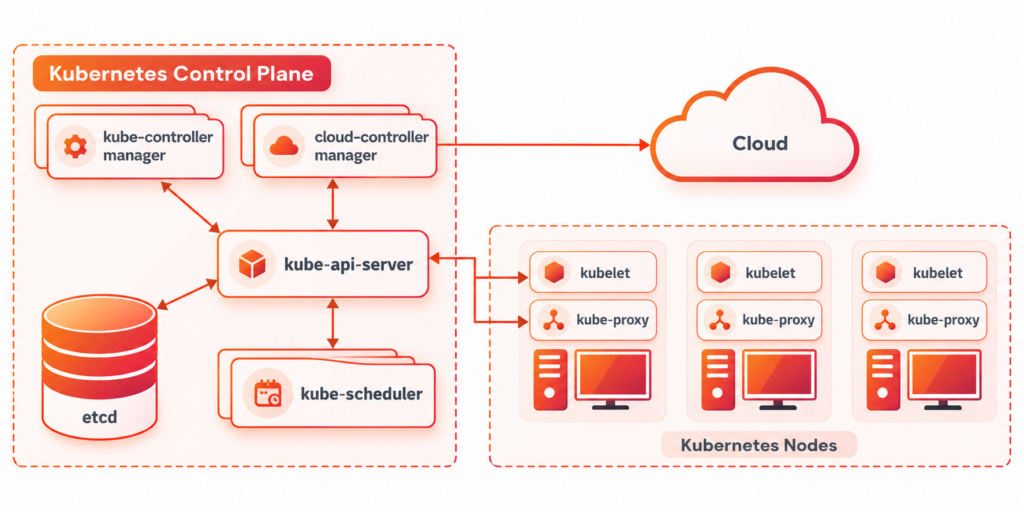
A Kubernetes pentest usually covers four layers:
· Control plane: the API server, etcd, the scheduler, and admission controllers
· Nodes: the kubelet, container runtime, and host operating system
· Workloads: pods, service accounts, security contexts, images, and secrets
· Cloud integration: IAM roles mapped to workloads, instance metadata, load balancers, and storage
Kubernetes security testing sits inside a broader cloud penetration testing program, because a cluster rarely fails on its own. Most serious findings cross the line between Kubernetes and the cloud provider.
Why Kubernetes Security Matters in Cloud Environments
Kubernetes now runs most production cloud-native workloads, which makes cluster security a business risk rather than a platform detail. The CNCF 2024 Annual Survey found that 80% of organizations run Kubernetes in production, and 93% are using, piloting, or evaluating it.
Security problems in these environments are common and costly. Red Hat’s Kubernetes adoption, security, and market trends report 2024, a survey of 600 DevOps, engineering, and security professionals, reports that:
· 67% delayed or slowed application deployment because of security concerns
· 40% detected a misconfiguration in their container or Kubernetes environment in the past 12 months
· 46% lost revenue or customers as a result of a security or compliance incident
Cloud pentests help identify these attack paths by assessing Kubernetes configurations from an attacker’s perspective. Instead of checking only whether individual vulnerabilities exist, testers determine how multiple weaknesses can be chained together, which is the part a dashboard of findings cannot show. The same pattern drives most cloud misconfiguration data breaches: small gaps that are harmless alone and dangerous together.
Kubernetes Penetration Testing vs Configuration Scanning
| Particulars | Configuration scanning | Kubernetes penetration testing |
| Question answered | Is this setting compliant? | Can an attacker exploit it, and how far can they go? |
| Method | Automated checks against a benchmark | Manual exploitation plus tooling |
| Output | A list of failed checks, often hundreds | Proven attack paths with evidence and impact |
| Chained risk | Not assessed | Core focus (pod to node to cloud account) |
| Business logic and context | Not assessed | Assessed against how the cluster is actually used |
| Best cadence | Continuous, in CI/CD and at runtime | Periodic, and after major changes |
Both are needed. Scanning keeps known-bad settings out of the cluster day to day. A Kubernetes pentest tells you which of the remaining findings matter, so the platform team fixes the handful of issues that lead to cluster takeover before the hundreds of low-impact findings that do not.
How a Kubernetes Penetration Test Works: Step-by-Step Methodology
A K8s penetration test follows a structured methodology so that results are repeatable and safe for production clusters. The phases below reflect how a cloud pentest of a managed cluster (EKS, AKS, or GKE) or a self-managed cluster is typically run.
Scoping and rules of engagement.
Define the clusters, namespaces, and cloud accounts in scope, the test window, and what is excluded. Confirm the cloud provider’s rules first. AWS’s penetration testing policy lists the services customers may test without prior approval; EKS worker nodes run on EC2, which is on that list, while the managed control plane belongs to AWS and is out of scope. Azure and Google Cloud publish equivalent rules.
Choosing the test perspective.
An external test starts with no access, like an internet attacker. An assumed-breach test starts with a shell inside one pod, which models a compromised application. Most mature programs run both, often as grey box testing with limited credentials.
Reconnaissance
Enumerate exposed API servers, kubelet ports, dashboards, ingress controllers, and load balancers. From inside a pod, check which service account token is mounted and what it can do with `kubectl auth can-i –list`.
Exploitation and privilege escalation
Abuse weak RBAC, privileged containers, host mounts, or readable secrets to move from pod to the node, then to other namespaces or cluster-admin.
Cluster-to-cloud movement
Test whether a workload can reach the instance metadata service or assume an over-permissioned cloud IAM role, which turns a cluster issue into an account-level breach.
Reporting and retesting
Document each attack path with evidence, severity, and a specific fix. Once the team patches, a retest confirms the path is closed.
The final step is the one most often skipped. A VAPT report does not reduce risk until remediation is verified, and a Kubernetes fix applied to one manifest is easily undone by the next Helm release.
Common Kubernetes Misconfigurations Found During Cloud Pentests
Cloud pentests often reveal recurring Kubernetes misconfigurations that expose workloads, credentials, and critical cloud resources to attackers. The table maps each finding below to the OWASP Kubernetes Top Ten 2025, the community list of the most common Kubernetes security risks. Each one is a setting a scanner can flag; the pentest shows whether it actually leads somewhere.
| Misconfiguration found in a Kubernetes pentest | OWASP Kubernetes Top Ten 2025 |
| Overly permissive RBAC permissions | K02 Overly Permissive Authorization Configurations |
| Exposed Kubernetes API server | K06 Overly Exposed Kubernetes Components |
| Publicly accessible dashboards | K06 Overly Exposed Kubernetes Components |
| Privileged containers | K01 Insecure Workload Configurations |
| Missing network policies | K05 Missing Network Segmentation Controls |
| Exposed or weakly protected secrets | K03 Secrets Management Failures |
| Cloud metadata and IAM abuse | K08 Cluster To Cloud Lateral Movement |
| Outdated, vulnerable cluster components | K07 Misconfigured And Vulnerable Cluster Components |

Book Your Free Cybersecurity Consultation Today!
Overly Permissive RBAC Permissions
Role-Based Access Control (RBAC) determines what users, groups, and service accounts can do inside a Kubernetes cluster. A common issue is granting broader permissions than workloads or users actually need. For example, a service account may be able to:
· Create or modify pods
· Read secrets
· Execute commands inside containers
· Modify deployments
· Access resources across multiple namespaces
If an attacker compromises a workload tied to an overprivileged service account, these permissions can turn a single-pod compromise into control of the cluster. The `create pods` and `get secrets` verbs are the two that most often lead to full privilege escalation during a Kubernetes pentest.
Security recommendation: Follow least privilege when creating Roles, ClusterRoles, and service account permissions. Avoid wildcard verbs and resources, disable token automounting where a pod does not need the API, and review bindings regularly.
Exposed Kubernetes API Server
The Kubernetes API server is a critical control plane component. If it is unnecessarily exposed to the public internet, it becomes a high-value target. Cloud pentests regularly find API endpoints that are reachable externally or protected by weak authentication and access controls.
An exposed API server does not automatically mean the cluster is compromised. However, anonymous access, weak authentication, excessive permissions, or configuration errors make the exposure much riskier.
Security recommendation: Restrict API server access to trusted networks, VPNs, private endpoints, or approved administrative sources. Disable anonymous authentication, enforce strong authentication, and monitor API activity through audit logs.
Join our weekly newsletter and stay updated
Publicly Accessible Kubernetes Dashboards
Kubernetes dashboards and management interfaces provide visibility into workloads, deployments, namespaces, and cluster resources. When these interfaces are exposed without adequate authentication or network restrictions, attackers gain a map of the environment. In some cases, excessive dashboard permissions also enable administrative actions such as deploying a new pod.
Testers check whether management interfaces, including the dashboard, monitoring tools, and CI/CD consoles, are reachable from external networks.
Security recommendation: Keep management interfaces private, put them behind single sign-on, apply RBAC, and restrict access to trusted networks or identities.
Privileged Containers
Containers should operate with only the privileges they require. However, cloud pentests frequently find workloads running in privileged mode. A privileged container has far greater access to the underlying host than a standard container, so if an attacker compromises it, the boundary between container and node can collapse.
Other risky configurations include:
· Running containers as root
· Allowing privilege escalation
· Excessive Linux capabilities
· Host filesystem mounts
· Host network or host PID namespace access
Security recommendation: Apply the Kubernetes Pod Security Standards at the restricted level through Pod Security Admission. Enforce non-root execution, disable privilege escalation, drop unnecessary Linux capabilities, and allow privileged containers only with a documented requirement.
Missing Network Policies
Kubernetes allows all pod-to-pod traffic by default. Without network policies, a compromised frontend pod can communicate with backend services, databases, or internal APIs that it does not need to reach.
Network policies restrict communication between namespaces, pods, and external endpoints. During a Kubernetes pentest, testers examine whether unnecessary east-west traffic lets a compromised workload perform lateral movement across the cluster.
Security recommendation: Implement a deny-by-default network model for ingress and egress, then explicitly allow only the traffic each workload requires.
Exposed or Weakly Protected Secrets
Kubernetes Secrets are base64-encoded, not encrypted, unless encryption at rest is configured for etcd. Kubernetes security testing regularly finds database passwords, API keys, and cloud credentials that any pod in a namespace can read, or that sit in plain environment variables and ConfigMaps.
Security recommendation: Enable encryption at rest with a KMS provider, restrict `get` and `list` on secrets to the workloads that need them, and move high-value credentials into an external secrets manager. Scan images and Git history for hardcoded keys before they ship.
Cloud Metadata and IAM Abuse
Cluster-to-cloud lateral movement is the misconfiguration that turns a Kubernetes finding into a cloud breach. If a pod can reach the instance metadata service, it may obtain the node’s cloud credentials. If a workload’s IAM role is over-permissioned, a compromised pod can read storage buckets, modify infrastructure, or create new identities.
The same pattern shows up in common Azure pentesting misconfigurations and in AWS environments, where misconfigurations remain a major security risk.
Security recommendation: Enforce IMDSv2 on AWS and block pod access to metadata endpoints. Use per-workload cloud identity (IRSA or EKS Pod Identity on AWS, Workload Identity on GKE and AKS) with least-privilege roles instead of node-level credentials.
Outdated and Vulnerable Cluster Components
Add-ons and controllers carry their own vulnerabilities, and a cluster assessment checks their versions as well as their configuration. In March 2025, the Kubernetes project disclosed CVE-2025-1974 in ingress-nginx, a critical flaw that could let an attacker take over a cluster. The project noted that over 40% of Kubernetes administrators use ingress-nginx, and fixed the issue in versions 1.12.1 and 1.11.5.
Security recommendation: Keep an inventory of cluster add-ons, track their advisories, and patch ingress controllers, CNI plugins, and admission webhooks on the same schedule as the Kubernetes version itself.
Kubernetes Penetration Testing Checklist
Use this checklist to close the gaps that cloud pentests find most often, and to prepare a cluster before the next assessment:
· Give least-privilege RBAC, with no wildcards and no auto-mounted tokens where they are not needed
· Keep the API endpoint private and turn off anonymous access to the API server and kubelet
· Set Pod Security Admission to restricted and block privileged pods
· Encrypt secrets at rest with KMS and store high-value credentials in a vault
· Add deny-all network policies for incoming and outgoing traffic, then allow only what is needed
· Enforce IMDSv2, block pod access to metadata, and use per-workload cloud identity
· Scan, sign, and pin images to protect against software supply chain attacks
· Put dashboards and management consoles behind SSO
· Patch ingress controllers and other add-ons on a tracked schedule
· Turn on API audit logs and runtime alerts, and confirm someone reviews them
The joint NSA and CISA Kubernetes Hardening Guidance covers the same controls in more depth and is a useful baseline for platform teams.
How Often Should You Run a Kubernetes Penetration Test?
Run a Kubernetes pentest at least once a year, and again after any change that alters the cluster’s attack surface. Clusters change faster than most infrastructure, so an annual test alone leaves long gaps.
Retest or extend testing when you:
· Launch a new cluster or migrate to a managed service such as EKS, AKS, or GKE
· Upgrade the Kubernetes version or replace the CNI, ingress controller, or service mesh
· Change RBAC models, identity providers, or cloud IAM integrations
· Expose a new workload to the internet
· Need fresh testing evidence for a customer security review or a compliance audit
Between full tests, continuous configuration scanning in the CI/CD pipeline catches regressions, and a targeted retest confirms that fixes from the last Kubernetes pentest still hold.
Final Thoughts
Kubernetes penetration testing matters because most cluster risk comes from configuration, not from flaws in Kubernetes itself. Many cloud vulnerabilities discovered during cloud pentests arise from excessive permissions, exposed interfaces, insecure workloads, weak segmentation, or gaps between Kubernetes and the underlying cloud environment.
Effective Kubernetes security requires continuous visibility across identities, workloads, APIs, networks, containers, secrets, and cloud services. Scanning shows what is present. A pentest shows what is exploitable, and a retest proves it is fixed.
Kratikal’s cloud penetration testing covers Kubernetes clusters on AWS, Azure, and GCP, starting with a check of your cloud provider’s testing policy so the engagement stays within its rules. Testers chain RBAC, workload, and cloud IAM findings into real attack paths, and every finding is retested after your team patches it, so the report you close is verified, not assumed.
FAQs
- What is Kubernetes penetration testing?
Kubernetes penetration testing is an authorized, simulated attack on a Kubernetes cluster and its cloud environment. Testers probe the API server, RBAC, pods, secrets, network policies, and cloud IAM to find misconfigurations, then chain them to show how far an attacker could get, such as from one compromised pod to cluster-admin or the cloud account. Each confirmed path is reported with a fix and retested.
- How do you pentest a Kubernetes cluster?
A Kubernetes pentest starts with scoping and the cloud provider’s testing rules, then runs reconnaissance on exposed components and mounted service account tokens. Testers exploit weak RBAC, privileged containers, readable secrets, and missing network policies to escalate privileges, test whether workloads can reach cloud metadata or IAM roles, and finish with a report and a retest of every fix.
- What tools are used for Kubernetes penetration testing?
Common tools include kubectl for permission checks, kube-hunter for discovering exposed components, kube-bench for CIS Kubernetes Benchmark checks, Trivy for image and manifest scanning, and Peirates for privilege escalation from inside a pod. Cloud CLIs test what stolen credentials can reach. Tools find candidates; manual testing confirms which ones are exploitable
- Are Kubernetes Secrets secure by default?
Kubernetes Secrets are not encrypted by default. They are base64-encoded and stored in etcd, so anyone with read access to etcd, or RBAC permission to get secrets in a namespace, can read them. Enable encryption at rest with a KMS provider, limit secret access to the workloads that need it, and keep high-value credentials in an external secrets manager.
- How often should Kubernetes environments be tested?
Kubernetes environments should get a penetration test at least once a year and after major changes, such as a new cluster, a Kubernetes version upgrade, a new ingress controller, RBAC or IAM redesigns, or newly internet-facing workloads. Continuous configuration scanning between tests catches regressions, while targeted retests confirm earlier fixes still hold after new releases.
- Can Kubernetes misconfigurations lead to cloud compromise?
Yes. Kubernetes misconfigurations can lead to cloud compromise when a pod can reach the instance metadata service or uses an over-permissioned cloud IAM role. An attacker who compromises that pod can take its cloud credentials and access storage, databases, or infrastructure outside the cluster. OWASP lists this as K08, Cluster To Cloud Lateral Movement, in its Kubernetes Top Ten 2025.