Every CISO has lived this moment: a scanner reports ‘n’ number of critical vulnerabilities, and the board asks one question: “How much risk does that actually represent?” Though a severity count answers it, the quantification of the risk provides a direct response that becomes easy to act on when it comes to monetary investment and other important security decisions. The IBM Cost of Data Breach Report 2025 states that the global expense of a data breach is $4.44 million. That gap between technical severity and financial reality is exactly why Cyber Risk Quantification (CRQ), powered by real vulnerability intelligence along with CVSS scores, has become a core CISO way to quantify cyber risk in 2026.
What Is Cyber Risk Quantification (CRQ)?
Cyber Risk Quantification is the process of translating cyber risk like vulnerabilities, threats, and control gaps, into estimated financial exposure rather than qualitative labels like “High” or “Medium.”
For example, instead of a color-coded heat map, a CRQ output looks like: “This exposure represents an estimated $2.5M in annualized loss.”
The conventional approach to risk reporting relied on subjective severity ratings that don’t directly translate into budget decisions. Executives make decisions based on business impact and rarely based on risk ratings or a heat map. This does not answer what they need to know – the cost a breach would cost them. CRQ closes that gap by giving boards, CFOs, and regulators a number they can actually work with.

Book Your Free Cybersecurity Consultation Today!
Why Vulnerability Intelligence Is Important in Cyber Risk Quantification?
Security teams and DevSecOps often use CVEs and CVSS scores to decide which vulnerabilities should be fixed first. However, a CVSS score only measures how severe a vulnerability could be if exploited; it does not indicate whether attackers are actively exploiting it. For example, two vulnerabilities with the same CVSS score of 9.8 may pose very different levels of risk if one is being widely exploited while the other is not.
This challenge is common across the industry. According to a third-party market survey commissioned by Filigran on exposure validation, 96% of security teams struggle to determine whether the vulnerabilities in their environment are actually exploitable. Two-thirds do not have a single, consolidated view of their overall cyber exposure.
Vulnerability intelligence helps organizations understand which vulnerabilities attackers are most likely to exploit, instead of relying only on CVSS severity scores. According to Trend Micro’s Cyber Risk Report 2026, attackers typically begin exploiting known vulnerabilities within 39 days of their public disclosure. However, organizations often take around 115 days to apply virtual patches. This leaves a significant security gap, making organizations vulnerable for months if they prioritize vulnerabilities based only on severity rather than real-world exploitability.
How CISOs Quantify Cyber Risk?
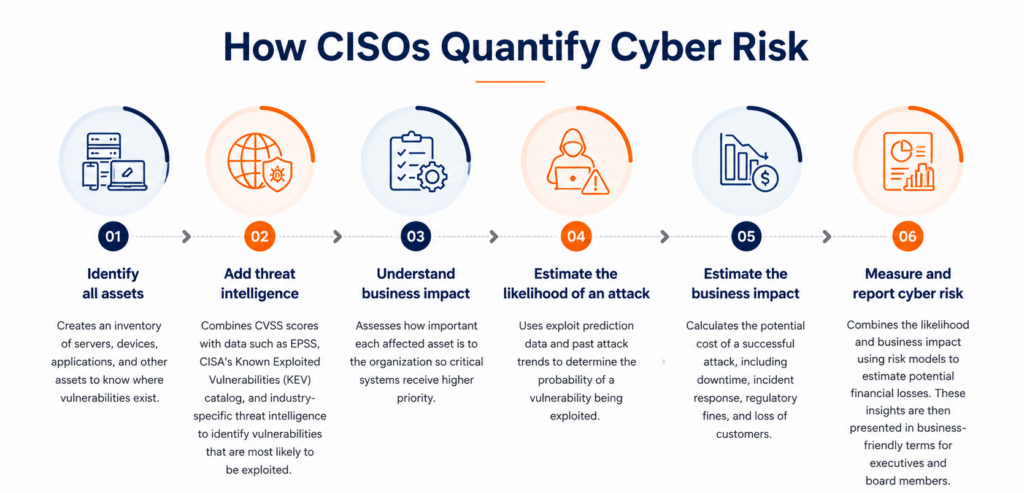
To understand the financial impact of cyber risks, CISOs typically follow these steps to turn vulnerability intelligence into a quantified risk figure:
1.Identify all assets: Creates an inventory of servers, devices, applications, and other assets to know where vulnerabilities exist.
2.Add threat intelligence: Combines CVSS scores with data such as EPSS, CISA’s Known Exploited Vulnerabilities (KEV) catalog, and industry-specific threat intelligence to identify vulnerabilities that are most likely to be exploited.
3.Understand business impact: Assesses how important each affected asset is to the organization so critical systems receive higher priority.
4.Estimate the likelihood of an attack: Uses exploit prediction data and past attack trends to determine the probability of a vulnerability being exploited.
5.Estimate the business impact: Calculates the potential cost of a successful attack, including downtime, incident response, regulatory fines, and loss of customers.
6.Measure and report cyber risk: Combines the likelihood and business impact using risk models to estimate potential financial losses. These insights are then presented in business-friendly terms for executives and board members.
Many organizations also use Key Risk Indicators (KRIs) to monitor cyber risk proactively. Unlike Key Performance Indicators (KPIs), which measure whether security tasks are completed, KRIs indicate whether cyber risk is increasing.
For example, instead of reporting “n critical vulnerabilities detected,” a KRI-focused report highlights the potential business impact, such as “An estimated $XXX million in financial exposure from exploitable vulnerabilities affecting critical business systems.”
Common KRIs for vulnerability management include:
- Attack surface exposure
- Patch management timelines
- Third-party risk
- Incident response speed
- Overall financial exposure from cyber risks
Speed Up Cyber Risk Quantification with AI-Driven Vulnerability Intelligence – AutoSecT by Kratikal!
To quantify cyber risk effectively, CISOs need a clear view of their organization’s security posture. With cyber threats evolving rapidly, security decisions must be both accurate and fast. This is where an AI-driven vulnerability scanning platform can make a significant difference. An intelligent vulnerability management solution helps CISOs complete the first three steps of cyber risk quantification by:
- Inventorying assets across the environment.
- Identifying high-risk, exploitable vulnerabilities.
- Providing vulnerability details such as affected assets, scan results, CVSS scores, and severity to help assess business impact.
AutoSecT by Kratikal is an AI-driven pentesting and VMDR platform that scans applications (web, mobile, API), cloud and network for true exploitable vulnerabilities. Its RAG-powered agentic AI engine generates dynamic test scripts, while its SLM-based models validate findings to ensure only AI-verified vulnerabilities are reported. The platform also performs real-time cloud security scanning, helping organizations maintain continuous visibility into their security posture.
To simplify decision-making, AutoSecT provides dedicated dashboards for both CISOs and DevSecOps teams. The CISO dashboard offers a business-focused view of the organization’s cyber risk, including:
- Total scans and scan status
- Most critical assets with CVSS scores
- High-risk vulnerabilities with affected assets and scan details
- Vulnerability severity and remediation progress
- Remediation status across different inventory types
By presenting validated vulnerabilities with near-zero false positives in a single dashboard, AutoSecT enables CISOs to combine vulnerability intelligence with their expertise to quantify cyber risk more effectively.
Cyber Risk Quantification – Compliance and Regulatory Context
For Indian organizations, under the DPDPA 2023 and CERT-In’s 2022 directions which mandate incident reporting within six hours, CISOs need risk data they can act on immediately, instead of a quarterly heat map. The RBI Cybersecurity Framework and SEBI Cyber Resilience Framework increasingly expect organizations to demonstrate quantified, not just qualitative, risk assessments as part of board reporting for the regulated sectors.
For US organizations, the SEC’s cybersecurity disclosure rules require publicly traded companies to disclose material breaches within four business days and “material” is fundamentally a financial determination, which is exactly what cyber risk quantification is built to support. NIST CSF 2.0 remains the reference framework, and the CISA Known Exploited Vulnerabilities (KEV) Catalog is increasingly treated as a required input for patch prioritization.
Join our weekly newsletter and stay updated
FAQs
- What is Cyber Risk Quantification (CRQ)?
CRQ is the process of translating cyber risk into estimated financial exposure, monetary figures and probabilities, instead of qualitative labels like High or Medium, so leadership can make risk-based investment decisions.
- What’s the difference between CVSS and Cyber Risk Quantification?
CVSS scores technical severity in isolation. CRQ combines CVSS with exploit likelihood, asset criticality, and business context to estimate actual financial exposure.
- What is vulnerability intelligence?
Vulnerability intelligence is enriched vulnerability data that goes beyond a CVE and CVSS score, incorporating exploit prediction, confirmed active exploitation (CISA KEV), and asset/business context to show real-world risk.
- How do CISOs calculate Annualized Loss Expectancy?
Annualized Loss Expectancy is typically calculated by multiplying the estimated single loss expectancy that is the financial impact of one incident by the annualized rate of occurrence which means how often that incident is expected per year to produce a range rather than a single number.
- How do CISOs quantify cyber risk?
CISOs quantify cyber risk by identifying organizational assets, analyzing exploitable vulnerabilities using threat intelligence, assessing the business impact of affected assets, estimating the likelihood and financial impact of an attack, and reporting the results using cyber risk models.
- Why is vulnerability intelligence important for cyber risk quantification?
Vulnerability intelligence helps CISOs prioritize vulnerabilities that are actively exploitable instead of relying only on CVSS severity scores. By combining exploit intelligence with asset criticality and business context, organizations can focus remediation efforts on the vulnerabilities that pose the greatest business risk.
- How can an AI-driven VMDR platform help CISOs quantify cyber risk?
An AI-driven VMDR platform automates asset discovery, identifies exploitable vulnerabilities, validates findings to reduce false positives, and provides real-time dashboards with CVSS scores, asset criticality, remediation status, and risk insights. This enables CISOs to make faster, data-driven decisions and quantify cyber risk more accurately.