
Authentication and session management form the backbone of application security. Every login, password reset, multi-factor authentication (MFA) challenge, and user session relies on cryptographic mechanisms to protect sensitive information. Weak cryptographic controls allow attackers to bypass authentication, steal credentials, and gain unauthorised access. These weaknesses are collectively known as cryptographic failures, one of the most critical security risks identified in modern web applications. While organisations often associate cryptographic failures with weak encryption algorithms or exposed data, they are equally risky when they affect authentication and session management.
A Closer Look at Cryptographic Failures
In simple terms, cryptographic failures happen when:
- Applications fail to encrypt sensitive data.
- It is encrypted, but using outdated or broken methods
- The encryption is fine, but it’s set up incorrectly
- Secret keys are weak, exposed, or hardcoded into the code
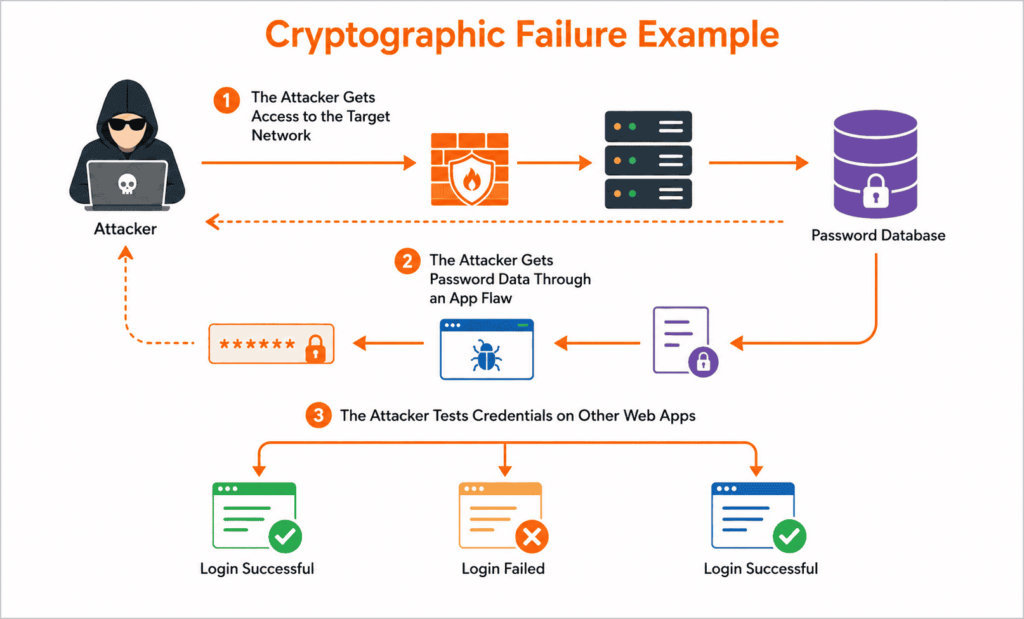
Cryptography is what turns a password into something unreadable or makes a session token impossible to guess. When it fails, even partially, attackers can steal credentials, hijack active sessions, and take over accounts without needing to break anything dramatic.
Why Authentication and Session Management Are So Vulnerable?
Authentication and session management are critical to application security because they verify user identities and maintain secure access throughout a user’s interaction with an application. Since these processes rely heavily on cryptography, even a small implementation flaw can expose the system to significant security risks. Here are the four key reasons why they are particularly vulnerable:
- Heavy Reliance on Cryptographic Mechanisms
Authentication and session management depend on cryptographic functions such as password hashing, encryption, digital signatures, secure token generation, and TLS. If any of these mechanisms are weak, outdated, or incorrectly implemented, attackers can exploit them to bypass authentication, steal credentials, or hijack user sessions.
- Small Misconfigurations Can Lead to Major Security Risks
A single cryptographic mistake, such as using weak hashing algorithms, predictable session IDs, hardcoded encryption keys, or improperly signed authentication tokens, can compromise the entire authentication process. Even if the rest of the application is secure, one weak cryptographic control can provide attackers with unauthorised access.
- Cryptographic Failures Are Often Difficult to Detect
Unlike application crashes or functional bugs, cryptographic failures usually do not affect the user experience. Users can log in, access resources, and maintain active sessions without noticing any issues. However, hidden vulnerabilities remain in the background, making them difficult to identify without regular security assessments, penetration testing, and cryptographic audits.
- Authentication Systems Are Prime Targets for Attackers
Authentication serves as the gateway to sensitive applications and business data, making it one of the first areas attackers attempt to compromise. By exploiting weak cryptographic implementations, attackers can crack passwords, forge authentication tokens, hijack sessions, and gain unauthorised access without needing to exploit multiple vulnerabilities elsewhere in the application.

Book Your Free Cybersecurity Consultation Today!
Common Cryptographic Failures in Authentication
The security of any authentication system is only as strong as the cryptographic mechanisms behind it. Below are some of the most common cryptographic failures that weaken authentication and increase the risk of unauthorised access.
- Using Weak or Outdated Password Hashing
Using outdated hashing algorithms like MD5, SHA-1, or plain SHA-256 allows attackers to crack weak password hashes quickly because these algorithms prioritise speed over security. Protect passwords with bcrypt, Argon2, or scrypt—purpose-built hashing algorithms that automatically apply salting and intentionally slow down hashing to resist password-cracking attacks. This extra processing time makes large-scale password-cracking attacks significantly more difficult, helping to keep user credentials secure.
- Missing or Poorly Implemented Salts
A salt is a random piece of data added to a password before it’s hashed. Its purpose is simple: make sure two users with the same password end up with completely different stored values.
Without a unique, random salt for every password, attackers can crack passwords much more easily. Identical passwords produce identical hashes, shared or predictable salts enable bulk attacks, and weak salting offers little protection. Attackers exploited the 2012 LinkedIn breach by stealing 117 million unsalted SHA-1 password hashes and cracking most of them within days.
- Using Insecure Encryption Modes (Especially ECB)
Encryption protects authentication data only when implemented correctly. Using insecure modes like ECB can expose patterns in encrypted data, allowing attackers to infer sensitive information without decrypting it. Modern authenticated encryption methods such as AES-GCM are the preferred choice, while AES-CBC with HMAC and ChaCha20-Poly1305 also provide strong security when implemented properly.
- Hardcoded or Weak Secret Keys
Authentication systems rely on secret keys to sign tokens and encrypt sensitive data, but weak practices, such as hardcoding keys, exposing them in public repositories, reusing them across environments, or leaving default values unchanged, can compromise security. If attackers obtain the key, they can forge valid authentication tokens and gain unauthorised access, as seen in 2019 when several enterprise applications used predictable JWT signing keys like “secret” and “changeme.”
| Are your authentication and session management controls as secure as you think? Weak cryptographic implementations can silently compromise application security. With Kratikal’s VAPT and Secure Code Review services, organisations can identify cryptographic failures, strengthen security controls, and reduce the risk of unauthorised access. |
Common Cryptographic Failures in Session Management
Weak cryptographic practices in session management can expose active user sessions, allowing attackers to hijack accounts and bypass authentication.
- Weak or Predictable Session Tokens
After a user logs in, the server gives them a session token, a unique ID that acts like a temporary badge saying “this user is already authenticated.” Every time the user clicks something, this token gets sent along so the server knows who they are. If this token can be guessed or predicted, an attacker can impersonate an authenticated user without ever knowing their password.
- JWT Misconfigurations
JWTs are widely used for session management, but misconfigurations such as accepting the alg: none algorithm, algorithm confusion, weak signing keys, or failing to validate token expiration can allow attackers to forge or reuse tokens and gain unauthorised access. Enforce the correct signing algorithm, use strong random keys, validate token expiry, and rotate signing keys regularly to prevent these risks.
- Sessions That Don’t Expire or Can’t Be Ended
Improper session invalidation can leave user accounts exposed even after logout. If an application deletes a session token only from the browser without revoking it on the server, anyone who steals that token can continue using it. Another common issue is failing to regenerate session tokens after a user’s role or permissions change, allowing previously issued tokens to retain elevated access. To reduce these risks, organisations should invalidate sessions on logout, enforce session timeouts, and issue new tokens whenever privileges change.
- Reusing Initialisation Vectors (IVs)
When encrypting data, applications generate a random Initialisation Vector (IV) to ensure the same plaintext produces different encrypted outputs each time. Reusing IVs removes this protection and allows attackers to analyse patterns and recover the original data. This is a low-level technical mistake, but it has caused real-world breaches, including vulnerabilities in early Wi-Fi security (WEP).
Join our weekly newsletter and stay updated
A Quick Security Checklist
For Authentication:
- Use Argon2, bcrypt, or scrypt for password hashing, not MD5, SHA-1, or plain SHA-256
- Add a unique random salt to every password before hashing
- Use AES-GCM for any encryption, avoid ECB mode entirely
- Store secret keys in a secure vault, never in source code
- Enforce HTTPS, use TLS 1.2 at minimum, TLS 1.3 preferred
- Enable HSTS so browsers always use HTTPS
For Session Management:
- Generate session tokens using a secure random generator, with at least 128 bits of randomness
- For JWTs: enforce the algorithm, use strong keys, validate expiry and other claims
- Invalidate sessions on the server when users log out or change roles
- Issue a new session token whenever privileges change
- Set all three cookie flags: Secure, HttpOnly, SameSite=Strict
- Never store tokens in URLs or application logs
- Use a unique IV for every encryption operation
The Final Word
Authentication and session management are only as secure as the cryptographic controls that support them. From weak password hashing and exposed secret keys to predictable session tokens and JWT misconfigurations, even a single cryptographic mistake can open the door to unauthorised access, account takeover, and data breaches. Since many of these cryptographic failures remain hidden during everyday operations, organisations often don’t discover them until an attacker does.
The good news is that these risks are preventable. As cyber threats continue to evolve, proactively identifying and remediating cryptographic failures isn’t just a best practice; it’s an essential step toward protecting users, sensitive data, and business-critical systems.
FAQs
- How do cryptographic failures affect authentication?
Cryptographic failures can weaken authentication by exposing password hashes, enabling attackers to forge authentication tokens, bypass login mechanisms, or crack user credentials.
- Why is password hashing important in authentication?
Password hashing ensures that user passwords are stored securely in an irreversible format. Modern algorithms such as Argon2, bcrypt, and scrypt make it significantly more difficult for attackers to recover passwords, even if they gain access to the database.
- How can organisations prevent cryptographic failures?
Organisations can prevent cryptographic failures by using modern encryption and hashing algorithms, implementing secure key management, generating cryptographically secure session tokens, enforcing HTTPS, and regularly rotating secrets.
- Can cryptographic failures lead to session hijacking?
Yes. Weak session tokens, insecure cookie configurations, JWT misconfigurations, and poor session management practices can enable attackers to hijack active user sessions and impersonate legitimate users.
- Why should organisations avoid MD5 and SHA-1 for password hashing?
MD5 and SHA-1 are outdated hashing algorithms that are fast and vulnerable to modern password-cracking techniques. Organisations should use stronger alternatives like Argon2, bcrypt, or scrypt to better protect user credentials.
- How often should organisations test for cryptographic failures?
Organisations should perform regular Vulnerability Assessments and Penetration Testing (VAPT), secure code reviews, and cryptographic audits, especially after major application updates, infrastructure changes, or before deploying new features.
- Are cryptographic failures part of the OWASP Top 10?
Yes. Cryptographic Failures is a category in the OWASP Top 10 that highlights risks arising from weak or improperly implemented cryptographic controls that can expose sensitive data and compromise application security.