
Web applications power everything from online banking and e-commerce to healthcare and enterprise operations. Unfortunately, web apps have become one of the most desirable targets of attackers due to this growing attack surface. Although cyberattacks are becoming more advanced, not every successful attack uses a zero-day exploit or an advanced hacking method. Rather, attackers still take advantage of the popular vulnerabilities that organizations have not identified or mitigated. Such repeated security vulnerabilities may result in data breaches, financial loss, regulatory fines, operational disruption, and lasting reputational damage. OWASP Top 10 identifies the most significant web application security threats that organizations must consider. It is an effective framework that can be used to enhance application security during the software development life cycle. Yet, numerous companies repeat the same errors. Security is no more a business priority, but a mandatory approach to comply.
The initial step to prevent such risks is to understand their reasons. This blog discusses why organizations still fail to address the same OWASP Top 10 risks and the actual measures they could implement to develop more secure applications.
Pay Attention to OWASP Top 10 – Here’s Why!
The OWASP Top 10, in contrast to fixed security guidelines, adapts with the development of new attack methods and the shift in application development. It is based on the most prevalent vulnerabilities seen by thousands of real-world security evaluations. With the ever-changing technology, organizations ought to reassess these risks regularly to be able to spot the weaknesses before attackers can learn about them.
IBM’s 2025 report found that the global average cost of a data breach reached $4.44 million. Most organizations do risk reviews as a way of complying with the rules. Unfortunately, compliance alone does not tend to provide lasting protection against the evolution of cyber threats.
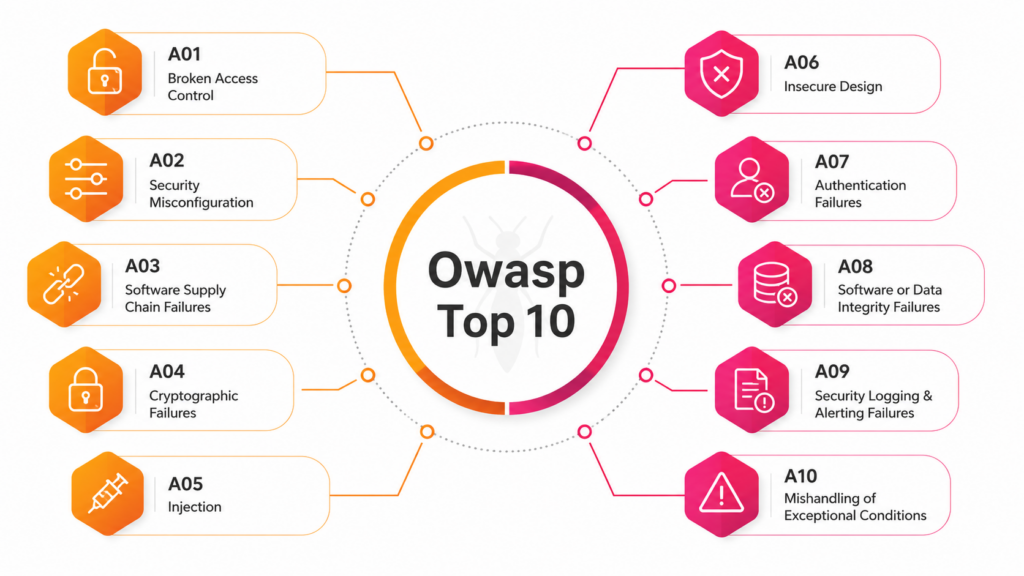
Mitigating the OWASP Top 10 risks improves:
- Secure software development practices
- Code reviews and security testing
- Penetration testing
- Developer security awareness
- Risk-based remediation planning
1. Security Often Arrives Too Late
Most of the development teams focus on product delivery rather than application security in the initial stages of development. It is usual to initiate security reviews after major features are accomplished.
This slow-paced practice lets design flaws and coding errors remain undetected. The vulnerability fixes after deployment can require more effort, higher cost, and business resources.
Business continuity is also impacted by delayed security testing. Urgent patches, bugs in production, and retesting consume valuable development time and delay future software releases. An alternative solution can be to apply security in the development cycle to identify the vulnerabilities first, before the attacker.
2. Limited Secure Coding Knowledge
Avoidable coding errors often lead to weak authentication, improper input validation, and insecure session management. Security workshops should be held regularly to allow developers to learn about new security threats and practice secure development with confidence.
Organizations must set secure coding standards, have peer code reviews, and nominate security champions within development teams. Such practices not only promote learning but also ensure safe development throughout the project lifecycle. Practical exercises can be applied as well to raise awareness because they might demonstrate how attackers exploit vulnerabilities of popular applications.
3. Configuration Mistakes Create Preventable Risks
Cloud computing has increased the pace of digital transformation in almost all industries. But configuration errors are still among the most prevalent security issues.
Storage facilities and ports that are not needed and have too many users are appealing targets to an attacker. Such basic mistakes can frequently reveal sensitive business data without involving complex hacks.
The use of automated configuration scanning and ongoing compliance testing assists companies in uncovering risky settings before they are exploited by attackers. Frequent cloud pentesting also enhances cloud security because the configurations are kept up to date with organizational policies. Compliance checks and regular configuration reviews of cloud environments are very effective in minimizing unnecessary security risks.
4. Weak Access Controls Remain Common
Failure to control access is always one of the most hazardous application security vulnerabilities. Most organizations end up giving unnecessary permission to employees even though they are not expected to perform certain duties within the organization.
Employees can keep privileged accounts even after leaving the company. In most settings, administrative accounts also live without periodic checks.
Effective identity management, role permissions and regular access reviews can be used to reduce unneeded security exposure.
5. Security Testing Should Be Continuous
Most organizations only conduct security testing when new software is ready to be deployed into the production system. In modern development practices, there is a need to have a more continuous security approach.
Continuous integration and deployment pipelines change applications rather often. With each software update, there is a possibility of new vulnerabilities emerging. Static analysis, dynamic testing, dependency scanning, and penetration testing bolster overall application security during the development process.
Continuous testing further minimizes remediation costs because the problems are detected before production. A good application security strategy incorporates several testing methods to determine vulnerabilities at various levels.
This should include:
- Static Application Security Testing
- Dynamic Application Security Testing
- Software Composition Analysis
- Interactive Application Security Testing
- API Security Testing
- Regular Penetration Testing
6. Poor Visibility Slows Incident Response
Even powerful preventative controls cannot eliminate all the potential cyber threats. Organizations should also have solid monitoring and quick incident reaction abilities. As per the 2025 Web Application Security Report by Cybersecurity Insiders, only 42% of organizations are confident in their current application security posture, while 58% lack confidence in protecting their web applications.
The rapid detection of suspicious activity is usually what defines the net effect of a cyberattack. With full application and infrastructure visibility, attackers are able to go unnoticed as they increase privileges or access sensitive business data.
Weak alert systems and incomplete logging prevent detection of suspicious activity within short durations of time. Attackers are likely to remain unnoticed when they access valuable business systems.

Book Your Free Cybersecurity Consultation Today!
Building Security Beyond the OWASP Top 10
Most organizations pass effective security tests, but do not sustain security enhancements in the long term. Cybersecurity is a constant concern due to the fact that the technology, threats and business environments are ever changing.
OWASP Top 10 is a great guide to prioritizing high risk vulnerabilities within the context of contemporary web applications. Threat modelling, training of employees, secure code review, and continuous vulnerability management should also be invested in by organizations.
A security-first culture promotes the interaction between developers, security units, and business executives. The outcome of solidarity is improved security and risk management sustainability.
Best Practices to Reduce OWASP Top 10 Risks
Application security risks need to be worked on regularly during the software development life cycle. Organizations must not wait until the vulnerabilities are discovered before they put proactive security measures. IT team developers, security teams and business leaders must collaborate in the development of secure applications.
Key practices include:
- Embed security in all software development stages.
- Train developers regularly on secure coding principles.
- Automate the vulnerability scan and dependency management.
- Review user permissions based on the principle of least privilege.
- Conduct Frequent security testing.
- Keep a watch on suspicious applications.
- Have a clear incident response and recovery plan.
These practices assist organizations in minimizing the risks of application security and attaining resilience to changing cyber threats.
A Brief On How Kratikal Help You Deal With Top 10 OWASP Threats
Kratikal offers a multi-layered approach to defend against the OWASP Top 10 vulnerabilities:
Vulnerability Assessment and Penetration Testing (VAPT): Following OWASP standards, Kratikal performs web application security testing by emulating real-world cyberattacks to uncover critical flaws such as Broken Access Control, Cryptographic Failures, and Injection vulnerabilities across web and mobile applications.
AutoSecT Platform: Our AI-driven security scanning tool leverages OWASP guidelines to detect structural weaknesses, business logic flaws, and API/web security gaps enabling faster, more accurate vulnerability identification.
Secure Code Review: Through a blend of manual expertise and automated tools, Kratikal reviews source code to identify and eliminate vulnerabilities at their root, ensuring applications are secure by design.
Together, these services help organizations proactively address OWASP Top 10 risks, strengthen their security posture, and build resilient, attack-resistant applications.
Join our weekly newsletter and stay updated
Conclusion
Organizations never fail because they do not have knowledge of application security risks. Majority of failures are due to lack of consistent security practices, and delayed vulnerability remedies across the environments of development. Businesses that follow the OWASP Top 10 alongside safe development, ongoing testing, and active surveillance build stronger resilience against new cyber threats.
FAQs
- What is OWASP Top 10?
OWASP Top 10 is a document that shows the common web app security issues and businesses use it to enhance their web app security. The list includes poor security settings, unsecure coding, broken access control, and weak passwords.
- Why do businesses face the same OWASP issues?
Many businesses rush to launch apps and ignore security checks. Some teams use old code or skip proper testing. Small mistakes may not appear longer and cyber attackers look for these weak spots and use them to enter systems and steal data.
- How do weak passwords harm business security?
Simple passwords make hacking easy. Many people use easy words, names, or the same password on many accounts and it opens doors for cyber attackers. They use tools that crack weak passwords. After getting login access, they can harm files, damage systems, or spread malware across the network.
- Why is broken access control dangerous?
Broken access control lets users see or change things they should not access. This can expose private business data or customer details. Many companies fail to set proper user permissions and one small mistake can create a big security issue inside the application.
- How does outdated software create cyber risks?
Old software often has known security holes. Cyber attackers search for such systems that still run older versions. Many businesses don’t update their software as they think of different technical issues. During this time, attackers get more chances to break into apps, servers, and business networks.
- How frequent should companies check for OWASP Top 10 risks?
Businesses should test their applications many times every year. Security checks should happen before launch, after updates, and during regular maintenance. Frequent testing helps teams catch new risks early. It also keeps systems safer from new hacking methods and attacks.