Modern organizations can have security infrastructure spanning numerous networks, cloud environments, web and mobile applications, and APIs. Each of these can have security vulnerabilities that can be exploited by attackers. As the area that an organization’s security team has to protect- the attack surface- expanded, so did the number of alerts and findings that security teams had to manage. Managing them manually often results in security teams being unable to determine which of the security findings are the most critical. Vulnerability Management as a Service offers a security posture framework to track testing, measure vulnerabilities, assess risks based on CVSS scoring, and even set SLAs to trigger notifications to ensure necessary response times. This framework allows organizations to incorporate these activities within a unified security process. This guide will cover the essentials of VMaaS through AutoSecT, the AI aspect of it, and end-to-end vulnerability management.
What Is Vulnerability Management as a Service?
Vulnerability Management as a Service offers a framework to manage these security weaknesses. It offers a way to continuously evaluate vulnerabilities and prioritize and address them throughout the IT environment. The framework becomes more helpful when it is combined with artificial intelligence. AI can filter false positives, assess risks based on the environment, and even suggest resolutions. This results in security teams spending less time managing unnecessary alerts and more time managing critical vulnerabilities.
VMaaS allows security teams to transition from basic vulnerability discovery to more comprehensive management, allowing organizations to better control their security posture and respond to vulnerabilities in a more structured way.
Why Organizations Need Vulnerability Management as a Service?
Security teams may receive a large number of vulnerability findings from different environments. Treating every finding with the same priority can waste time and resources. The AutoSecT approach focuses on smarter prioritization. With VMaaS, security teams can focus on managing the most critical findings. This service also manages the ‘negative’ side effect of false positives. Instead of using a static risk score to determine vulnerability management, AI takes into account the organizational environment.
How Does Vulnerability Management as a Service Work?
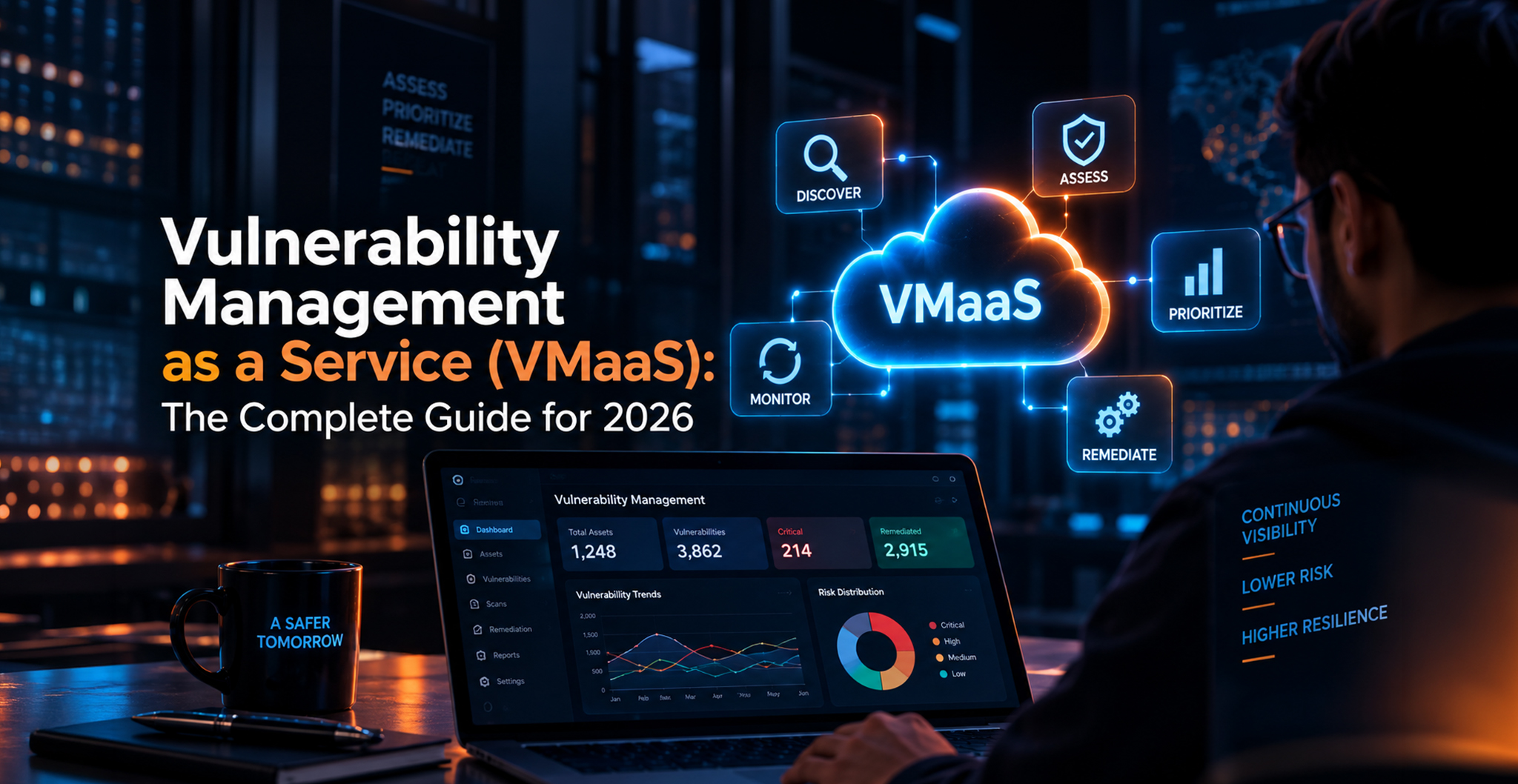
VMaaS follows a structured approach to continuously identify, assess, prioritize, and remediate vulnerabilities across your IT environment.
1. Real-Time Testing Insights
VMaaS provides visibility during and after vulnerability testing. With AutoSecT, the dashboard gives security teams a centralized view of their security posture.
Teams can:
- Track ongoing tests in real time.
- Monitor the total number of vulnerabilities.
- Assess risks using CVSS-based scoring.
- Configure custom SLA-based alerts.
This visibility helps teams understand the current state of testing and respond to findings within the required timeframe.
2. Smarter Vulnerability Prioritization
Not all vulnerabilities pose the same level of risk, and a long list of vulnerabilities can be difficult for security teams to decide where to focus their efforts. VMaaS helps security teams prioritize patches with the help of AI.
AutoSecT will automatically prioritize the most critical vulnerabilities. It also provides bi-directional integration with JIRA, as well as ticketing integrations with Slack, Microsoft Teams, and Google Chat.
3. End-to-End Vulnerability Management
Finding a vulnerability is only the beginning. Security teams also need to track it through resolution. VMaaS brings these activities together through a centralized view of the organization’s asset inventory.
AutoSecT supports vulnerability management across:
- Web applications
- Mobile applications
- API endpoints
- Cloud environments
- Networks

Book Your Free Cybersecurity Consultation Today!
Key Benefits of Vulnerability Management as a Service
VMaaS helps organizations strengthen their security posture by providing continuous visibility, prioritized risk insights, and actionable remediation support.
1. Reduction of Risks
Vulnerability Management as a Service helps organizations reduce risk by identifying vulnerabilities, eliminating them, and lowering threat exposure proactively, rather than waiting for vulnerabilities to become incidents.
2. Improvement of Security Posture
Continuous exposure to threats allows security teams to defend against vulnerabilities that pose an actual risk.
3. Increased Efficiency
Automation allows security teams to focus on more important tasks rather than repeatedly doing mundane tasks.
4. Cost Savings
An effective vulnerability management framework helps organizations reduce the risks associated with data breaches, regulatory compliance violations, and other operational risks.
5. Regulatory Compliance
Vulnerability management helps organizations meet their security and compliance obligations. AutoSecT supports various frameworks including ISO 27001, SOC 2, and NIST 800-53.
6. Improved Visibility and Reporting
Real-time data allows security teams to make informed decisions about the organization’s security posture. Reporting is simplified and gives teams a clear picture of the organization’s vulnerabilities and resolution efforts.
7. Trust and Reputation
Improving your security processes allows you to gain your customers’ trust, as well as that of your business partners and stakeholders.
The Role of AI in Vulnerability Management
Traditional vulnerability management can create large volumes of alerts. Security teams may then spend valuable time sorting through findings and false positives. Kratikal uses AI to make vulnerability management more focused. Vulnerability Management as a Service can go beyond static scoring and use context-aware risk analysis to find the more dangerous vulnerabilities in an environment.
1. Context-Aware Risk Analysis
Not all vulnerabilities have the same impact. AI-driven risk analysis considers the environment when helping teams prioritize vulnerabilities. This gives security teams a more focused way to determine which findings need attention first.
2. Behavior-Driven Detection
AutoSecT analyzes real-time threat intelligence and behavioral data to help organizations stay ahead of attackers.
3. Intelligent Resolution
The use of AI in vulnerability management also extends to providing prioritized resolution recommendations, thus automating the process to a greater extent and reducing the time required to make resolution decisions.
As a result, security teams can focus on improving the organization’s security posture rather than managing security noise.
Join our weekly newsletter and stay updated
How does AutoSecT support Vulnerability Management as a Service?
AutoSecT goes beyond traditional VAPT by combining VAPT and vulnerability management within a single AI-driven platform. After a VAPT exercise, the platform provides real-time testing insights, vulnerability counts, CVSS-based risk assessment, and SLA-based alerts. It also provides AI-based patching recommendations and supports multi-team collaboration through integrations.
The platform supports:
- Risk-based vulnerability prioritization
- AI-driven patching recommendations
- Centralized asset visibility
- Real-time threat intelligence
- Bi-directional JIRA integration
- Slack, Microsoft Teams, and Google Chat integrations
- Compliance-ready reporting
It covers networks, cloud infrastructure, web applications, mobile applications, and APIs. This allows organizations to manage vulnerabilities across different parts of their attack surface from a centralized view.
Best Practices for Effective VMaaS
Organizations can get more value from VMaaS by keeping vulnerability management continuous and structured.
- Maintain visibility across all important assets.
- Prioritize critical vulnerabilities instead of treating every finding equally.
- Set SLA-based alerts for timely responses.
- Connect vulnerability workflows with ticketing and collaboration tools.
- Track findings from discovery through resolution.
- Use AI-driven insights to reduce false positives.
- Review the security posture continuously.
Conclusion
While finding security flaws is essential, managing vulnerabilities includes having clear visibility, effective prioritization, and timely resolution with continuous oversight. Vulnerability Management as a Service combines various vulnerability management processes into a single, structured process. This allows teams to efficiently manage vulnerabilities across their wired, wireless, and cloud environments, as well as application vulnerabilities and APIs, while diminishing the distraction of false positives.
FAQs
- What is Vulnerability Management as a Service?
Vulnerability Management as a Service is a cloud-based or hybrid service that continually identifies, assesses, prioritizes, and addresses security gaps that exist in networking, cloud, applications, and APIs.
- What does VMaaS cover?
VMaaS covers networks, cloud environments, web applications, mobile applications, and API endpoints.
- Why is AI important in vulnerability management?
AI can help minimize false positives and provide smarter recommendations for resolution. This helps security teams prioritize vulnerabilities.
- How does AutoSecT differ from traditional vulnerability scanners?
Traditional vulnerability scanners rely on signature-based scanning. AutoSecT uses AI-based risk scoring and threat intelligence to perform vulnerability scanning and prioritization. It also offers ticketing integrations and compliance-ready reports.
- How does VMaaS help in vulnerability prioritization?
It uses risk-based AI to help security teams focus on the most dangerous vulnerabilities.
- What compliance frameworks does AutoSecT support?
AutoSecT supports ISO 27001, SOC 2, and NIST 800-53.
- Is vulnerability management a one-time process?
No, vulnerability management is a continuous process of discovering, assessing, prioritizing, resolving, and monitoring.