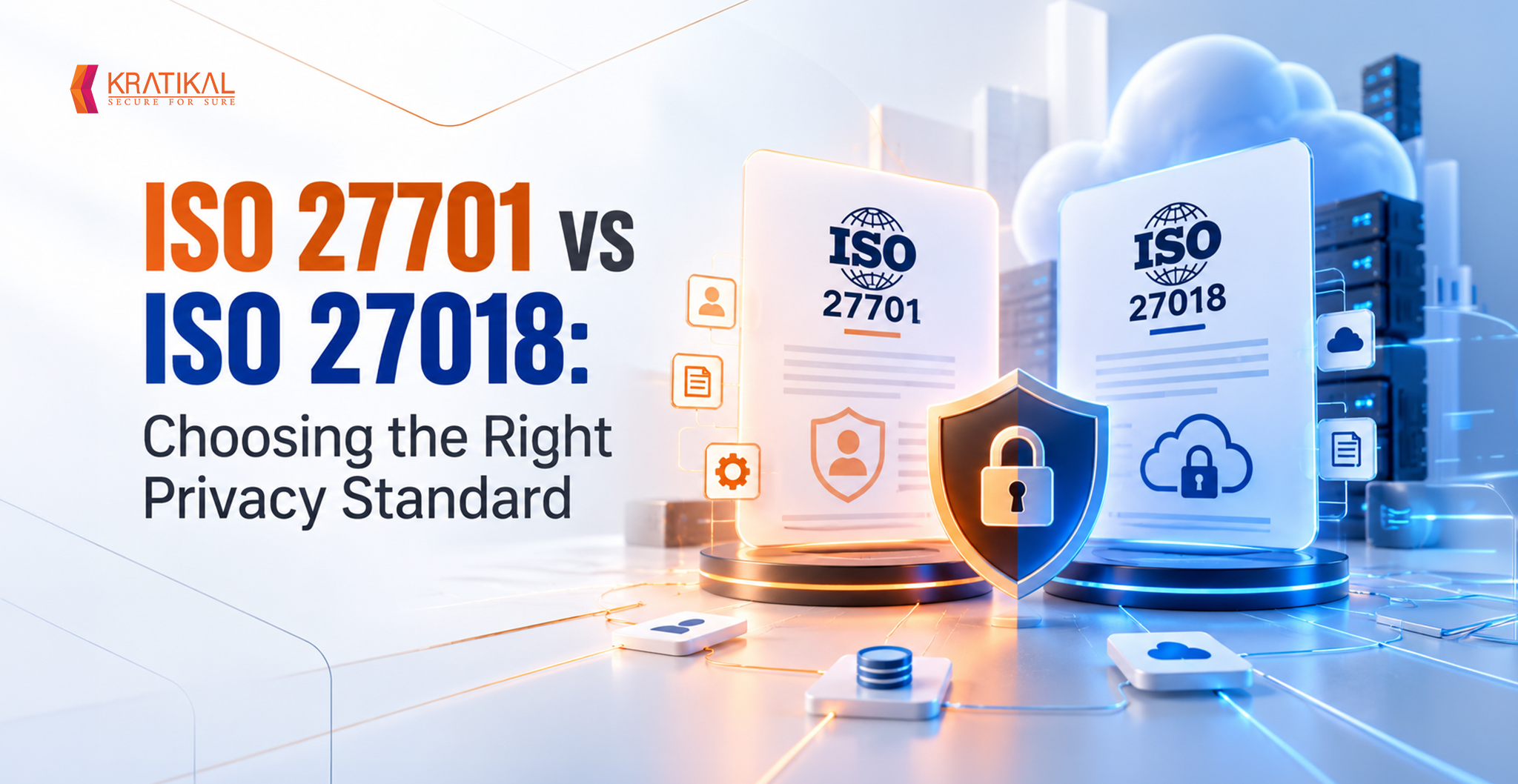
Companies must safely manage customer information to build trust, follow data privacy regulations and protect customers. Choosing the correct privacy standard is often difficult. Potential customers compare ISO 27701 vs ISO 27018. Even if the goal is the same (that is, the protection of personally identifiable information (PII)), the use cases for both standards are different. In particular, ISO 27701 is a more comprehensive privacy information management framework, whereas ISO 27018 is aimed at the protection of personal data processed by public cloud service providers. Some organizations may benefit from both. For example, a cloud service provider could use ISO 27701 to manage privacy across its operations and apply ISO 27018 controls to relevant public cloud services. The right choice should follow a gap assessment. Review your existing security controls, privacy obligations, customer expectations, and business objectives before making a decision. From a business perspective, understanding the subtle differences between the standards helps develop best practices for privacy and better manage and mitigate associated risks. Ultimately, this helps in building trust with customers and supporting business objectives.
What Is ISO 27701?
ISO 27701 is an international standard for ‘privacy information management systems’ (PIMS). It extends the information security management framework to address privacy risks related to personal data. The standard enables organizations to design, implement, maintain and enhance the privacy management processes of the organization. It defines the responsibilities of PII controllers and processors.
ISO 27701 has the potential to improve privacy management for organizations across various sectors. It can help businesses that operate through digital, IT and other service platforms, and cloud environments.
Key Features of ISO 27701
- Privacy management framework: Helps define processes for managing personal information.
- Defined responsibilities: Privacy obligations of PII controllers and processors are articulated.
- Risk management: Helps identify and manage privacy risks.
- Regulatory support: Helps to follow privacy laws.
- Improvement: Regularly assess and improve privacy controls.
ISO 27701 certification can show your organization’s commitment to processing data in a responsible manner. However, being certified to this standard does not mean the organization is compliant with all the privacy laws.
What is ISO 27018?
ISO 27018 is the standard that focuses on public cloud and provides guidance to cloud service providers (CSPs) to protect personally identifiable information (PII). The standard is based on the ISO/IEC 27002:2013 controls and focuses on protecting PII in public clouds.
The standard talks about transparency of data processing, access control and protection of PII. Organizations that use cloud services to evaluate cloud providers and strengthen their privacy practices can adopt the standard.
Key Features of ISO 27018
- Data protection in a public cloud: Focuses on the protection of personally identifiable information in public clouds
- Transparency of data processing: Focuses on communicating the processing of personally identifiable information to customers.
- Access Controls: Focuses on ensuring that personnel are authorized to access PII.
- Data disclosure protection: Focuses on PII protection when a cloud service provider is required by law to disclose the information.
- Privacy–focused controls: Addresses risks of storing and processing PII in the cloud.
ISO 27018 can help cloud providers have privacy and security controls for cloud services. It can also help customers evaluate cloud services.
ISO 27701 vs ISO 27018: Key Differences
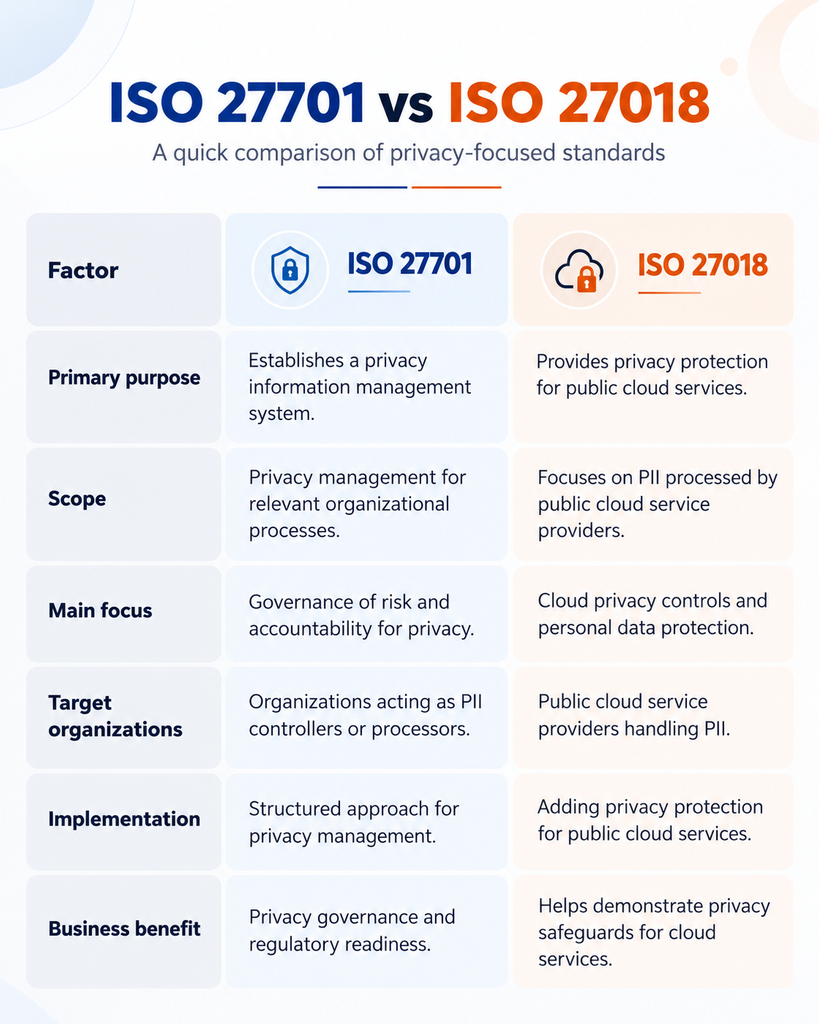
The key difference between ISO 27701 vs ISO 27018 is their scope and purpose. ISO 27701 provides a privacy management framework and controls for the organization. Whereas ISO 27018 provides guidance to cloud service providers to protect PII in the public cloud.
Scope and Coverage
When discussing the differences between ISO 27701 vs ISO 27018, scope is among the first factors to consider. ISO 27701 focuses on managing privacy across processes of an organization. It establishes policies and procedures for privacy management and addresses risk and performance issues related to privacy.
On the other hand, ISO 27018 focuses on PII protection by public cloud services. As such, organizations wishing to adopt a broad privacy management framework would most likely prefer ISO 27701, while public cloud services would mainly find relevance in ISO 27018.
Implementation Requirements
For implementation of ISO 27701, organizations are required to establish and maintain a privacy management system. This includes assessing, addressing, and controlling privacy risks. Further, processes, procedures and responsibilities related to privacy have to be documented.
ISO 27018 covers controls for cloud privacy, including the controls for personal data processing and transparency. Different levels of effort will be required for implementing these controls depending on the organization’s security framework and data processing activities.
Certification and Compliance
Different considerations apply to certification for ISO 27701 vs ISO 27018. The 2025 version of ISO 27701 introduced a dedicated PIMS approach, and the 2019 version was an extension to ISO 27001/ISO 27002. Organizations should review the applicable version to determine certification requirements and plan their audits accordingly.
ISO 27018 is more of a guidance document and is not a standalone management system. Depending on the certification body, its controls may be assessed in an existing or new certification/assurance process.
Neither standard ensures compliance with all data protection laws. Organizations must consider their other legal and contractual obligations.
Benefits of ISO 27701 Compliance
ISO Compliance enables organizations to establish and demonstrate an approach to privacy management. It provides the following benefits even when documentation is not required:
- Improved privacy governance: This is achieved by establishing ownership of privacy responsibilities and decision-making.
- Enhanced risk management: This occurs when an organization is able to identify privacy risks and determine appropriate controls to manage these risks before an adverse incident occurs.
- Public trust: This is accomplished when an organization is able to demonstrate a structured approach to personal data management.
Organizations that want to incorporate privacy into their overall business processes can find these benefits from using ISO 27701.
Benefits of Using ISO/IEC 27018
Addressing privacy concerns with public cloud services can be facilitated with the implementation of practices described in ISO/IEC 27018.
- More Privacy for the Cloud: The standard helps address the protection of personal data in cloud environments.
- More Clarity for Customers: The standard helps describe the practices to handle customer personal data in cloud environments, thereby enhancing transparency for customers.
- Less Risk of Data Exposure: When appropriate safeguards are used, the standard helps describe how to reduce the risk of unauthorized access or disclosure of personal data.
- Better Evaluation of Vendors: The standard can help an organization evaluate a cloud service provider’s privacy practices.
- More Trust for Customers: Privacy-focused controls can help an organization increase trust for its customers.
For cloud providers, these benefits can help them in their customer assurance and procurement activities.
ISO 27701 vs ISO 27018: Which Standard Should You Choose?
Choosing between ISO 27701 vs ISO 27018 depends on your business model, privacy objectives, and data processing responsibilities.
Choose ISO 27701 for your organization if:
- You need a structured privacy information management system.
- You process personal data in different divisions/units of your organization.
- You need to identify and allocate privacy responsibilities and enhance accountability.
- You must improve your privacy risk management process.
- You need a framework to support privacy governance.
Choose ISO 27018 for your organization if:
- You provide public cloud services and process PII.
- You need to address privacy risks in a cloud environment.
- You need to offer privacy protections and safeguards to your cloud customers.
- You need personal data processing in the cloud to be managed with sufficient controls.
How Kratikal Can Help With Privacy Compliance
Implementing the right privacy standard requires a clear understanding of your organization’s risks and obligations. Kratikal helps businesses strengthen their security and compliance practices through structured assessments and practical guidance.
Kratikal supports organizations with compliance-related assessments, including ISO standards and other relevant security frameworks. We help you identify control gaps, improve documentation, and prepare teams for audits. Whether you are considering ISO 27701 or evaluating ISO 27018-related cloud privacy controls, expert guidance can help you develop a suitable implementation plan.
FAQs
- What is the main difference between ISO 27701 vs ISO 27018?
ISO 27701 provides a broader privacy information management framework. ISO 27018 focuses on protecting personally identifiable information processed by public cloud service providers.
- Is ISO 27701 better than ISO 27018?
Neither standard is universally better. ISO 27701 is more suitable for broader privacy management, while ISO 27018 addresses public cloud privacy concerns. The right choice depends on your organization’s needs.
- Can an organization implement both ISO 27701 vs ISO 27018?
Yes. Organizations can use ISO 27701 to establish privacy management processes and apply ISO 27018 guidance to relevant public cloud services.
- Is ISO 27701 compliance mandatory?
ISO 27701 certification is generally voluntary. However, customers, contracts, or specific business requirements may make it necessary. Applicable privacy laws can also impose separate legal obligations.
- Who should consider ISO 27018 compliance?
Public cloud service providers that process personally identifiable information should consider ISO 27018 compliance. Organizations selecting cloud providers can also use its guidance to evaluate privacy safeguards.
- Does ISO 27701 replace ISO 27001?
No. ISO 27701 addresses privacy management, while ISO 27001 focuses on information security management. The 2025 edition of ISO 27701 supports standalone implementation, although the standards can also complement each other.
- Does ISO 27018 guarantee GDPR compliance?
No. ISO 27018 supports cloud privacy practices, but GDPR compliance requires meeting all applicable legal obligations. Organizations must assess their specific processing activities and regulatory responsibilities.
- How long does ISO 27701 implementation take?
The timeline depends on organizational size, data processing complexity, existing controls, and documentation. A gap assessment can help estimate the effort and establish a practical implementation roadmap.