

GraphQL has changed how applications retrieve and consume data. Instead of exposing multiple endpoints for different resources, GraphQL typically provides a single endpoint where clients can request exactly the data they need. This flexibility improves application development and API consumption, but it also creates a different security testing surface.
A GraphQL API can expose sensitive data, complex relationships, business logic, and backend functionality through a single query interface. A weakness in authorization, query validation, or resolver logic can therefore affect multiple parts of an application.
This makes GraphQL API penetration testing important for organisations that rely on GraphQL for web applications, mobile applications, microservices, and internal platforms. Unlike traditional REST API testing, security testing for GraphQL needs to examine the schema, queries, mutations, resolvers, nested relationships, aliases, fragments, and server-side controls.
Gist on GraphQL API Penetration Testing
GraphQL API penetration testing is a security assessment designed to identify vulnerabilities in applications that expose functionality or data through GraphQL APIs.
The assessment combines conventional API penetration testing techniques with GraphQL-specific testing methods. The objective is not simply to determine whether the GraphQL endpoint responds to unexpected requests. A thorough assessment examines whether an attacker can:
- Access data belonging to another user
- Execute unauthorised queries or mutations
- Bypass object-level authorisation
- Retrieve excessive amounts of data
- Exploit business logic
- Enumerate the GraphQL schema
- Trigger resource exhaustion
- Manipulate arguments and variables
- Access administrative functionality
The testing approach should consider both technical vulnerabilities and the application’s intended business behaviour.
Common GraphQL Security Risks
Most GraphQL problems match the OWASP API Security Top 10, a well-known list of the biggest risks in APIs. Below are the issues a GraphQL penetration test usually looks for.
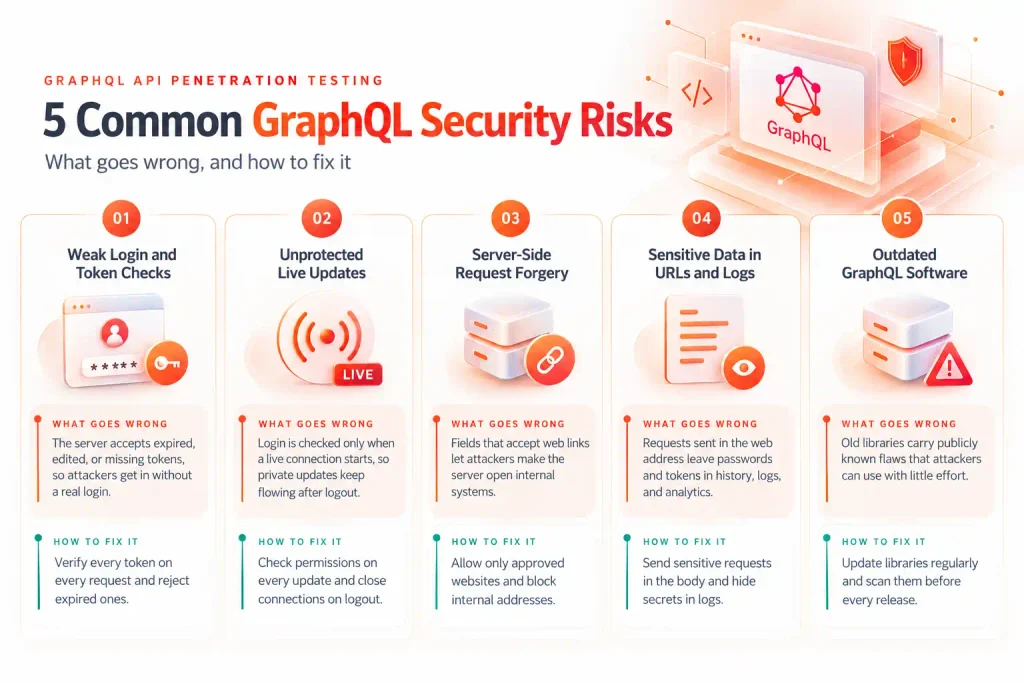
Weak Login and Token Checks
Most GraphQL APIs use tokens, small digital keys, to know who is making a request. If the server doesn’t check these tokens properly, attackers can get in without a real login. Common mistakes include accepting expired tokens, not checking whether a token was changed, or letting some queries run without any token at all. Testers try old, edited, and missing tokens to see what the API allows.
Unprotected Live Updates (Subscriptions)
GraphQL subscriptions let apps receive live updates, such as new chat messages or order status changes. They often use a separate connection called a WebSocket. Developers sometimes check the user’s login only when this connection starts and never again. As a result, a user may keep receiving private updates after logging out, or receive updates meant for other users. Testers check who can subscribe to what, and for how long.
Server-Side Request Forgery (SSRF)
Some GraphQL fields accept web links, for example, to upload a profile picture from a URL or set up a webhook. If the server visits any link it receives, attackers can point it at internal systems that should never be reachable from outside, such as cloud settings or private admin pages. Testers try internal addresses in these fields to see whether the server follows them.

Book Your Free Cybersecurity Consultation Today!
Sensitive Data in Web Addresses and Logs
Some GraphQL APIs allow requests to be sent inside the web address itself. When this happens, private details like passwords, tokens, or personal information can end up in browser history, server logs, and analytics tools. Anyone with access to those logs can then read the data. Testers check which requests can be sent this way and what sensitive details might be stored.
Outdated GraphQL Software
GraphQL servers are built with ready-made software libraries. Like any software, these libraries sometimes have security flaws that get fixed in newer versions. If a company doesn’t update them, attackers can use publicly known flaws to break in. Testers identify the GraphQL software and version in use and check it against known vulnerabilities.
GraphQL API Penetration Testing Scope: What to Include
Scope means agreeing on what will be tested, and how, before the test begins. A clear scope makes the test faster, safer, and more useful. Here is what to decide:
| What to Decide | Details | Why It Matters? |
| Endpoints | All GraphQL addresses, including test, old, and backup versions | Forgotten addresses often have weaker security |
| Schema | Whether testers get the API’s full data map | Sharing it helps testers find hidden actions faster |
| User accounts | At least two accounts for each role, such as admin and normal user | Permission problems show up when comparing accounts |
| Request types | Queries, mutations, and live updates (subscriptions) | Live updates are often less protected |
| Key business flows | Payments, password reset, OTP, coupons, pricing | Logic mistakes hide in multi-step processes |
| Load testing limits | Whether overload testing is allowed, and on which system | Avoids accidentally crashing the live app |
| Firewall and rate limits | Whether testers can bypass them | Shows whether findings reflect real-world risk |
| Retest | When fixes will be checked again | A problem isn’t solved until a retest confirms it |
Two tips make the biggest difference. First, give testers the API’s data map and accounts for every role. This “grey box” approach finds more permission problems in less time. Second, run overload tests and actions that delete data on a test system, not the live one.
How Does a GraphQL API Penetration Test Works?
A GraphQL test follows the same basic steps as any API penetration testing project, with some extra GraphQL checks added in.
- Find the API. Testers find every GraphQL address used by the website and mobile app. They also identify the GraphQL software being used, since each one has known default settings.
- Map the data. Testers try introspection to get the full data map. If it is turned off, they rebuild the map using error hints and the app’s code.
- Check permissions. Testers list every action and every user role, then test each combination to see who can do what.
- Test for overload. Testers try batching, deep queries, and very large requests, within the agreed limits.
- Test inputs. Testers send harmful inputs to look for injection and similar problems.
- Test business logic. Testers try to misuse real processes, such as using a coupon twice or confirming an order without paying.
- Prove and report. Each problem is confirmed with a working example, rated by how serious it is, and linked to the OWASP API Top 10.
- Retest. After developers fix the problems, testers check each fix again
How to Reduce GraphQL Risk?
Development teams can fix most common GraphQL problems with a few simple steps:
- Turn off introspection and “Did you mean…?” hints in the live app, and remove testing tools like GraphiQL from public versions.
- Add a permission check to every resolver, not just at the entry point.
- Set limits on how deep and how large a query can be.
- Count every query and alias toward rate limits, and block batching on login and OTP actions.
- Check and clean every input before it reaches a database, system command, or outside link.
- Show simple error messages to users and keep detailed errors in server logs.
Join our weekly newsletter and stay updated
Conclusion
GraphQL provides developers with flexibility, efficient data retrieval, and a unified interface for modern applications. At the same time, its query-driven architecture introduces security considerations that traditional API testing may not fully address.
A comprehensive GraphQL API penetration testing assessment should therefore examine more than the GraphQL endpoint. It should evaluate schema exposure, authentication, object- and field-level authorisation, queries, mutations, nested relationships, input validation, business logic, injection risks, batching, aliases, and resource consumption.
FAQs
- Why is GraphQL API penetration testing important?
GraphQL can expose multiple data objects and operations through a single endpoint. A weakness in authorisation, resolver logic, or query controls can therefore expose sensitive data or allow unauthorised actions. Penetration testing helps identify these weaknesses before attackers can exploit them.
- What vulnerabilities are commonly found in GraphQL APIs?
Common risks include broken object-level authorisation, broken field-level authorisation, excessive data exposure, injection vulnerabilities, insecure subscriptions, SSRF, introspection exposure, query-depth abuse, batching attacks, and business logic flaws.
- How is GraphQL penetration testing different from REST API testing?
REST APIs generally expose functionality through multiple endpoints, while GraphQL can provide access to multiple resources through a single endpoint. Testing therefore needs to examine schemas, queries, mutations, fields, arguments, nested relationships, aliases, and resolvers in addition to standard API security controls.
- Should GraphQL introspection be disabled?
Introspection is not inherently a vulnerability and can be useful for development and legitimate API consumers. However, organisations should assess whether unrestricted introspection is appropriate in production and ensure that sensitive operations remain protected even when the schema is discoverable.
- What should be included in the scope of GraphQL API penetration testing?
A comprehensive scope can include endpoint discovery, schema analysis, authentication, authorisation, queries, mutations, input validation, injection testing, business logic testing, subscriptions, batching, aliases, rate limiting, query complexity, and resource-consumption testing.