As digital service providers increasingly rely on personal data to personalise customer experiences and support business decisions, managing privacy risks has become a business priority. Collecting and processing personally identifiable information (PII) also introduces regulatory, operational, and reputational risks. Organisations must not only protect personal data but also demonstrate that privacy controls are effectively implemented across their operations. An ISO 27701 audit helps organisations assess whether their Privacy Information Management System (PIMS) is properly designed, implemented, and supported by verifiable evidence. Published in October 2025, ISO/IEC 27701:2025 introduced a standalone framework for privacy information management, replacing the 2019 edition. Organisations planning for certification should therefore align their audit requirements and implementation plans with the applicable edition.
What Is an ISO 27701 Audit?
An ISO 27701 compliance audit is a logical evaluation of the privacy management system an organisation has with respect to the requirements of ISO/IEC 27701. It analyses how the companies recognise the risk of privacy, manages processing of personal data, allocates the responsibilities, control and performance monitoring.
The evaluation takes into account the policies that are written and the practices that are in operation. A privacy policy may describe appropriate procedures, for example, but an auditor may also need evidence that access restrictions are enforced, data retention schedules are followed and privacy incidents are managed effectively.
An internal readiness audit and an independent certification audit are to be distinguished. An internal audit presents the weaknesses, and ensures that corrective actions are undertaken prior to the formal assessment of ISO 27701 compliance.
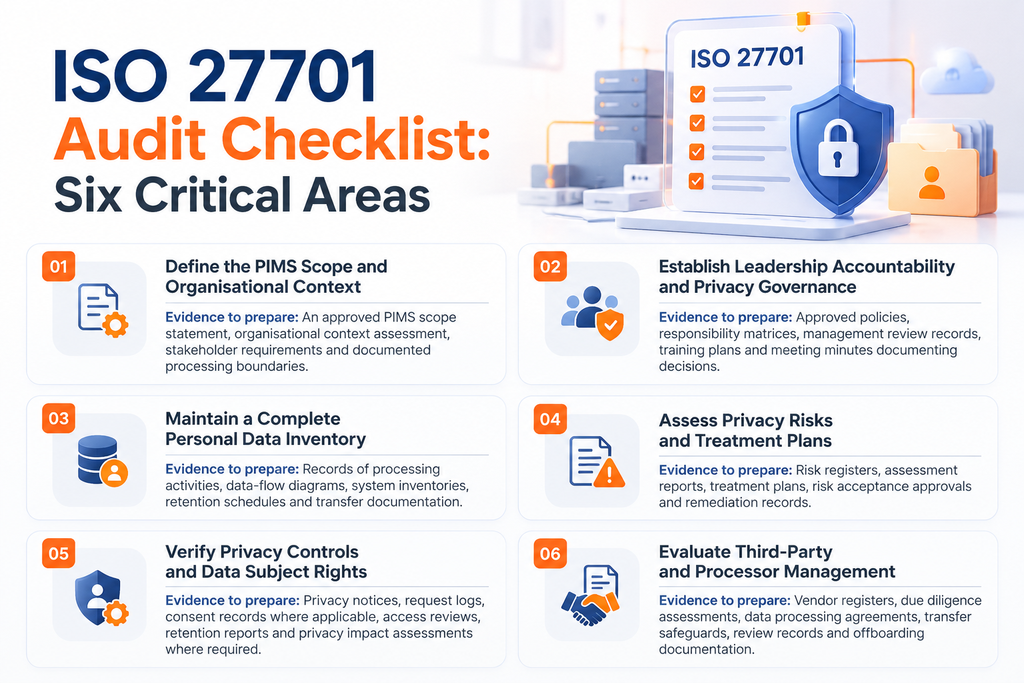
ISO 27701 Audit Checklist: Six Critical Areas
This ISO 27701 audit checklist covers the key areas organisations should assess, from privacy governance and risk management to control implementation and supporting documentation. It helps identify gaps, strengthen privacy practices, and prepare the PIMS for certification.
1. Define the PIMS Scope and Organisational Context
The first step is establishing which business activities, systems, locations, teams and data-processing operations fall within the Privacy Information Management System.
Checklist:
- Document the PIMS scope, boundaries and applicable exclusions, with supporting justification where required.
- Identify internal and external factors affecting privacy management.
- Determine relevant stakeholder requirements, including customers, regulators, employees and business partners.
- Identify the organisation’s role as a personally identifiable information (PII) controller, processor or both, as applicable.
- Confirm that the scope reflects actual data-processing activities rather than an artificially narrow selection of systems.
Evidence to prepare: An approved PIMS scope statement, organisational context assessment, stakeholder requirements and documented processing boundaries.
2. Establish Leadership Accountability and Privacy Governance
Privacy management requires clear ownership. If responsibility is distributed across legal, IT, security and operations teams without effective coordination, critical decisions can be delayed or overlooked. An ISO 27701 audit should evaluate whether senior management provides appropriate direction, resources and oversight. Privacy responsibilities should be assigned to relevant functions, with escalation routes for material risks and incidents.
Checklist:
- Establish and approve a privacy policy aligned with organisational objectives.
- Assign responsibilities for privacy governance, risk management and control implementation.
- Demonstrate leadership commitment through resource allocation, reviews and documented decisions.
- Define reporting mechanisms for privacy risks, incidents and control failures.
- Ensure relevant employees understand their privacy responsibilities.
Evidence to prepare: Approved policies, responsibility matrices, management review records, training plans and meeting minutes documenting decisions.
3. Maintain a Complete Personal Data Inventory
It is impossible to govern personal data in organisations without knowing what they collect, why they process it, where it resides and who can access it. Incomplete inventories may conceal unnecessary collection, excessive retention and unmanaged transfers.
Checklist:
- Maintain an inventory of personal data and relevant processing activities.
- Document processing purposes, data categories and affected individuals.
- Identify systems, storage locations, access permissions and data flows.
- Record applicable retention periods and secure disposal procedures.
- Identify international transfers and relevant contractual or legal safeguards.
- Review the inventory whenever systems, vendors or business processes change.
Evidence to prepare: Records of processing activities, data-flow diagrams, system inventories, retention schedules and transfer documentation.
4. Assess Privacy Risks and Treatment Plans
A risk-oriented PIMS directs resources to processing activities that might cause tremendous effects on people or bring the organisation to material business risk. Such dangers can come due to excessive access, non-secure integrations, faulty records, improper retention or unauthorised disclosure. The ISO 27701 audit ought to define whether there is a systematic identification of privacy risks, which have been assessed according to defined principles and treated using a proper treatment plan.
Checklist:
- Maintain a documented privacy risk assessment methodology.
- Assess risks associated with relevant personal data processing activities.
- Evaluate the likelihood and potential impact of privacy-related harm.
- Assign risk owners and document treatment decisions.
- Track remediation actions, deadlines and residual risks.
- Reassess risks following significant changes or incidents.
Evidence to prepare: Risk registers, assessment reports, treatment plans, risk acceptance approvals and remediation records.
5. Verify Privacy Controls and Data Subject Rights
The privacy controls must translate documented commitments into operational safeguards. The relevant actions would be based on the role of the organisation, the activities of the organisation’s processing, risks and legal obligations relevant to an organisation. For controllers, important considerations include the lawful basis or other applicable justification for processing, transparency, purpose limitation and handling individuals’ rights.
Checklist:
- Review processes for collecting and communicating information about personal data use.
- Verify consent management where consent is the applicable legal basis.
- Establish procedures for access, correction, deletion and other applicable data subject requests.
- Validate identity verification, response tracking and escalation procedures.
- Review access controls, data minimisation and retention enforcement.
- Confirm that privacy requirements are considered when introducing new products, features or processing activities.
Evidence to prepare: Privacy notices, request logs, consent records where applicable, access reviews, retention reports and privacy impact assessments where required.
6. Evaluate Third-Party and Processor Management
External providers using their own systems, subcontractors and data-handling practices can cause privacy risks. It is especially critical for organizations that are using SaaS platforms, cloud architecture, subcontracted customer support or external analytics. The ISO 27701 audit is supposed to evaluate the integrity of selecting the vendor, the contractual agreements and continuous monitoring according to the sensitivity of the data and risk involved with every relationship.
Checklist:
- Maintain an inventory of third parties that process personal data.
- Perform proportionate privacy and security due diligence before onboarding vendors.
- Define processing instructions, responsibilities and applicable contractual requirements.
- Assess subcontracting arrangements and relevant international data transfers.
- Monitor vendor performance, incidents and material changes.
- Establish secure data return, deletion and access revocation procedures when contracts end.
Evidence to prepare: Vendor registers, due diligence assessments, data processing agreements, transfer safeguards, review records and offboarding documentation.
How Kratikal Prepares You for an ISO 27701 Certification Audit?
After completion of the checklist, the organisations are then supposed to transform the findings into a prioritized readiness program.
- Conduct a gap assessment. Evaluate the current policies, processes and evidence against the requirements of the relevant standard.
- Prioritise material risks and control failures. Gaps involving sensitive personal data, unclear accountability, inadequate processor agreements or ineffective incident response may require earlier attention than administrative improvements.
- Validate implementation through evidence. Interview process owners, operational records of the sample and test functionality of controls.
- Verify corrective actions and confirm audit readiness. Check the completeness of evidence, verify outstanding, and make sure leadership is fully informed of unresolved risks.
Conclusion
Certification ready PIMS needs to be built on the coordinated governance, trusted data visibility, risk-based controls and evident management commitment. An effective ISO 27701 audit checklist assists organisations in managing this work, recognising where it is weak and in evaluating whether the privacy controls are consistently set in place across business operations.
By aligning the audit programme with the applicable edition of ISO/IEC 27701, reviewing supporting evidence, and assigning clear ownership for corrective actions, organisations can address compliance gaps and strengthen their readiness for certification. This structured approach also helps integrate privacy protection into everyday business processes and decisions.
FAQs
- Is ISO 27701:2025 a standalone standard?
Yes. ISO/IEC 27701:2025 is a standalone PIMS management system standard. The previous ISO/IEC 27701:2019 edition was an extension to ISO/IEC 27001 and ISO/IEC 27002.
- Is ISO 27001 mandatory for ISO 27701 certification?
No. Under ISO/IEC 27701:2025, organisations can pursue PIMS certification independently without first obtaining ISO/IEC 27001 certification. However, they should confirm the applicable certification requirements and any relevant contractual or regulatory obligations before proceeding.
- What documents are required for an ISO 27701 audit?
Relevant documents may also include the PIMS scope, privacy policy, processing records, risk assessments, control evidence, vendor agreements, incident records, training records, internal audit reports, and management review minutes.
- How long does ISO 27701 certification take?
The timelines fluctuate as per the size of the organisation, the complexity of the processes, the current systems of management, availability of resources, and the maturity of the current privacy controls. Gap assessment is pertinent in defining a realistic implementation and certification plan.
- Does ISO 27701 certification guarantee GDPR compliance?
No. ISO 27701 can facilitate privacy management and reflect other relevant business practices but certification does not necessarily imply ISO 27701 compliance with all GDPR requirements and other privacy legislation.
- How often should an organisation conduct an ISO 27701 audit?
Internal audits are supposed to be conducted at scheduled periods depending on the standard to be applied, environment, risks and audit programme. The controls should also be reassessed in organisations as they face major business, technology, regulatory or processing changes.
- Who should audit ISO 27701?
Internal auditors can give an organisation the ability to audit its performance using competent, properly impartial auditors. A certified certification body under the applicable certification and accreditation arrangements should conduct a certification audit.