
Every organization that stores, processes, or transmits cardholder data knows the drill: firewalls configured, encryption in place, access controls documented, quarterly scans scheduled. On paper, PCI DSS compliance looks airtight. Yet payment card breaches continue to make headlines, and a growing number of them trace back to a component that traditional compliance checklists barely address: APIs.
As payment ecosystems shift toward mobile wallets, embedded finance, and real-time transaction processing, APIs have become the connective tissue of the payment card industry. They power everything from tokenization services to third-party payment gateways. And yet, API security remains one of the most under-scrutinized areas in PCI DSS compliance programs. This is not a small oversight; it’s a structural blind spot that attackers are actively exploiting.
Why Are APIs the Weak Link in Payment Ecosystems?
PCI DSS was built around a network-perimeter mindset: segment the cardholder data environment (CDE), lock down access, monitor traffic at defined chokepoints. APIs break that model. They are designed to be accessible, often exposed to partners, mobile apps, and third-party processors, and they move cardholder data across trust boundaries that legacy compliance frameworks never anticipated.
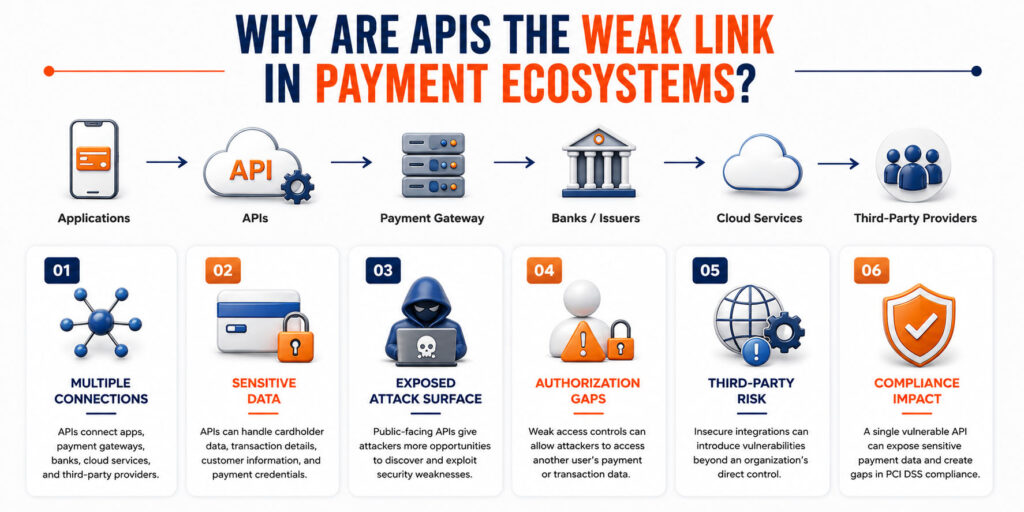
A few structural realities make APIs uniquely risky in payment environments:
- They are logic-heavy, not just data pipes. An API doesn’t just move card data; it enforces (or fails to enforce) business rules around authentication, authorization, and rate limits. A flaw in that logic can expose cardholder data without ever “breaching” a firewall.
- They multiply the attack surface silently. Every new microservice, mobile app version, or partner integration can introduce a new API endpoint. Shadow APIs and undocumented endpoints are common in fast-moving development environments and often fall outside the defined CDE scope for PCI DSS compliance assessments.
- They are dynamic, while compliance is periodic. PCI DSS assessments follow a cycle of annual audits and quarterly scans. APIs change continuously through CI/CD pipelines. A compliant snapshot today can be irrelevant within weeks.
Where PCI DSS Compliance Programs Fall Short on API Security
Most organizations approach PCI DSS Compliance with a checklist mentality tuned to network and application-layer controls, but several API-specific gaps consistently go unaddressed.
1) Incomplete Scoping of the Cardholder Data Environment
PCI DSS requires organizations to accurately define the CDE, but API-driven architectures make this genuinely difficult. Data can flow through orchestration layers, caching services, and third-party API gateways that aren’t always mapped during scoping exercises. If an API silently handles cardholder data, even in transit or logs, and teams leave it out of scope, they aren’t testing, monitoring, or hardening it to PCI DSS standards.
2) Weak or Inconsistent Authentication on Internal APIs
Requirement 8 of PCI DSS mandates strong authentication for access to system components, but this is frequently applied rigorously to user-facing logins and loosely to machine-to-machine API calls. Internal APIs connecting microservices, or APIs used by third-party payment processors, sometimes rely on static API keys or long-lived tokens with no rotation policy, a direct contradiction of PCI DSS’s intent, even if it technically isn’t flagged during an audit.
3) Insufficient Input Validation and Business Logic Testing
Traditional vulnerability scans check for known CVEs and common injection flaws. They rarely test for broken object-level authorization (BOLA), excessive data exposure, or mass assignment vulnerabilities, all OWASP API Security Top 10 issues that can leak cardholder data without triggering a single signature-based alert. PCI DSS Requirement 6 calls for secure development practices, but many organizations interpret this narrowly, missing API-specific logic flaws entirely.
4) Third-Party and Partner API Risk
Payment ecosystems rely heavily on third-party APIs, payment gateways, fraud detection services, and loyalty platforms. PCI DSS Requirement 12 addresses service provider due diligence, but API-level risk assessments of these integrations are often superficial. Organizations often verify a partner’s PCI DSS compliance on paper but fail to test how their own APIs interact with the partner’s endpoints or how a compromised partner API could impact their systems.
5) Inadequate Logging and Monitoring at the API Layer
Requirement 10 mandates logging and monitoring of access to cardholder data, but many logging strategies are built around server and database access rather than API request/response patterns. Without proper API-level logging, including anomalous call volumes, unusual parameter manipulation, or geographic irregularities, a slow-moving API abuse attack can persist undetected for months.
If you want to know about PCI DSS Compliance Requirements, read the blog on PCI DSS Compliance version 4.1

Book Your Free Cybersecurity Consultation Today!
Closing the Gap: What Effective API Security Adds to PCI DSS Compliance
Bridging this gap requires treating API security as a first-class component of the compliance program, not an afterthought layered on top of it.
- Maintain a live API inventory:
Continuous discovery of APIs, including shadow and deprecated endpoints, should feed directly into CDE scoping, not sit in a separate DevOps dashboard.
- Test business logic, not just infrastructure:
VAPT engagements should explicitly include API-focused testing aligned with the OWASP API Security Top 10, covering authorization flaws, data exposure, and rate-limiting bypass, not just network-layer penetration testing.
- Enforce strong, rotating authentication for all API consumers: Internal and external, with token expiry and scope limitations built in by design.
- Extend third-party risk assessments to the API level: Verifying not just a partner’s compliance certificate but the actual security posture of the endpoints your systems talk to.
- Build API-aware monitoring: This can distinguish normal transaction patterns from anomalous behavior, feeding into the same SIEM and alerting pipeline used for broader PCI DSS compliance monitoring.
Join our weekly newsletter and stay updated
The Bottom Line
As payment ecosystems become increasingly API-driven, securing APIs has become essential for protecting sensitive cardholder and transaction data. Organizations must go beyond traditional network security and address API-specific risks such as broken authentication, authorization flaws, excessive data exposure, injection attacks, and insecure third-party integrations. Maintaining a complete API inventory, enforcing least-privilege access, protecting tokens and credentials, monitoring API activity, and conducting regular security testing can help organizations identify and remediate vulnerabilities before attackers exploit them. By making API security an integral part of their security and compliance strategy, organizations can reduce attack surfaces, protect payment data, and strengthen their overall PCI DSS Compliance posture.
FAQs
- How can organizations secure payment APIs?
Use strong authentication, authorization, encryption, rate limiting, monitoring, and regular security testing.
- Why should organizations maintain an API inventory?
An API inventory helps security teams identify all active, deprecated, internal, and external APIs. Without complete visibility, undocumented or forgotten APIs can become entry points for attackers and create compliance blind spots.
- What role does API logging play in PCI DSS Compliance?
API logs can provide visibility into authentication attempts, failed authorization requests, sensitive transactions, and suspicious activity. Proper logging and monitoring can support threat detection, investigation, and compliance requirements.
- Can API vulnerabilities lead to payment fraud?
Yes. Vulnerabilities involving authentication, authorization, transaction manipulation, or business logic can potentially allow attackers to alter payment requests, access sensitive information, or perform unauthorized actions.
- How does API monitoring support PCI DSS Compliance?
Monitoring helps organizations detect suspicious API activity, unauthorized access attempts, and potential security incidents.
- How can weak authorization affect payment APIs?
Weak authorization can allow attackers to access or modify payment information they are not permitted to access.
- What role does API access control play in PCI DSS Compliance?
Strong access controls ensure that only authorized users and applications can access payment-related resources.