Cybersecurity has become a business priority rather than just an IT responsibility. Organizations today face ransomware attacks, data breaches, regulatory requirements, and growing customer expectations around security. Yet many companies struggle to build a structured security program that can keep pace with these challenges. Large enterprises typically hire a full-time Chief Information Security Officer (CISO) to guide their security strategy. However, most small and medium enterprises do not have the resources to hire a safety executive. A Virtual CISO is a safety executive that a small or medium enterprise can afford. The vCISO is an executive-level safety resource that an organization can afford to implement safety governance, enhance safety controls, and manage cyber risk. The vCISO aligns safety resources with the objectives of the organization.
Why Security Program Maturity Matters
Many organizations invest in security tools but still struggle with security incidents. The problem is rarely the absence of technology. Instead, it is often the lack of a structured security strategy.
A mature security program helps organizations:
- Understand their cyber risks
- Establish security governance
- Prioritize security investments
- Improve incident response readiness
- Satisfy the organization’s legal obligations
Safety resources can be governance-focused or reactive to the organization’s safety concerns.

Book Your Free Cybersecurity Consultation Today!
The Demand for Safety Resources
Cyber threats continue to evolve at high speed. Customers, regulators, and business partners expect organizations to adopt a high level of cybersecurity. Demonstrating a high level of cybersecurity is critical, and hiring a full-time CISO is one way organizations can achieve this.
What is a Virtual CISO?
A vCISO is someone experienced in cybersecurity who can provide an organization with security leadership and oversight at a fraction of the cost of a full-time CISO.
A vCISO typically works with leadership teams to:
- Develop security strategies
- Conduct risk assessments
- Create security policies
- Guide compliance efforts
- Oversee incident response planning
- Improve security governance
- Security awareness
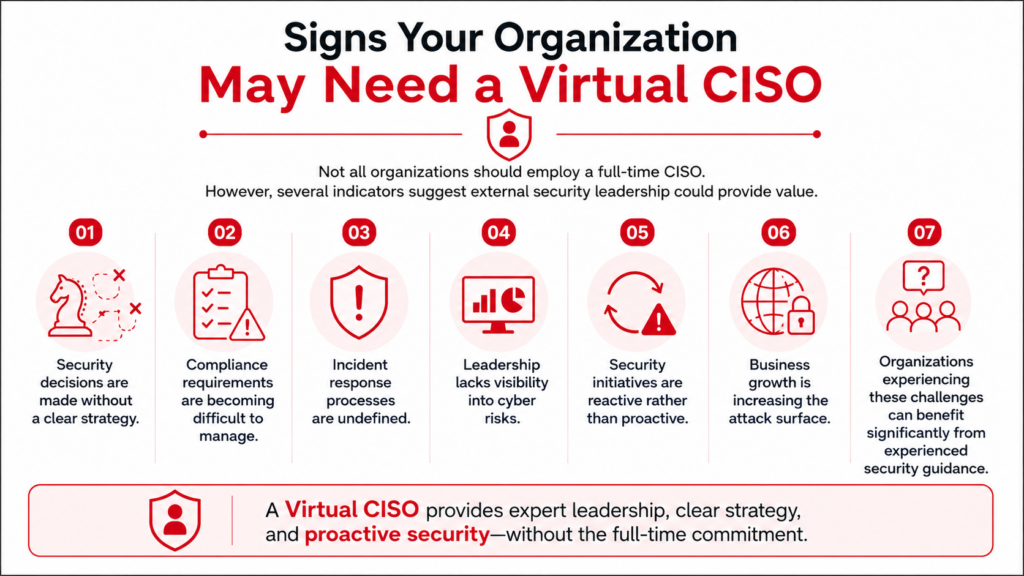
Common Challenges Organizations Face Without Security Leadership
- Security Investments Lack Direction
Organizations often purchase security tools and technology with little or no guidance. The result is unsolved risks and an increase in security investment.
- Risk Management Becomes Reactive
Security teams end up prioritizing a response to an evolving threat rather than planning for the management of threats. This reactionary approach leaves the organization vulnerable to new threats.
- Compliance Efforts Become Difficult
Regulatory requirements continue to proliferate. Many organizations need to be more able to define how to comply with the new security requirements without guidance.
- Incident Response Readiness Remains Weak
Many organizations have no defined response plans, no defined communication or escalation procedures. The preparation and response to an incident are crucial to the impact of the security incident.
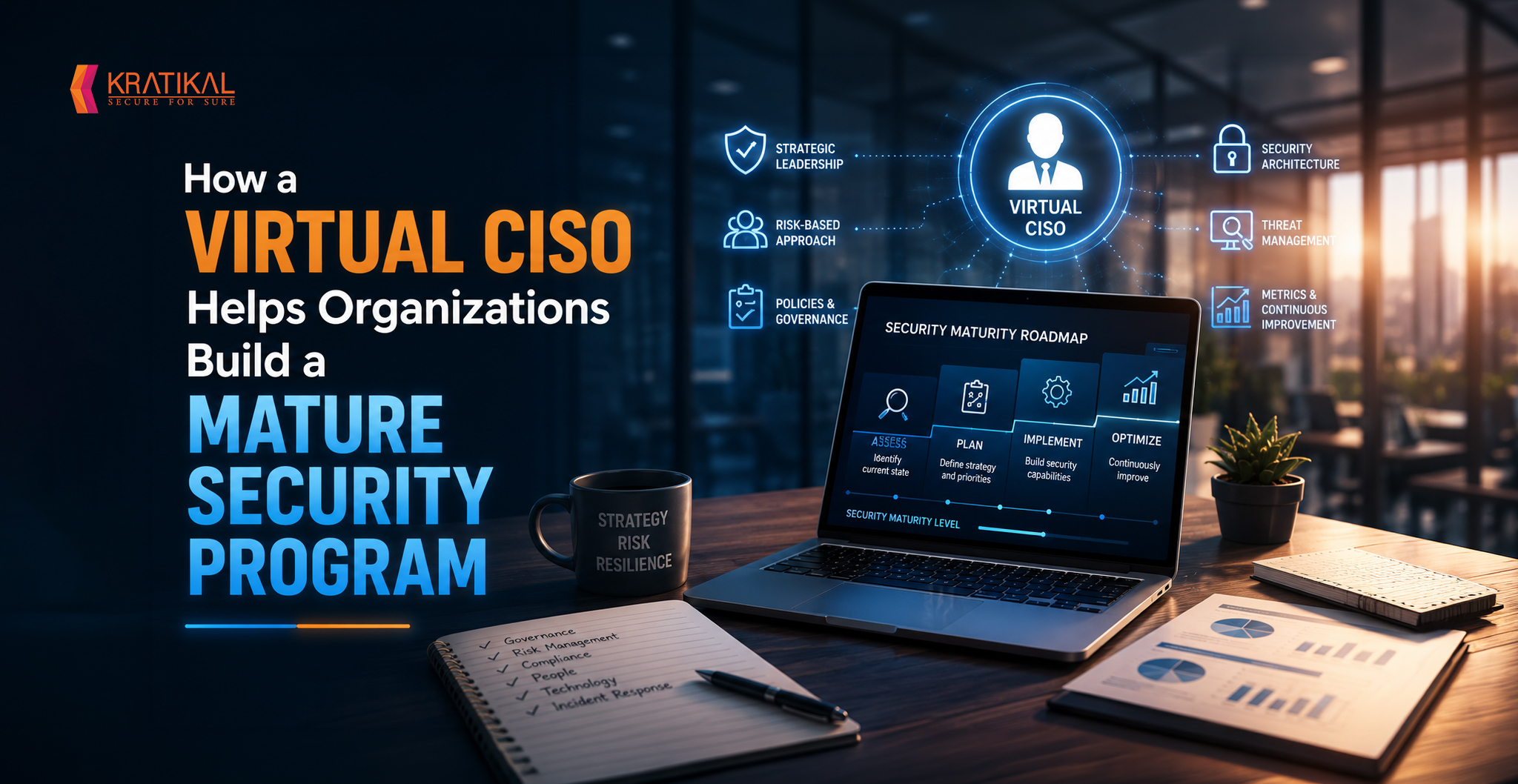
How a Virtual CISO Helps Build a Mature Security Program
Step 1 – Establishing a Security Strategy
Every mature security program begins with a clear security strategy. The Virtual CISO analyzes the organization, determines the security gaps, and prioritizes the gaps based on the business goals. The strategy allows the organization to improve security in a proactive and priority-based manner, instead of responding to various security threats.
Step 2 – Strengthening Risk Management
The foundation of security at the enterprise level and the various ecosystems that make up the enterprise is risk management. The Virtual CISO works with the organization to define, assess, and prioritize risks in their environment.
This includes evaluating:
- Technical vulnerabilities
- Third-party risks
- Cloud security exposures
- Operational risks
- Compliance risks
The goal is to ensure security efforts are aligned with the organization’s risk profile.
Step 3 – Developing Security Policies and Governance
Policies provide the framework for consistent security practices. Without documented policies, security decisions become inconsistent and difficult to enforce.
A Virtual CISO helps create policies covering:
- Access management
- Data protection
- Incident response
- Acceptable use
- Vendor security
- Security awareness
Strong governance reinforces these policies.
Step 4 – Improving Security Awareness
Security incidents have many causes. One of the main causes is human error. A Virtual Chief Information Security Officer (CISO) assists the organization in creating a security awareness training to teach employees about phishing, credential theft, social engineering, and other related tactics. Security awareness training reduces the overall enterprise risk.
Step 5 – Supporting Compliance Initiatives
Many organizations must comply with security frameworks and regulatory requirements.
Examples include:
- ISO 27001
- PCI DSS
- GDPR
- HIPAA
- SOC 2
- RBI and CERT-In guidelines
A Virtual CISO guides enterprises in understanding obligations, remediating security deficiencies, and preparing for audits. This reduces compliance-related stress and improves audit readiness.
Building a Security Program That Evolves With the Business
Security programs must evolve as organizations grow. The security concerns of a budding enterprise are vastly different from the concerns of an enterprise with a multi-regional presence. A Virtual CISO ensures the alignment of security tactics with the growth of the enterprise.
This includes:
- Evaluating new technologies
- Assessing cloud adoption risks
- Reviewing third-party relationships
- Supporting digital transformation projects
- Managing emerging threats
This offers the security of the enterprise and restrictions that align with the goals of the enterprise.
How a vCISO Aids in the Development of Security Metrics and Reporting?
Visibility into security operations and the ability to measure the effectiveness of security efforts and justify investments is the need of every leadership team.
A Virtual CISO provides support in developing and monitoring security metrics such as:
- Time taken to remediate vulnerabilities
- Security incident trends
- Compliance status
- Risk reduction efforts
- Security awareness effectiveness
The availability of these metrics enables leadership to prioritize security efforts.
Virtual CISO Services
The need for vCISO services increases as the need for scalable security leadership increases, and the cost of a full-time security executive is prohibitive.
- Cost
A full-time CISO is cost-prohibitive to small and mid-sized businesses. A Virtual CISO meets the need for experienced leadership at a more affordable cost.
- Valuable Security Resources
vCISO services recruit security leadership solutions that are readily available.
- Scalable Services
Easily adjust the security services to match security requirements.
- Broader Industry Experience
Most vCISO’s multi-industry exposure enables them to flexibly formulate solutions informed by experience from varied sectors.
How Kratikal Supports Organizations Through vCISO Services?
The maturity of an organization’s security program goes beyond the integration of security technologies. It requires the formulation of security strategies, security program management, and operational security program evolution.
Kratikal vCISO services assist organizations in building their security program while supporting the organization in the alignment of security activities to the organization’s objectives.
Our experts help organizations:
- Develop cybersecurity roadmaps
- Conduct risk assessments
- Build governance frameworks
- Strengthen compliance programs
- Improve incident preparedness
- Enhance security awareness
- Monitor evolving threats
As a CERT-In-certified organization, Kratikal enhances the security of organizations through complex security regulatory frameworks. Kratikal focuses on building security programs which are practical and can be scaled to provide continuous security for organizations.
Best Practices for Working With a Virtual CISO
To maximize the benefits of a vCISO, an organization needs to treat the CISO services as a strategic partnership. Leadership teams are encouraged to involve their vCISOs with business planning, new technologies, and related risk management discussions.
To align security efforts with business priorities, security initiatives must be sustained through regular communication and the setting of clear objectives and goals that can be measured. It is the responsibility of organizational leaders to embrace the findings of security assessments and to institute the recommended changes. Continuous improvement is the only path to long-term success.
Conclusion
The evolution of cyber threats has transformed the integral role of cyber security from the protection of organizational assets to the preservation of business continuity, the stability of operations, and the preservation of customer trust.
Organizations that establish strong governance, proactive risk management, effective security awareness, and structured incident preparedness are better positioned to navigate today’s evolving threat landscape. Strategic leadership, clear direction, and continuous improvement help businesses strengthen their defenses while supporting long-term growth and operational success.
Join our weekly newsletter and stay updated
FAQs
- What is a Virtual CISO?
As the name suggests, a vCISO (Chief Information Security Officer) is a virtual, contract, or part-time C-Suite security strategy professional.
- How is a Virtual CISO different from a full-time CISO?
A full-time CISO is a permanent member of the C-suite, whereas a vCISO is a virtual C-suite security strategy professional who is available on a contract basis.
- Which organizations benefit most from Virtual CISO services?
The organizations that benefit the most from vCISO services include small to mid-sized organizations, growing businesses, and organizations that have developing security demands.
- Can a vCISO help with compliance requirements?
Absolutely. A Virtual CISO can provide support for compliance requirements that include, but are not limited to, ISO 27001, GDPR, PCI DSS, SOC 2, and HIPAA compliance.
- Does a Virtual CISO manage incident response planning?
A vCISO is responsible for the design and development of the incident response plan and the associated procedures, plan communication, and recovery strategy.
- In what ways does a Virtual CISO facilitate better risk management?
A vCISO differentiates levels of risk across the enterprise, guides the organization on the order of remediation based on risk, cost, and effort, and aids in the optimization of security spending in alignment with the enterprise goals.
- Is using a Virtual CISO a smart financial decision?
Yes. Cybersecurity consultancy services at the executive level are costly. A vCISO allows an organization to procure such services without incurring the cost of a full-time head.
- Does a vCISO help with cloud security?
Yes. A vCISO can examine the risks associated with the cloud, evaluate security controls, assess risk posed by third parties, and help establish cloud security governance.