

A single compromised user account should never be enough to bring down an entire enterprise. Yet, in many organizations, attackers can move from a low-privileged account to complete domain control by exploiting weaknesses in Active Directory (AD). Despite being the foundation of identity and access management for most Windows-based environments, Active Directory is often misconfigured, under-monitored, and treated as a “set it and forget it” technology.
Hackers recognize the immense value of Active Directory because it governs who can access critical systems, applications, servers, and sensitive business data. Once attackers gain a foothold inside the network, Active Directory frequently becomes their primary target. By exploiting weak permissions, misconfigured policies, outdated authentication protocols, and excessive administrative privileges, they can escalate privileges, move laterally within the environment, and eventually gain complete control of the domain.
Why Is Active Directory Often the First Choice for Attackers?
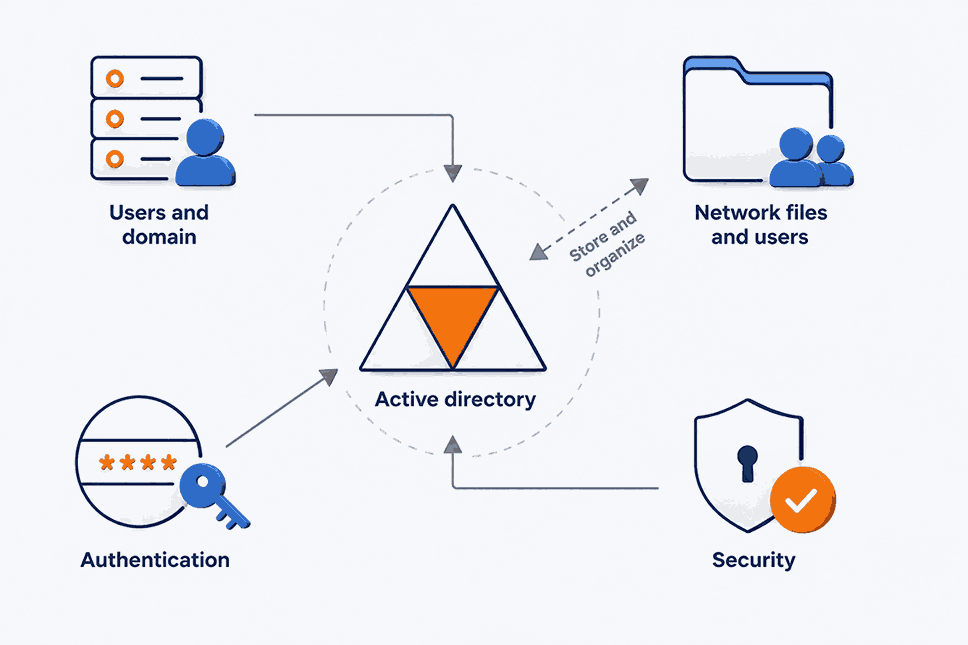
Microsoft designed Active Directory in an era when convenience often took priority over resilience against today’s advanced attack techniques. Its architecture assumes a level of trust between systems and accounts that doesn’t hold up against modern adversaries. A single domain controller compromise can cascade into control over every server, workstation, and application tied to that domain.
This centralization is a double-edged sword. It makes IT administration efficient, but it also means attackers only need to find one weak link- a misconfigured trust, an overprivileged service account, a forgotten legacy protocol- to move from a low-value foothold to domain-wide control. Once inside, adversaries don’t need to fight their way through dozens of independent systems. They map trust relationships, identify privileged accounts, and quietly work their way to the top.
This is why so many high-profile ransomware incidents share a common thread: initial access through phishing or an exposed endpoint, followed by rapid privilege escalation inside Active Directory, followed by domain-wide encryption or data exfiltration.
The Misconfigurations Hiding in Plain Sight
Most organizations don’t get breached because of a zero-day exploit. Attackers breach organizations by exploiting accumulated, everyday misconfigurations that security teams never fixed. Some of the most common issues security teams uncover in AD environments include:
- Overprivileged accounts and nested group memberships: Users and service accounts that accumulated far more access than their roles require, often because it was “easier” at the time.
- Weak or static service account passwords: Many service accounts use passwords that haven’t changed in years, making them prime targets for offline cracking.
- Legacy protocols left enabled: Organizations often keep NTLM, unconstrained delegation, and other legacy mechanisms active long after they should retire them, primarily to maintain backward compatibility.
- Poor OU and Group Policy hygiene: Group Policy Objects (GPOs) that grant broader rights than intended, sometimes across an entire domain.
- No tiered administration model: Domain admin credentials being used to log into everyday workstations, exposing high-value credentials to low-value, high-risk endpoints.
- Limited visibility into authentication events: Without proper logging, unusual login patterns, ticket requests, or replication activity go unnoticed until it’s too late.
None of these are exotic. They are the kind of gaps that build up quietly over years of operational pressure, and they’re exactly what attackers look for.
Kratikal’s network penetration testing approach goes beyond identifying individual vulnerabilities; it maps how attackers can move through Active Directory and escalate privileges to reach critical systems.

Book Your Free Cybersecurity Consultation Today!
Privilege Escalation: Where Small Gaps Become Full Domain Takeovers
This is where privilege escalation becomes the real story. An attacker rarely walks in the front door with domain admin rights. Instead, they start small: a phished employee’s credentials, an exposed low-privilege service account, an unpatched workstation, and then work their way upward.
Inside Active Directory, privilege escalation often follows well-worn paths:
- Kerberoasting and AS-REP roasting: Which extract service account credentials that can be cracked offline.
- Pass-the-Hash and Pass-the-Ticket attacks: Which reuse captured credentials or Kerberos tickets to authenticate as another user without ever knowing their password.
- DCSync and DCShadow attacks: Which abuse replication permissions to extract or manipulate domain data directly from a domain controller.
- Golden and Silver Ticket attacks: Attackers forge Kerberos tickets to impersonate any user, including domain admins, and often maintain access long after organizations remediate the initial compromise.
- Abuse of ACLs and delegation settings: Where subtle permission misconfigurations allow a standard user account to eventually control objects far above its intended privilege level.
Why Network Penetration Testing Is the Missing Piece?
Here’s the uncomfortable truth: most vulnerability scanners aren’t built to find these attack paths. They can tell you a patch is missing, or a port is open, but they can’t tell you that a marketing team’s service account has a path, through three nested groups and a misconfigured delegation setting, to domain admin.
This is exactly the gap that network penetration testing is designed to close. Unlike automated scanning, network penetration testing simulates how a real attacker would behave once they already have some level of access inside your environment. Skilled testers map trust relationships, enumerate privileged accounts, and attempt the same privilege escalation techniques that real adversaries use, safely, and with the goal of showing you the path before someone else finds it.
A well-scoped internal network penetration test doesn’t just flag “this account is over-privileged.” It shows the entire chain: how an attacker starting from a standard user account could pivot through specific misconfigurations to reach domain admin, and what that would mean for the business.
Because Active Directory environments are dynamic- new users, new groups, new applications, new GPOs- this isn’t a one-time exercise. Attack paths that didn’t exist six months ago can appear overnight. Regular network penetration testing, rather than an annual compliance checkbox, is what keeps defenses aligned with a constantly shifting environment.
Join our weekly newsletter and stay updated
Final Thoughts
Active Directory security rarely makes headlines the way ransomware payouts or data breach fines do, but it is almost always part of the story behind them. Organizations that treat AD hardening as a one-time project, rather than an ongoing discipline, are leaving the door open to privilege escalation paths they don’t even know exist.
The organizations that get this right pair strong internal hygiene with regular, realistic network penetration testing, because the only way to know whether your Active Directory can withstand a determined attacker is to test it the way one actually would.
FAQs
- What are common Active Directory security misconfigurations?
Common issues include excessive privileges, weak service account passwords, legacy protocols, misconfigured GPOs, improper delegation, and poor administrative controls.
- What is privilege escalation in Active Directory?
Privilege escalation occurs when attackers exploit permissions, configurations, or credentials to move from a low-privileged account to higher-level access.
- Why isn’t vulnerability scanning enough for Active Directory?
Scanners identify individual weaknesses, while network penetration testing can demonstrate how attackers chain multiple weaknesses into a realistic attack path.
- How often should organizations test Active Directory security?
Organizations should test regularly and after major changes to users, groups, GPOs, applications, or network infrastructure.
- How can organizations reduce Active Directory security risks?
Organizations should enforce least privilege, secure service accounts, restrict administrative access, monitor authentication activity, and conduct regular network penetration testing.