

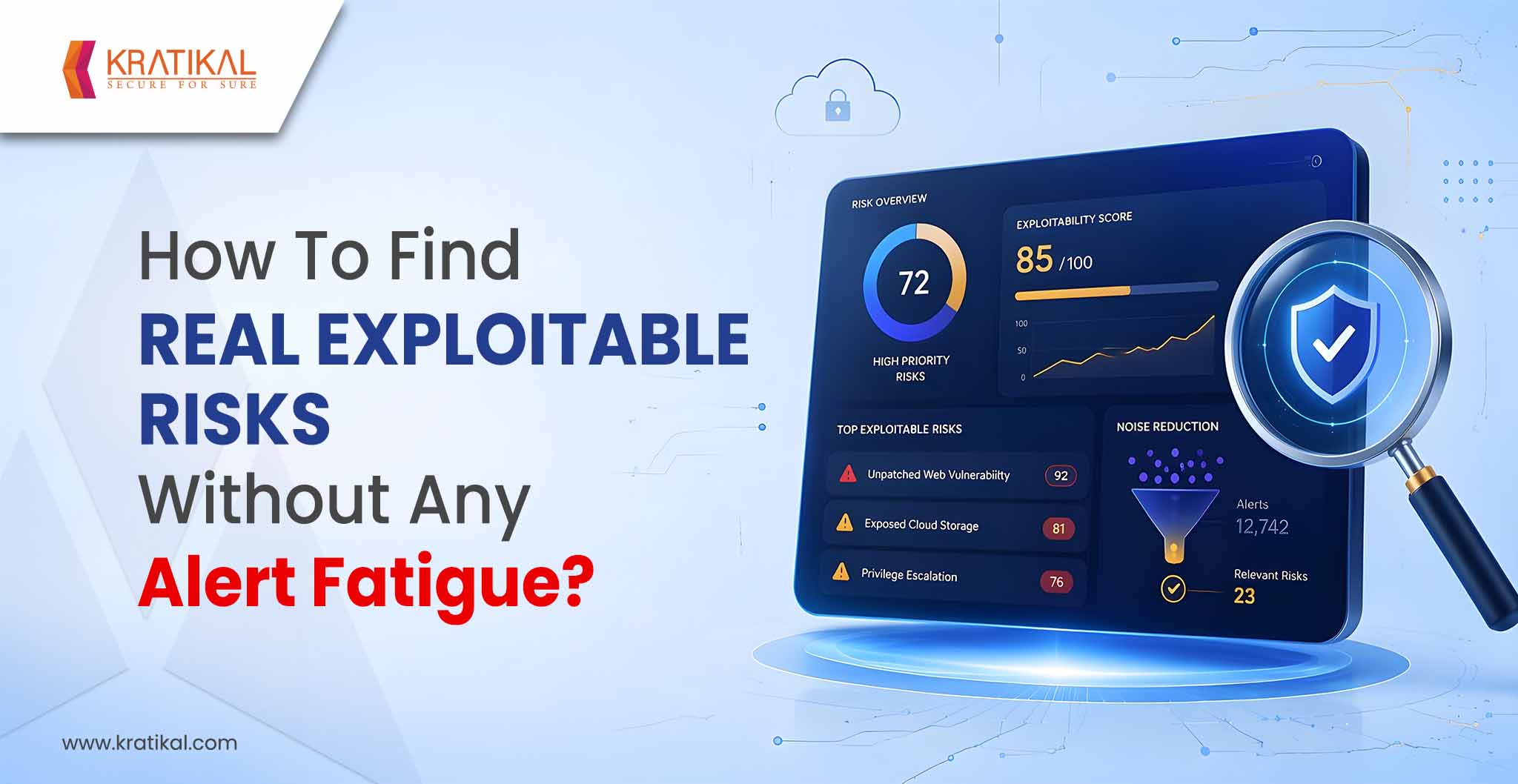
‘Security’ is an important part of any organization’s operational portfolio. However, given the growing and advanced nature of the security incidents, the strategy and planning in this area need dynamic improvements, similar to what they are up against – fast and evolving. An organization’s team cannot spend most of its time fixing the flaws. Vulnerabilities exist in an organization’s IT infrastructure, but ensuring that security scanning identifies the risks that are actually exploitable if left unpatched is a necessity. According to an article published in Security Magazine, only 9% of organizations remediate high-severity production vulnerabilities within 24 hours, whereas 74% require 1 to 7 days. These are the easy attack pathways that the malicious actors look for. If your organization falls in the 74% stack, this blog will help you break out of this bottleneck!
Table of Contents
Why Alert Fatigue is a Risk Bundle In Itself?
Let’s suppose you are provided with a long list of vulnerabilities with detailed analysis. No doubt, you have in-depth knowledge of the flaws in your asset stack, but imagine your security team receiving constant updates on every vulnerability identified.
The next step involves spending hours going through these notifications, figuring out whether the vulnerabilities are in or out of your organization’s scope. Also, with a normal vulnerability scanner, the probability of false positives persists. Manual intervention is necessary if your vulnerability assessment only provides what you want but not what you need. With each passing day, your organization becomes vulnerable to the next big attack spotlight.
The above is ‘alert fatigue,’ which means your team is taking around 60% more time to ensure your IT infrastructure is secure. And that is more than enough time for a malicious actor to infiltrate your organization.
Book Your Free Cybersecurity Consultation Today!

How To Find The Real Risks?
You need a VMDR tool, the one that serves your purpose. Every organization operates on a different level. Therefore, it is important to ensure that the vulnerability assessment that you perform lists out the vulnerabilities that may not be severe but can make your organization highly exploitable.
Also, make sure your vulnerability scanner double-checks the risks that it identifies. Given the growing percentage of false positives in the results, cross-checking manually may be a viable option, but the time spent is ‘disguised’. Letting a VMDR tool do the task for your team is a productivity enhancer, thus allowing your smart minds to focus on other priority tasks.
Another important aspect to focus on is risk prioritization. After you are done with your security scanning, the output is not just a list but a complete bifurcation of true vulnerabilities based on your requirements, such as getting a complete list of the most critical assets tested from your entire stack, a separate list of the high-risk vulnerabilities along with asset and scan details, vulnerability remediation status, and so on.
The checklist you need to consider while choosing the right vulnerability scanner is never-ending. But the solution we bring to you is tested and proven by our experts. AutoSecT by Kratikal is an AI-driven Pentest and VMDR platform that scans for every exploitable vulnerability present in your applications (web, mobile, API), cloud, and network.
How AutoSecT Finds Real Exploitable Risks Without Any Alert Fatigue
AutoSecT harnesses the power of AI when performing vulnerability assessments for your organization’s inventory. All the risks identified are AI-verified. This means, when you scan your network with AutoSecT, its RAG-powered agentic AI performs real-time exploit validation. It helps confirm which findings can be exploited and segregates them from the other ‘non-risky’ flaws that you can remediate later, if it’s within your organization’s scope. This also eliminates the scope of false positives. At this stage, where alert fatigue usually happens, the maximum is reduced to a minimum.
Subsequently, the VMDR tool categorizes the AI-verified vulnerabilities, based on their severity, business impact, and exploitability factor of your organization, into five categories: critical, high, medium, low, and info. Your team just needs to go through the AutoSecT dashboard and start with the patching process. The ‘alert fatigue’ quotient gets eliminated again.
The patching time is reduced to a great extent with AutoSecT. Against each exploitable risk listed, AI-based remediation suggestions are provided in a concise manner. If our security team wants step-by-step patching guidelines for the same, they can get them with just a simple click without switching screens. During remediation, to ensure a smooth workflow, you can integrate AutoSecT with the tools your teams already use, such as JIRA, Slack, Google Chat, Teams, Cliq, etc.
Comprehensive Vulnerability Management Dashboard – CISO and Analytics
Also, AutoSecT has two dashboards – CISO and Analytics, each serving its own purpose. In the CISO dashboard, you get a complete overview of the exploitable vulnerabilities. In the analytics dashboard, you get a detailed overview of the risk list, like total vulnerabilities in the workspace, fixed status of vulnerabilities as per severity/asset types, remediation SLA progress, latest inventory risk insights, etc. With vulnerabilities displayed on multiple factors directly in the dashboards, your security team saves time that would have been spent segregating the vulnerabilities as per their requirement.
How AutoSecT Works?
Here are the six steps showcasing how our vulnerability scanner performs:
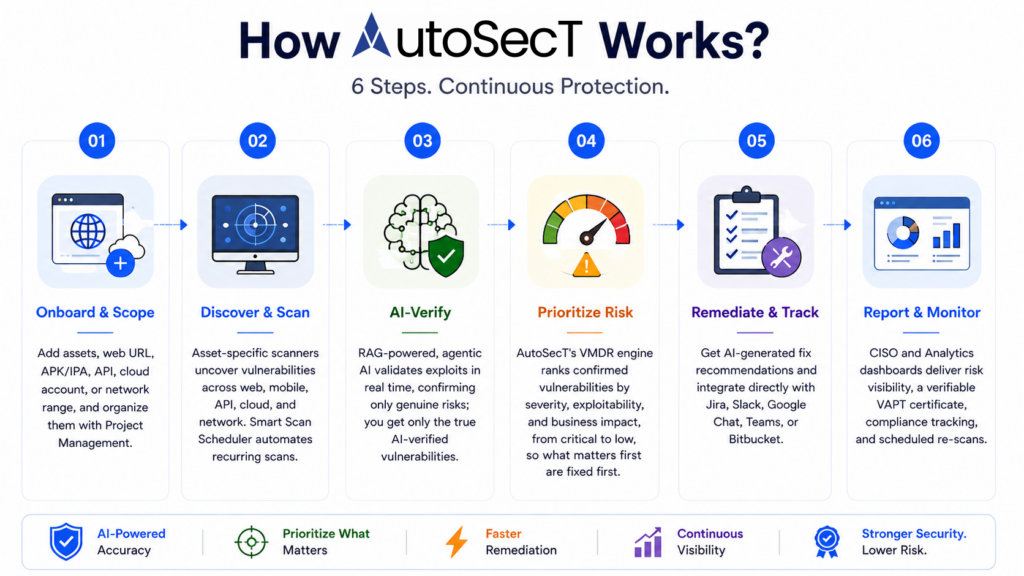
Onboard & Scope: Add assets, web URL, APK/IPA, API, cloud account, or network range, and organize them with Project Management.
Discover & Scan: Asset-specific scanners uncover vulnerabilities across web, mobile, API, cloud, and network. Smart Scan Scheduler automates recurring scans.
AI-Verify: RAG-powered, agentic AI validates exploits in real time, confirming only genuine risks; you get only the true AI-verified vulnerabilities.
Prioritize Risk: AutoSecT’s VMDR engine ranks confirmed vulnerabilities by severity, exploitability, and business impact, from critical to low, so what matters first are fixed first.
Remediate & Track: Get AI-generated fix recommendations and integrate directly with Jira, Slack, Google Chat, Teams, or Bitbucket.
Report & Monitor: CISO and Analytics dashboards deliver risk visibility, a verifiable VAPT certificate, compliance tracking, and scheduled re-scans.
The Take Away
Reducing alert fatigue is a necessity to ensure productive time management. Along with that, finding the true exploitable risks out of the numerous flaws in your inventory and with near-zero false positives enhances the ‘efficiency’ quotient of your security posture to a great extent. AutoSecT is currently on a free 15-day trial with no future commitments. Use it and see it for yourself. To be aware yourself with the other features of AutoSecT, visit – kratikal.com/autosect.
Get in!
Join our weekly newsletter and stay updated
FAQs
- What is alert fatigue in cybersecurity?
Alert fatigue occurs when security teams receive an overwhelming number of notifications from security scanning tools, making it difficult to identify real threats. This can delay remediation and increase the risk of successful cyberattacks.
- How does a vulnerability scanner help identify exploitable risks?
A modern vulnerability scanner like AutoSecT continuously scans applications (web, mobile, APIs), networks, and cloud environments to identify security weaknesses, validate findings to reduce false positives and highlight vulnerabilities that are actually exploitable.
- Why is risk prioritization important after security scanning?
Security scanning often discovers hundreds or thousands of vulnerabilities. Risk prioritization helps security teams focus first on vulnerabilities with the highest exploitability, business impact, and severity, ensuring faster and more effective remediation.
- How can AI improve vulnerability assessment accuracy?
AI enhances vulnerability assessment by validating exploitability, reducing false positives, and providing contextual risk analysis. This enables security teams to focus on genuine threats instead of spending time reviewing low-risk findings.
- What features should you look for in a VMDR tool?
When choosing a VMDR tool, look for AI-powered exploit validation, continuous security scanning, automated asset discovery, risk-based prioritization, remediation guidance, compliance reporting, and integrations with tools like Jira and Slack.
- How often should organizations perform security scanning?
Organizations should perform security scanning continuously or on a scheduled basis, especially after code changes, infrastructure updates, or new deployments. Automated recurring scans help identify vulnerabilities before attackers can exploit them.
- How does AutoSecT reduce alert fatigue during vulnerability management?
AutoSecT uses AI-powered exploit validation to verify vulnerabilities, minimize false positives, and prioritize confirmed risks based on exploitability and business impact. This allows security teams to focus on real threats instead of reviewing excessive alerts.



Leave a comment
Your email address will not be published. Required fields are marked *