

Let’s begin with the usual before we transition to something new! Due to the threat landscape being hyper-connected, your security team is drowning! And that is what brings you here! Attacks come later, but prior to that, it’s costing you ‘time’. Security teams spent a considerable amount of time patching the issues that hackers swipe left. This is what we commonly refer to as ‘alert fatigue’. The reason behind it is false positives, one of the most underestimated challenges in vulnerability management. In situations where every flagged issue demands investigation and most turn out to be harmless, you need something fast and effective. Yes, we are talking about pentest and VMDR platforms that focus on the reduction of false positives. A hard-to-find feature in the market. But not impossible! AutoSecT aims for 90% false positive reduction, so your teams can plug into only real security gaps.
What is AutoSecT?
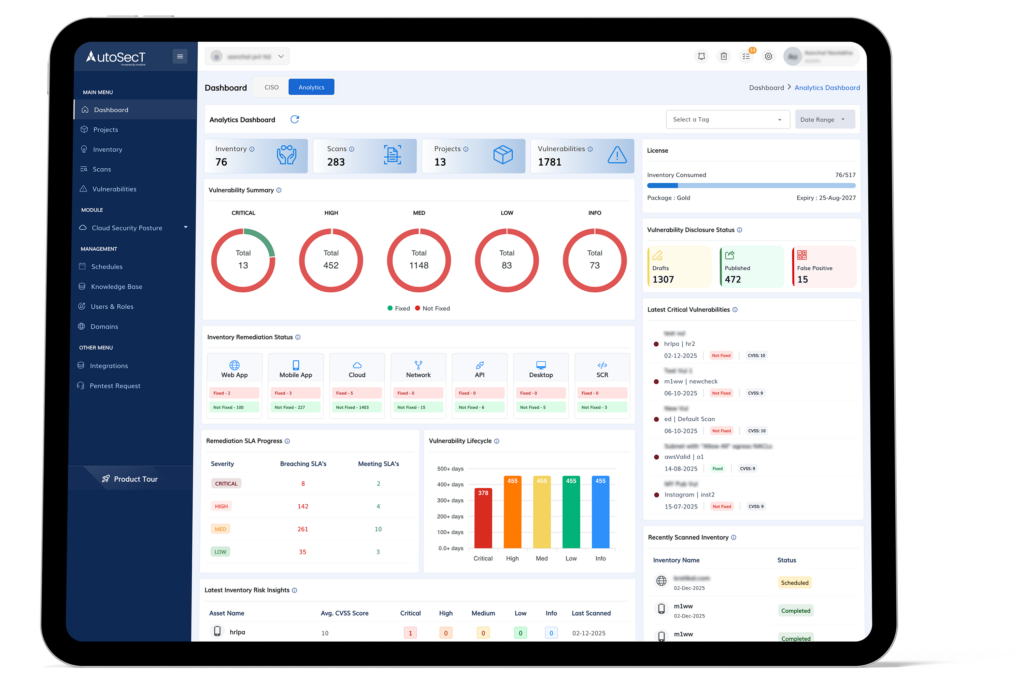
AutoSecT by Kratikal is an AI-driven pentest and VMDR platform that is being built and improved habitually to detect and inform you about the flaws in your asset inventory, like cloud, web apps, mobile apps, API endpoints, and network. It excels in AI-driven real-time vulnerability analysis, real-time validation of security threats using intelligent automation, prioritizing and managing vulnerability mitigation lifecycle based on risks – critical, high, medium, low. As a part of VMaaS, AutoSecT lists out the vulnerabilities after AI-verification, ensuring false positive reduction along with AI-driven recommendations for each vulnerability, making it easier and more efficient for teams responsible for patching the loopholes.
Why False-Positives in The Bigger Problem in Vulnerability Management?
Conventional VMDR tools are based on static rules set, generic signatures, and pattern patching, thus casting a wide net. Such tools flag anything that looks suspicious. Security teams are then put into a pool of thousands of alerts, most of which are false positives, creating conditions where generic alerts are misidentified as threats.
What is the damage downstream?
- Teams waste time triaging non-issues.
- Critical vulnerabilities get buried under the non-critical noise.
- Remediation cycles move at sloth-speed.
- The risk scores don’t reflect the real threats.
- Organizations are exposed at the precise moment when they need clarity.
- Stakeholders’ trust in the pentest tool and platforms erodes.

Book Your Free Cybersecurity Consultation Today!
Why AutoSecT Ensures Near-Zero False Positives?
AutoSecT, along with other key goals, was designed from the ground up to address the problem of false positives at scale.
1. AI-Verified Vulnerabilities
This feature was the core of the false-positive reduction. A capability that ensures only real vulnerabilities are flagged through real-time validation using intelligent automation. Once a scan is complete, AutoSecT re-validates the findings before surfacing them in its dashboard for security teams to patch.
This active validation layer of AutoSecT uses AI agents and combines fingerprinting, compliance mapping, and active validation into a unified workflow. When a potential vulnerability is detected, AI cross-references real-time threat intelligence, behavioural data, and contextual signals before clarifying it as a true vulnerability.
Your team sees only what genuinely matters!
2. Agentic AI
AutoSecT’s Agentic AI capability continuously discovers, assesses, and validates vulnerabilities in real time. Unlike legacy VMDR tools that rely on periodic batch scans and static lookups, the agentic model is always on, it observes, reasons, and acts.
By automatically analyzing real-time threat intelligence and behavioral data, the platform stays ahead of attackers rather than merely reacting to them. This behavior-driven detection approach means the system learns what normal looks like across your environment and flags only genuine deviations.
This dramatically cuts through the noise. Security operations teams can focus their energy on what is genuinely critical rather than exhausting themselves on phantom threats.
3. Risk-Based Prioritization
AutoSecT takes into serious consideration the fact that ‘Not All Vulnerabilities Are Equal’. Even among true positives, not every vulnerability deserves the same urgency, which automatically validates the near-zero false positive claim. AutoSecT applies a sophisticated risk-based analysis within its VMDR framework, prioritizing vulnerabilities based on a combination of:
- Severity, meaning how dangerous is the flaw in absolute terms?
- Exploitability, meaning, is it actively being exploited in the wild?
- Business impact, meaning, what assets or data could be compromised?
- Likelihood of exploitation, given your specific environment, meaning how probable is a real attack?
This context-aware risk scoring moves beyond the blunt instrument of CVSS scores alone. It reflects the reality that a medium-severity vulnerability in a mission-critical, externally exposed application may be far more dangerous than a critical flaw in an isolated internal system. AutoSecT accounts for these nuances so your team prioritizes what truly threatens your business.
4. AI-Driven Patch Recommendations
Reducing false positives is only half the battle. What happens after a true positive is confirmed matters just as much. AutoSecT provides AI-based patch recommendations for every confirmed vulnerability, ensuring that once the noise is filtered out, your team has a clear and intelligent path to remediation.
These recommendations are tailored to your specific IT environment, not generic advisories. Combined with CVSS-based scoring visible through the centralized CISO and Analytics Dashboard, teams can move from detection to remediation with confidence and speed.
5. Smarter Collaboration
Alert fatigue is a people problem. Even when detections are accurate, poor workflow integration can still exhaust security teams. AutoSecT tackles this through deep multi-integration capabilities, connecting with JIRA, Slack, Microsoft Teams, Cliq, and Google Chat.
Vulnerabilities are assigned to the right teams the moment they’re confirmed. Bi-directional JIRA integration ensures continuous, real-time updates without the need for manual status tracking. This means the right people see the right alerts and only those alerts, at the right time. Fewer irrelevant notifications mean fewer interruptions and sharper focus.
6. Scale Without Compromise
AutoSecT is built for organizations of all sizes, from startups to large enterprises. The platform’s scalable, customizable architecture means that as your asset inventory grows, whether from 100 endpoints to 25,000 network assets, the false positive reduction engine scales with it.
The platform already monitors over 1.2 million vulnerabilities identified yearly, across 25,000+ network assets, 6,000+ APIs, 2,200+ cloud assets, and 1,150+ web platforms. AutoSecT’s AI-driven approach ensures that accuracy holds even as volume grows.
Join our weekly newsletter and stay updated
The Bottom Line
False positives waste time and erode the credibility of security programs, and create the dangerous illusion that everything is being handled when it isn’t. AutoSecT directly confronts this challenge with AI-verified detections, agentic real-time intelligence, context-aware risk scoring, and seamless team integrations. For organizations serious about building a resilient security posture without drowning their teams in noise, AutoSecT represents a genuine step forward: smarter scanning, verified findings, and vulnerability management that scales with confidence.
FAQs
- How does AutoSecT’s AI distinguish between a false positive and a real threat?
AutoSecT uses a behavior-driven detection model powered by Agentic AI. It analyzes real-time behavioral data and threat intelligence to understand what is normal in your specific environment. Deviations are cross-referenced against multiple signals, exploitability, context, and business impact, before being classified as true positives.
- Does AutoSecT handle false positive reduction across all asset types?
Yes. AutoSecT covers web applications, mobile apps, cloud infrastructure (AWS, GCP, Azure), APIs, and network assets. It applies environment-specific intelligence to each asset type, giving it the contextual awareness needed to avoid misclassifying benign conditions as threats across every surface it scans.
- How does AutoSecT prioritize vulnerabilities after filtering false positives?
AutoSecT uses a risk-based analysis framework that factors in severity, exploitability, business impact, and likelihood of exploitation. This ensures that critical issues are addressed promptly, and teams focus remediation efforts where they matter most.