
SQL injection. Broken authentication. Misconfigured APIs – the attack surface has never been wider, and the cost of a single breach- financial, reputational, regulatory- has never been higher. Effective vulnerability management begins with scanning. But not all web security scanners are created equal. Some excel at crawling complex single-page applications; others integrate seamlessly into DevSecOps pipelines; others are built for compliance-heavy enterprise environments. Choosing the right tool is a strategic decision, let alone a technical one. This guide covers the 10 best web security scanners of 2026 for effective vulnerability management.
Top 10 Web Security Scanners 2026
1. AutoSecT by Kratikal
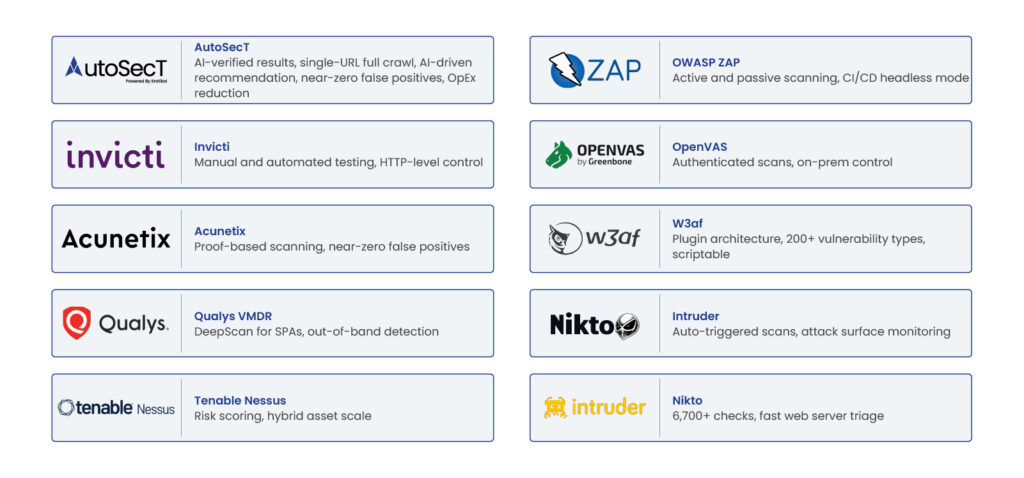
AutoSecT is an AI-driven web security scanner and vulnerability management platform that takes the complexity out of continuous security testing. Point it at a single URL, and it automatically crawls every page, form, script, and API endpoint, delivering a comprehensive scan of your entire web application without manual configuration. Its AI-verified vulnerability engine goes beyond flagging potential issues: it validates findings in real time to eliminate false positives using AI-generated exploits along with detailed PoC, so that security teams act only on confirmed threats rather than chasing the unimportant.
Where AutoSecT distinguishes itself from standalone web scanners is in what happens after detection – vulnerability management. AI-driven patch recommendations give developers clear, actionable steps to patch the real flaws. The platform also extends coverage beyond web to APIs, mobile apps, cloud environments, and network assets, making it a genuine single-pane-of-glass solution for organizations that want unified management of vulnerabilities rather than a patchwork of tools that work in isolation. With over 1.2 million vulnerabilities identified annually across 1,150+ web and 6,000+ API assets, AutoSecT is built for teams that need both depth of coverage and speed of remediation.
Book Your Free Cybersecurity Consultation Today!

2. Invicti (formerly Netsparker)
Invicti, formerly known as Netsparker, sets itself apart in web security scanning through its proof-based scanning technology. It means that rather than simply reporting potential vulnerabilities, Invicti provides proof of their exploitability in a read-only format. This confirms that a flaw is genuinely present before raising an alert, thus minimizing false positives. Moreover, this allows security teams to focus on remediation where they actually matter. For enterprise teams managing large portfolios of web assets, the tool’s asset management and continuous scanning capabilities provide consistent coverage at scale.
3. Acunetix
Acunetix web security scanner detects a wide range of web vulnerabilities, including SQL injection, XSS, SSRF, and misconfigurations across both web applications and web services. Its vulnerability detection solution further provides coverage for blind injection flaws. This scanner is a go-to tool for development teams due to its seamless integrations with issue-tracking and version control platforms like Jira, GitHub, and GitLab. It does so by allowing vulnerabilities to flow directly into existing workflows as actionable tickets, speeding up remediation without disrupting the development cycle.
4. Qualys VMDR
Qualys VMDR is a fully cloud-native platform that unifies web application scanning, vulnerability management, and remediation tracking. Its Web Application Scanner (WAS) module performs deep crawling and testing of web applications, detecting OWASP Top 10 vulnerabilities, misconfigurations, and sensitive data exposure across both authenticated and unauthenticated surfaces. For organizations managing large, distributed portfolios of internet-facing web assets across hybrid and multi-cloud environments, Qualys delivers the scalability and consistency that point solutions cannot.
5. Tenable Nessus
Tenable Nessus is one of the most established and widely deployed web security scanners in the industry. For web security scanning specifically, Nessus identifies vulnerabilities across web applications, web servers, and supporting infrastructure. It has a dynamic plugin library of over 100,000 checks that is continuously updated as new CVEs emerge. Its web application tests cover common vulnerabilities including SQL injection, XSS, and misconfigured web servers. This scanner is best for organizations that need both infrastructure and application coverage from a single scanner.
6. OWASP ZAP (Zed Attack Proxy)
Another obvious name in the list is OWASP ZAP (Zed Attack Proxy). The globally used open-source web application security scanner is maintained by a global community of security professionals under the Open Worldwide Application Security Project. ZAP offers both active and passive scanning modes. When in active mode, its functionalities include scanning web applications for vulnerabilities like SQL injection, XSS, and broken authentication, while monitoring traffic for security issues without sending attack payloads is one of the functionalities of OWASP ZAP in passive mode.
7. OpenVAS
OpenVAS (Open Vulnerability Assessment Scanner) is maintained by Greenbone Networks as part of its community edition. It is an open-source vulnerability scanner for web and network. When it comes to web security scanning, it performs authenticated and unauthenticated scans, detecting misconfigurations, outdated software versions, and exploitable weaknesses across internet-facing web assets. Listed as a bit technical when it comes to initial setup compared to its contemporaries, it has proven to deliver enterprise-grade scanning depth without licensing costs.
8. W3af (Web Application Attack and Audit Framework)
W3af (Web Application Attack and Audit Framework) is an open-source web application security scanner. It is built specifically for identifying and exploiting web vulnerabilities across a broad attack surface. The architecture is plugin-based. This organizes functionality into discovery, audit, and attack modules that give security engineers segmented control over scan scope and testing methodology. W3af detects a wide range of web vulnerabilities, including SQL injection, cross-site scripting, CSRF, blind SQL injection, and remote file inclusion, making it effective for thorough web application assessments.
9. Intruder
Next in the list is a cloud-based web vulnerability scanner. The motive behind this scanner is to make continuous security testing accessible without requiring deep technical expertise. It automatically scans web applications for vulnerabilities, including OWASP Top 10 risks, misconfigurations, and exposed sensitive data. They do so by running checks drawn from the same engines used by enterprise security teams. Regarding vulnerability management, Intruder is known for its proactive monitoring approach. It automatically scans new assets when detected or when significant new vulnerabilities are publicly disclosed. It helps minimize the exposure window without manual intervention, solving the time constraint aspect.
10. Nikto
Nikto is an open-source web application scanner. It has turned out to be a staple tool for security teams due to its sticking-to-the-point, not-so-basic approach to vulnerability management of web applications. Its solutions include detailed checks for 6,700+ files listed as potentially dangerous on web servers. In addition to that, it looks for outdated server software, version-specific vulnerabilities, default credentials, and common misconfigurations, all within minutes of initiation. Nikto cannot be deemed a full-featured DSAT platform, but it plays a significant role when it comes to vulnerability management.
Join our weekly newsletter and stay updated
Wrapping Up
The best scanner in the world can produce nothing but a growing backlog if findings don’t reach developers in a form they can act on. This is why effective vulnerability management matters. Prioritize web scanners that integrate with your ticketing systems, generate developer-friendly reports, and provide remediation guidance alongside raw CVE data. As of 2026, AI-driven vulnerability management is becoming the main dish of the table. Think of a tool that correlates scanner output with real-time intelligence to prioritize the vulnerabilities most likely to be exploited first, separating the real threats from the regular ones. When evaluating your next web security scanner, ask not just “what does it find?” but “what does it help us fix, and how fast?”
Most enterprise web security scanners offer trial periods. AutoSecT is free to try! Scan your web assets with its 15-day free trial. Open-source options like OWASP ZAP, OpenVAS, and Nikto are also available at no cost. Be surprised at what’s already exposed!
FAQs
- What does a web security scanner support vulnerability management?
A web app security scanner is a tool that automatically identifies security weaknesses in web applications, APIs, and websites. It plays a critical role in vulnerability management by continuously detecting, prioritizing, and helping remediate vulnerabilities before attackers can exploit them.
- What vulnerabilities can a web scanner detect?
Most modern web vulnerability scanners can identify vulnerabilities such as SQL injection, cross-site scripting (XSS), broken authentication, security misconfigurations, SSRF, exposed sensitive data, insecure APIs, and other risks included in the OWASP Top 10.
- How do I choose the best web application security scanner for my organization?
AutoSecT provides accurate vulnerability detection, near-zero false positives, API security testing, continuous scanning capabilities, remediation guidance, CI/CD integration, and centralized vulnerability management features that align with your organization’s security goals.
- How do I choose the best web application security scanner for my organization?
AutoSecT provides accurate vulnerability detection, near-zero false positives, API security testing, continuous scanning capabilities, remediation guidance, CI/CD integration, and centralized vulnerability management features that align with your organization’s security goals.
- Are open-source web scanners suitable for enterprise vulnerability management?
Open-source web application security scanners like OWASP ZAP, OpenVAS, and Nikto can be effective for basic vulnerability management. However, enterprises often require advanced features such as AI-driven validation, automated AI-driven remediation workflows, vulnerability compliance mapping, and centralized asset management offered by commercial solutions.
- How often should organizations run web security scans?
Organizations should perform web security scans continuously or at least after major application updates, infrastructure changes, and code releases. Continuous scanning strengthens vulnerability management by reducing the time between vulnerability discovery and remediation.
- What is the difference between vulnerability scanning and penetration testing?
A web security scanner automatically identifies potential security weaknesses, while penetration testing involves security experts actively attempting to exploit vulnerabilities. Both are essential components of a comprehensive vulnerability management strategy.
- Can a web security scanner reduce false positives?
Yes. Advanced web security scanners use techniques such as proof-based scanning and AI-driven validation to verify vulnerabilities before reporting them, helping security teams focus on genuine threats and improving vulnerability management efficiency.
- Do web security scanners support API security testing?
Many modern web security scanners include API security testing capabilities to identify authentication flaws, authorization issues, exposed endpoints, injection vulnerabilities, and misconfigurations across REST, GraphQL, and SOAP APIs.
- Why is remediation guidance important in vulnerability management?
Finding vulnerabilities is only the first step. Effective vulnerability management requires actionable remediation guidance that helps developers quickly understand, prioritize, and fix security issues, reducing overall risk exposure.
- Can AI-driven web security scanners improve vulnerability management outcomes?
Yes. AI-driven web scanners can automate vulnerability validation, prioritize risks based on exploitability, provide intelligent remediation recommendations, and reduce manual effort, enabling faster and more effective vulnerability management across modern attack surfaces.