Banks and NBFCs handle huge amounts of customer data every day. Payments, loans, UPI, online banking, mobile apps — everything now runs on digital systems. But with this growth comes risk, too. Cyberattacks keep rising, and the RBI has become stricter about security and compliance.
That is why every bank and NBFC now needs a strong RBI compliance audit process. It helps check if the organization follows RBI rules, secures customer data, and keeps systems secure. Also, helps review IT systems, networks, software, and security controls. It shows whether the organization can handle threats, outages, and data leaks.
In 2026, financial companies cannot treat compliance like a yearly task. It has become part of daily operations. Let’s go through the main checklist that banks and NBFCs should follow before an audit.

Book Your Free Cybersecurity Consultation Today!
Why RBI Compliance Audits Matter
RBI wants financial institutions to stay secure and prepared. A single cyberattack can harm services, leak customer data, and damage trust.
An IS Audit helps organizations:
- Find security gaps
- Reduce cyber risks
- Improve internal controls
- Protect customer information
- Avoid penalties from regulators
It also helps teams understand where their IT systems stand. It checks whether systems are secure, updated, and working as expected. For banks and NBFCs, these audits are no longer optional. They are now part of responsible business operations.
RBI Compliance Audit Checklist for 2026
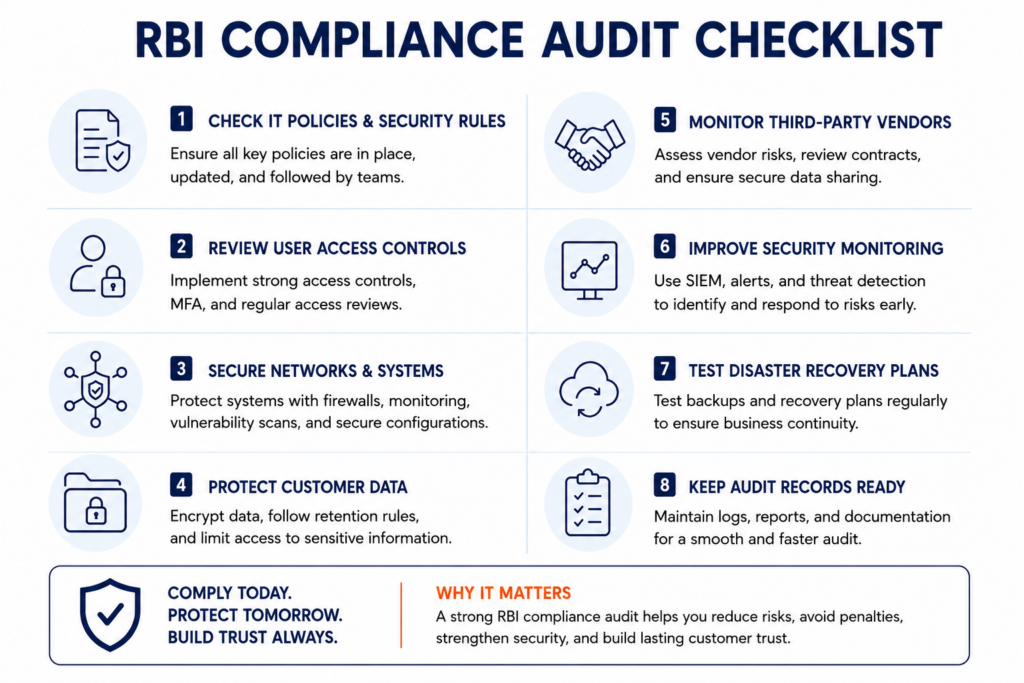
1. Check IT Policies and Security Rules
Auditors first check whether the organization has proper security policies in place.
This includes:
- Information security policy
- Password policy
- Access control policy
- Vendor management policy
- Incident response plan
- Disaster recovery plan
Policies should match RBI guidelines and current business operations. During an IS (RBI) Audit, missing or outdated policies often create problems. An RBI audit also checks whether teams actually follow these policies in day-to-day work.
2. Review User Access Controls
Not every employee should access every system. Banks and NBFCs should control who can view, edit, or download protected data.
The checklist includes:
- Role-based access
- Multi-factor authentication
- Removal of inactive accounts
- Strong password rules
- Regular access reviews
Weak access controls can create security risks. Employees may get access to sensitive systems or data. An IS audit helps find these gaps before they cause serious issues.
Secure Networks and Systems
Financial systems stay connected all the time. This makes network security very important.
For a successful RBI compliance audit, organizations should review:
- Firewall settings
- Antivirus protection
- VPN security
- Network monitoring
- Intrusion detection system
Regular vulnerability scans help find security gaps in networks and systems. Penetration testing checks how strong the security controls are. An RBI audit reviews these tools to make sure critical systems stay protected.
Protect Customer Data
Banks and NBFCs store sensitive customer information like:
- Account details
- PAN and Aadhaar records
- Transaction history
- Loan documents
- Payment data
RBI expects organizations to protect this data at every stage.
The checklist should include:
- Data encryption
- Secure backups
- Data retention rules
- Restricted access to sensitive files
- Secure data disposal methods
During an IS (RBI) audit, auditors often focus heavily on data protection controls. An IS audit also checks whether customer information stays safe from leaks and cyber attacks.
Monitor Third-Party Vendors
Many financial companies now work with cloud providers, fintech partners, and external vendors. But third-party systems can also create security risks.
Organizations should review:
- Vendor security checks
- Compliance agreements
- Risk assessments
- Cloud security measures
- Data-sharing controls
A strong RBI compliance audit process includes vendor risk management as a key area. An IS audit helps identify weak points in external systems and partner access.
Improve Security Monitoring
Cyber threats can happen anytime. Financial institutions need systems that can detect problems early.
Important areas include:
- SIEM monitoring
- Security alerts
- Log management
- Threat detection
- Incident response process
Teams should know how to react when suspicious activity appears. This is where expert support becomes useful. Our team includes certified cyber security compliance experts. They have hands-on experience with SIEM, network monitoring, and data loss prevention tools.
We help organizations improve visibility, reduce risks, and prepare for a smoother RBI audit process. An RBI audit also checks whether monitoring systems can detect threats quickly and support faster response.
Test Disaster Recovery Plans
System failures and cyber attacks can stop financial services without warning. That is why RBI expects organizations to prepare for emergencies.
The RBI Compliance Audit checklist should cover:
- Backup testing
- Recovery procedures
- Business continuity plans
- Alternate data centers
- Recovery time targets
Teams should test these plans often. Among the RBI compliance audit checklists, auditors may ask for proof of disaster recovery testing. A RBI audit checks whether systems can recover properly after an outage or attack.
Keep Audit Records Ready
Documentation plays a big role during audits.
Organizations should maintain records for:
- Security incidents
- Risk assessments
- Vulnerability scans
- Employee training
- Compliance reviews
- Access logs
Good documentation makes the RBI audit process faster and easier.
Why Financial Institutions Need Expert Compliance Support
RBI guidelines keep changing. Many banks and NBFCs struggle to keep up with new compliance and cyber security requirements. That is why experienced compliance partners help a lot.
Our experts have worked with organizations across many industries and understand regulatory and industry-based compliance in depth. We know how important it is to protect the financial data of Indian citizens. That is why we bring together important compliance requirements related to RBI, SEBI, IRDAI, and NSE under one place.
Kratikal’s compliance auditors understand regulatory frameworks and industry requirements as well. They provide dedicated solutions to meet the compliance needs of each organization.
Join our weekly newsletter and stay updated
Conclusion
In 2026, compliance is not limited to passing audits. Banks and NBFCs also need to build trust and save customer data. A strong RBI compliance audit keeps organizations updated on new threats. It also improves their security and risk management.
An effective IS audit helps strengthen IT systems and daily operations. It helps teams find security gaps before they create bigger problems. So, financial institutions that focus on compliance today will stay safer and more reliable in the future.
RBI Compliance Audit FAQs
- What is an RBI compliance audit?
An RBI compliance audit checks if banks and NBFCs follow RBI rules and security guidelines. It also reviews how they protect customer data and manage risks.
- Why does an IS audit matter for banks and NBFCs?
An RBI (IS) audit checks IT systems, networks, and security controls. It helps find weak points before they create bigger security problems.
- How often should banks and NBFCs conduct audits?
Banks and NBFCs should conduct audits at regular intervals. Many organizations also review their systems throughout the year to stay prepared.