Artificial Intelligence (AI) is one of the fastest-growing technologies. Businesses are automating processes and making decisions using AI. Companies use it to create products and services to better interact with their customers. There are risks for both the business and the consumer using this technology. ISO 42001 is the international standard for creating and using an Artificial Intelligence Management System (AIMS). Organizations can evaluate their AI processes through an evaluation of the standard by using an ISO 42001 Checklist. This allows the organization to identify the requirements of the AIMS.
Organizations should be proactive in strengthening their AI governance before pursuing AIMS certification. A structured gap analysis supports this effort by outlining weaknesses within the AI governance framework. The framework creates an opportunity for organizations to strategically infuse responsible AI practices within day-to-day company operations. In this guide, we give you the tools to identify gaps within your organization through a structured gap analysis. We provide sample checklists and show you how to prepare for AIMS certification.
What is an ISO 42001 Checklist?
An ISO 42001 Checklist is a tool that allows organizations to evaluate their management of AI practices and identify potential gaps with respect to ISO/IEC 42001. The checklist usually covers management’s commitment, risk management, and processes related to the AI system. The checklist also covers the evaluation and improvement of the management system.
Why Is an ISO 42001 Gap Analysis Important?
A gap analysis helps you understand the shortfall between your current AI governance practices and the requirements of ISO/IEC 42001 compliance.
Performing a gap analysis has a range of benefits, including:
- Recognizing compliance shortfalls: Gap analyses help determine shortcomings in governance, oversight, and infrastructure.
- Managing risks associated with AI: Undocumented or unaddressed risks (e.g., bias and malicious acts) associated with AI systems may result in exposure to legal and/or regulatory sanctions and damage the reputation of your organization.
- Defining responsibility: Determining who makes decisions concerning the governance and oversight of AI systems.
- Preparing for certification: Analyses may help identify the elements needed to establish a management system for AI.
- Improving overall performance of the organization: Allows the organization to define and measure its performance objectives for its AI systems.
- Prioritizing actions: Helps management focus on the most critical and essential regulatory requirements.
ISO 42001 Checklist for Gap Analysis: Key Areas to Review
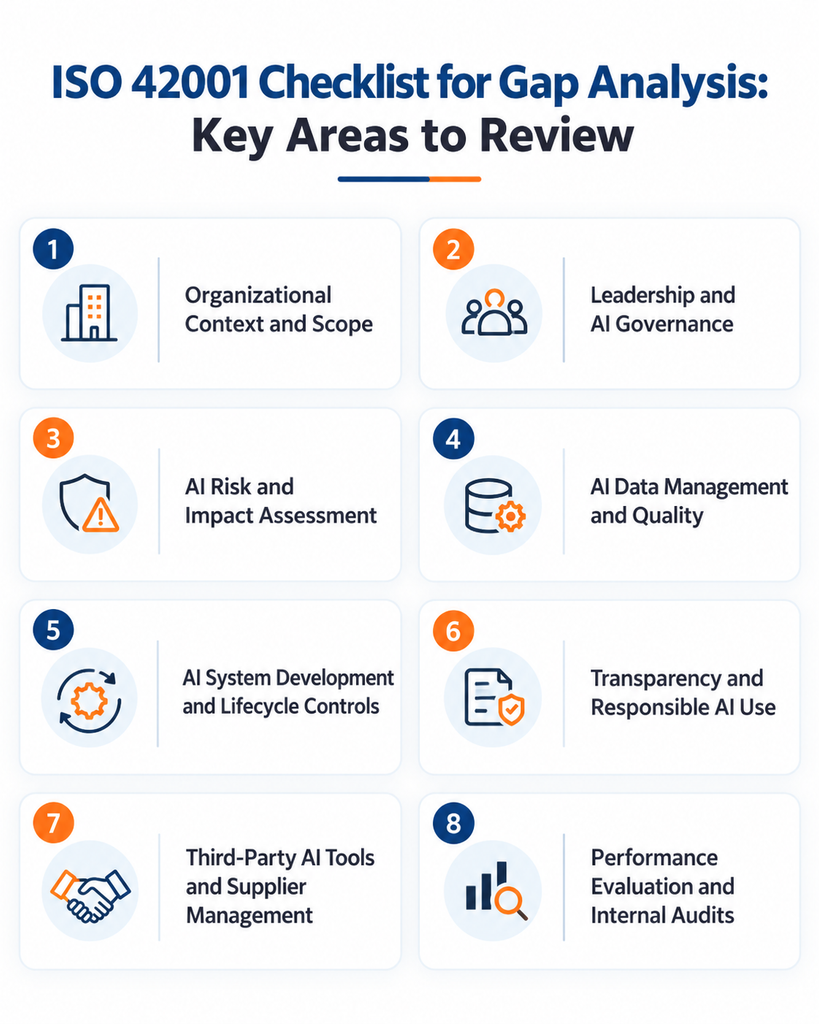
Here are the eight key areas that you need to look into to manage AI risks using ISO 42001 standard:
1. Organizational Context and Scope
First, understand how the AI systems are developed and/or provided by the organization. Using a defined scope enables the identification of all the activities pertaining to the management of AI systems.
- Are all AI systems developed and/or used by the organization captured within the defined scope?
- Are the purposes and the intended functionalities of the systems captured?
- Have you determined the applicable legal and regulatory requirements?
- What are the requirements of customers, employees, suppliers, and other parties?
- What is the scope of the Artificial Intelligence Management System (AI MS)?
2. Leadership and AI Governance
Management direction is crucial for responsible AI. Staff needs to know who makes decisions, takes risks, and oversees AI-related work.
- Has management approved a documented AI policy?
- Are AI governance roles and responsibilities clearly assigned?
- Is there an accountable person or team overseeing the AIMS?
- Are AI objectives aligned with the organization’s business strategy?
- Does management provide the resources needed to implement AI governance?
- Is the AI policy communicated to relevant employees and stakeholders?
3. AI Risk and Impact Assessment
Traditional IT risk assessments do not fully capture all the risks associated with the integration of AI in business processes. Examples of such risks include bias in predicted outcomes, privacy and security risks, and other negative consequences on target populations. The ISO 42001 checklist requires assessment of risks and impact associated with the integration of AI systems.
- Do you have established criteria for recognizing and measuring the risk associated with AI systems?
- Do you continually consider risks in the AI system through its lifecycle?
- Have you considered possible adverse impacts throughout your AI system?
- Are decisions regarding risk treatment and the selection of risk treatment alternatives documented?
- Are employees authorized to accept the risk?
- Do you revise risk assessments to reflect the changes made to the AI system?
4. AI Data Management and Quality
AI systems depend on the data used to train, test, and operate them. Poor data quality can lead to inaccurate results, while inappropriate data handling can create privacy and security risks.
- How do you ensure the data associated with the AI system meets the business requirements?
- Do you document how you obtained the data used to develop the AI system?
- Do you monitor data quality?
- Have you validated the dataset used for AI system development for bias and quality?
- Are you able to trace data lineage to understand how the data used in the AI system was manipulated?
- Have you established adequate safeguards to protect data?
- Have you established adequate measures to protect personal data?
5. AI System Development and Lifecycle Controls
Organizations need controls for designing, developing, testing, deploying, and maintaining AI systems. These controls should reflect the system’s purpose and risk level.
- How do you manage the development of AI systems?
- How are the development and deployment of AI systems documented?
- Do requirements and acceptance criteria for the implementation of AI systems exist?
- Is access to models, prompts, datasets, and implementation configurations controlled?
- Are performance measures in place to evaluate AI systems after they are deployed?
- Do procedural documentation and/or automated mechanisms capture events and incidents?
- Are procedures to retire AI systems available?
6. Transparency and Responsible AI Use
Transparency regarding AI systems allows users and the service provider to gain a better understanding of the systems to help ascertain the appropriate and permitted functions of the AI systems and to help identify issues and concerns regarding the systems.
- Do you document the acceptable and unacceptable uses of AI systems?
- Are systems of and/or about the AI available to users and other stakeholders?
- Are users of the AI systems able to report their concerns and/or Adverse Impact?
- Are procedures in place to capture instances where the use of the AI systems creates an undue burden on individuals?
- Are procedures in place to ensure that a human reviews the output of an AI system?
7. Third-Party AI Tools and Supplier Management
Most organizations utilize external AI models and other services provided by cloud platforms and software vendors. By managing these external vendor relationships, an organization can control various risks related to data and service availability and integrity.
- Which third-party AI tools and providers do you use?
- Do you have policies and contracts addressing supplier responsibilities?
- Do you evaluate the security of your suppliers, including their privacy and AI risks?
- Do you understand how third-party services process and retain data?
- Do you monitor provider changes and updates?
- Is it possible to take alternative actions if your reliance on a third-party AI service becomes critical?
8. Performance Evaluation and Internal Audits
While controlling AI, organizations must evaluate the effectiveness of their management of AI systems.
- Have you set performance targets for managing AI?
- Are performance and risk indicators of AI systems monitored?
- Do your internal audits occur according to your predetermined schedule?
- Do you bring the findings of your audits to management’s attention and correct them?
- Does management document its decisions, and do you audit the AI systems after management acts?
How to Conduct an ISO 42001 Gap Analysis
Once you have reviewed the checklist, follow a structured approach to turn the findings into an implementation plan.
- Define the Scope: Identify the AI systems, business units, processes, and third-party services covered by the AIMS.
- Collect Documentation: Gather AI policies, risk assessments, system inventories, technical records, and supplier agreements.
- Assess Requirements: Compare existing practices with ISO/IEC 42001 requirements and review supporting evidence.
- Identify and Prioritize Gaps: Classify findings as implemented, partially implemented, not implemented, or not applicable. Prioritize gaps based on risk and business impact.
- Create an Action Plan: Assign responsibilities, deadlines, resources, and measurable targets for each corrective action.
- Verify Improvements: Review completed actions, check supporting evidence, and conduct internal audits and management reviews before certification.
Conclusion
A well-structured ISO 42001 Checklist gives organizations a practical starting point for evaluating AI governance and identifying areas that need improvement. By reviewing leadership, risk management, data quality, lifecycle controls, transparency, and continual improvement, businesses can build a more accountable approach to AI.
At Kratikal, we help organizations achieve ISO 42001 compliance through expert guidance and structured implementation support. From AI risk assessments to compliance readiness, we help strengthen your AI management system and support responsible AI practices.
FAQs
- What is an ISO 42001 Checklist used for?
The ISO 42001 Checklist assists in assessing AI governance, identifying deficiencies, and developing strategies to address them in the context of seeking ISO/IEC 42001 certification.
- Is ISO/IEC 42001 applicable to all companies, including small companies?
Yes. The standard is applicable to companies of all sizes and to sectors and countries at all levels of development and economic situations that use or provide AI-based products and services. The standards can be tailored to address specific risks and circumstances.
- What is a management system for AI?
The management system for AI covers various areas including the context of the organization, leadership, planning, execution, monitoring and review of performance, and continuous improvement of the system. Appendix A of the standard gives examples of controls for governance and risk management associated with AI.
- What documents are needed for an ISO 42001 gap analysis?
Common documents include an AI policy, AI system inventory, risk assessments, impact assessments, data management procedures, technical documentation, supplier records, training records, and internal audit reports. The exact evidence depends on the organization’s scope and applicable requirements.
- Does an ISO 42001 Checklist guarantee certification?
No. A checklist helps identify gaps, but certification depends on implementing the applicable requirements and completing the independent certification audit.
- How often should an AI gap analysis be conducted?
Organizations should review their AI management system at planned intervals and when significant changes occur. New AI deployments, data changes, incidents, supplier changes, and evolving risks may trigger additional assessments.
- What is the difference between a gap analysis and an ISO 42001 audit?
A gap analysis is the process of evaluating differences between the requirements of the standard and the organization’s current practices. An audit is a formal assessment, typically conducted by a third party, to evaluate an organization’s management system against the requirements of the standard.
- Can existing ISO 27001 controls be used to implement ISO 42001?
Some of the information security controls, such as document controls and management review, can be used to satisfy some of the requirements of ISO 42001. However, an organization should consider requirements and assess and control AI risks throughout the lifecycle of AI.