

A forgotten staging server, an exposed remote access service, or an unpatched gateway can create an entry point into a business. These assets may sit outside the systems security teams review most often, yet remain accessible to anyone on the internet. External penetration testing examines that exposure from an attacker’s starting position. It helps answer a practical question: Which weaknesses in our internet-facing systems could someone actually use, and what would the consequences be?
The value comes from connecting exposure to evidence. A list of open ports is useful inventory. Demonstrating that an unnecessarily exposed service permits unauthorised access gives the business a specific problem to fix.
Scope of External Penetration Testing
The scope of an external penetration test defines which internet-facing assets, services, and security controls will be evaluated. Establishing a clear scope ensures that testing remains focused, authorised, and aligned with business requirements.
The assessment generally covers the following areas:
1. Public-Facing Servers and Infrastructure
Internet-facing servers are common targets because they host business applications, databases, websites, and other critical services. Testers examine web servers, application servers, database servers, and other exposed infrastructure to identify outdated software, insecure configurations, unnecessary services, and exploitable vulnerabilities.
2. Network Devices and Perimeter Security
Firewalls, routers, switches, and network gateways help control communication between internal and external environments.
A Network Pentest evaluates these devices to identify weaknesses in their configurations, access restrictions, and security policies.
Testing may include:
- Identifying exposed network ports and services.
- Examining firewall rules and access control configurations.
- Detecting insecure network protocols.
- Identifying publicly accessible administrative interfaces.
- Evaluating VPN gateways and remote access mechanisms.
3. Web Applications and APIs
Public-facing web applications and APIs can expose sensitive business functionality to external attackers.
The security team examines authentication mechanisms, session management, access controls, input validation, and application configurations to identify weaknesses that could result in unauthorised access or data exposure.
4. Cloud Infrastructure
Cloud-hosted environments frequently contain internet-accessible resources that require continuous security validation. External testing may assess publicly exposed cloud instances, storage services, management interfaces, and network configurations across cloud environments.
5. Remote Access Services
Remote access solutions enable employees and third parties to connect to corporate resources from outside the organisation.
Testers evaluate VPN services, remote desktop protocols, authentication mechanisms, and other externally accessible entry points to identify weak access controls and security misconfigurations.
External Penetration Testing Process: A Step-by-Step Approach
An effective external penetration test follows a structured methodology to identify vulnerabilities, validate potential attack paths, and assess the overall security of internet-facing infrastructure.
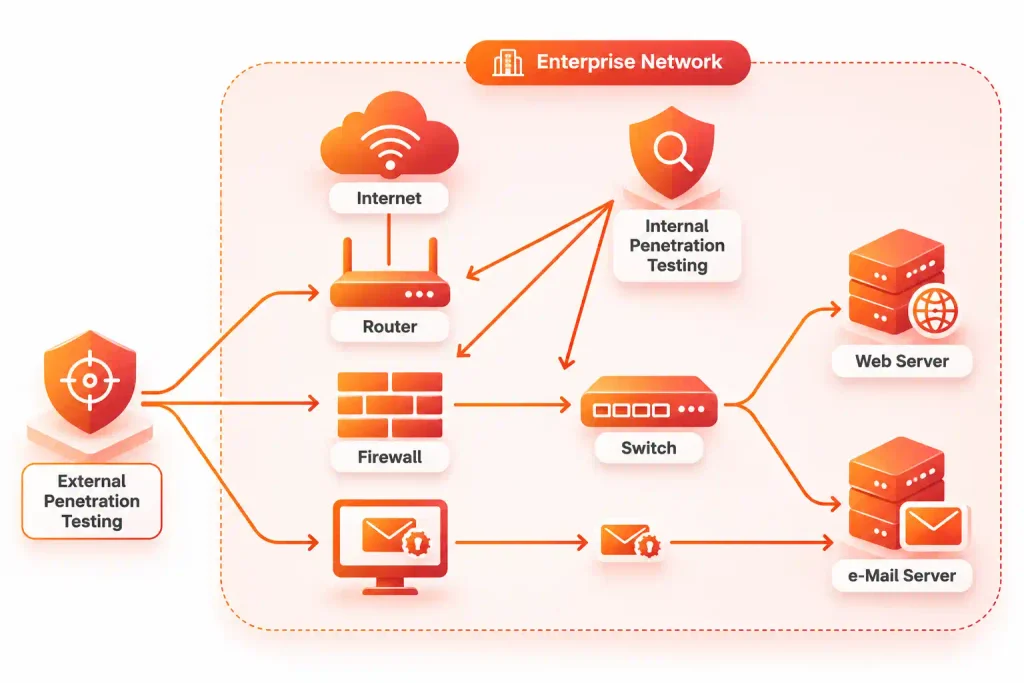
The process generally involves six stages.
Planning and Reconnaissance
The first stage involves understanding the organisation’s external attack surface and identifying the assets included in the assessment.
Testers collect publicly available information about the organisation’s domains, IP addresses, subdomains, hosting environments, and exposed services.
Common reconnaissance activities include:
- Domain and subdomain enumeration.
- WHOIS and DNS information gathering.
- Public IP address identification.
- Technology and service fingerprinting.
- Identification of exposed network infrastructure.
This stage helps establish an initial understanding of the organisation’s external footprint and highlights assets that require further investigation.
Network Scanning and Enumeration
Once testers map the external attack surface, they identify active hosts, open ports, running services, and their associated versions.
Tools such as Nmap and other network discovery solutions help identify services that may expose potential entry points.
During this stage, testers examine:
- Open and unnecessary network ports.
- Running services and software versions.
- Exposed administrative interfaces.
- Insecure protocols and configurations.
- Services accessible without appropriate restrictions.
The objective is to understand which systems are externally accessible and determine where security weaknesses may exist.
Vulnerability Assessment
After identifying exposed systems and services, testers examine them for known vulnerabilities and configuration weaknesses. This includes checking software versions against publicly documented vulnerabilities, reviewing security configurations, and identifying weaknesses in network services.
Common areas of investigation include outdated operating systems, unpatched applications, weak encryption, default credentials, and misconfigured security controls. Automated vulnerability scanners can help identify potential issues. However, manual verification remains important to distinguish exploitable vulnerabilities from false positives.
Post-Exploitation and Impact Analysis
After successfully exploiting a vulnerability, testers evaluate what an attacker could potentially achieve with the access obtained.
This stage focuses on understanding the broader business impact rather than simply confirming that a vulnerability exists.
Activities may include:
- Evaluating the level of access obtained.
- Identifying potential paths to sensitive information.
- Assessing privilege escalation opportunities.
- Examining whether access could extend to other systems.
- Determining the potential impact on business operations.
These findings help organisations understand how an individual weakness could contribute to a larger security incident.
Reporting and Remediation
The final stage involves documenting the assessment results in a structured penetration testing report.
The report typically includes:
- Executive summary of the assessment.
- Scope and testing methodology.
- Identified vulnerabilities and severity ratings.
- Proof of concept or supporting evidence.
- Potential business and technical impact.
- Recommended remediation measures.
After implementing the suggested fixes, organisations can conduct retesting to verify whether the vulnerabilities have been resolved successfully.

Book Your Free Cybersecurity Consultation Today!
Common Vulnerabilities Found During External Penetration Testing
External penetration testing can uncover several security weaknesses that may remain unnoticed during routine infrastructure monitoring.
Some of the most common findings include:
Exposed Ports and Unnecessary Services
Internet-facing systems may have open ports and running services that are not required for business operations. These services can provide attackers with additional entry points, particularly when they contain known vulnerabilities or weak configurations.
Outdated Software and Unpatched Systems
Servers and network devices running outdated software may contain publicly known vulnerabilities. Attackers can exploit these weaknesses to execute malicious code, gain unauthorised access, or disrupt services.
Weak Authentication Mechanisms
Poor password policies, default credentials, weak authentication configurations, and inadequate access restrictions can make externally accessible systems easier to compromise.
Misconfigured Firewalls
Incorrect firewall rules may unintentionally expose internal services, administrative interfaces, or sensitive systems to the public internet. Such misconfigurations can weaken the organisation’s network perimeter.
Insecure Remote Access Services
Exposed RDP, SSH, and VPN services with weak authentication or outdated configurations can create opportunities for unauthorised access to corporate infrastructure.
SSL/TLS Configuration Weaknesses
Improperly configured SSL/TLS protocols, weak cipher suites, and expired certificates can compromise the security of encrypted communications and expose sensitive information to interception.
Information Disclosure
Publicly accessible services may reveal sensitive technical information, including software versions, server details, configuration files, and error messages. Attackers can use these details to identify potential vulnerabilities and plan targeted attacks.
Business Benefits of External Penetration Testing
As businesses expand their digital infrastructure through cloud environments, remote access solutions, and internet-facing applications, their exposure to external cyber threats increases. Every publicly accessible asset can potentially become an entry point for attackers if it lacks adequate security controls.
- Minimises External Attack Surface: Identifies exposed ports, unnecessary services, vulnerable systems, and misconfigured assets that could provide attackers with opportunities to gain unauthorised access.
- Reduces the Risk of Security Breaches: Uncovers and validates exploitable vulnerabilities before malicious actors can use them to compromise systems, steal sensitive information, or disrupt business operations.
- Strengthens Perimeter Security: Evaluates the effectiveness of firewalls, VPNs, authentication mechanisms, and network access controls to identify gaps in the organisation’s external defences.
- Supports Regulatory and Compliance Requirements: Helps organisations strengthen security testing practices and demonstrate risk management efforts in alignment with standards such as ISO 27001, PCI DSS, and other applicable regulatory requirements.
- Improves Security Risk Management: Provides actionable insights into potential attack paths, allowing security teams to prioritise vulnerabilities based on their severity, exploitability, and potential business impact.
Join our weekly newsletter and stay updated
Conclusion
An organisation’s internet-facing infrastructure remains exposed to threats arising from unpatched systems, misconfigured network devices, weak authentication, and unnecessary services. Identifying these weaknesses before attackers exploit them is essential to maintaining business continuity and protecting sensitive information.
External penetration testing enables organisations to assess their external attack surface through controlled attack simulations, vulnerability validation, and impact analysis. It goes beyond identifying potential security gaps by demonstrating how attackers could exploit them and what those weaknesses could mean for business operations.
Regular external assessments, combined with infrastructure penetration testing and timely remediation, help businesses strengthen their perimeter defences, reduce security risks, and stay prepared for evolving attack techniques. Ultimately, the goal is not just to discover vulnerabilities but to ensure that exploitable weaknesses do not become business-critical security incidents.
FAQs
- What assets are covered under external penetration testing?
External penetration testing typically covers public-facing servers, firewalls, routers, VPN gateways, web applications, APIs, cloud infrastructure, and remote access services.
- How is external penetration testing different from a Network Pentest?
External penetration testing focuses on identifying vulnerabilities across an organisation’s internet-facing attack surface. A Network Pentest evaluates network devices, services, configurations, and access controls. Network penetration testing can be part of a broader external assessment.
- What should businesses prioritise after an external penetration test?
Businesses should prioritise vulnerabilities based on severity, exploitability, exposure, and potential business impact. Critical and high-risk findings should receive immediate attention, followed by remediation validation and retesting.
- What is the difference between external penetration testing and perimeter security testing?
External penetration testing actively simulates attacks against internet-facing assets to validate exploitable weaknesses. Perimeter security testing focuses on evaluating the effectiveness of security controls protecting the boundary between internal and external networks.
- What happens if critical vulnerabilities are discovered during testing?
Critical vulnerabilities should be communicated to the organisation promptly through an agreed escalation process. Security teams can then assess the immediate risk, implement corrective measures, and arrange retesting.