
Auditors are usually presented with information gathered by various departments, regulatory reports, internal policies, previous audit reports and past audit reports. But in circumstances where compliance-related risks are recorded in different spreadsheets and reporting systems, then it is hardly possible to create a coherent perspective of the regulatory landscape of an organisation. Lack of information, duplicated records and ownership may also complicate the audit activities. An organized compliance risk assessment aids auditors in integrating all these risk areas into one centralised risk register.
Instead of keeping registration of all the regulations, departments or operational processes, organisations can implement a single, consolidated register, the data on which can be recorded, assessed, monitored and reported regarding compliance risks. This is equally helpful in trying to determine a compliance gap, gauge its possible influence and determine whether the right controls are operating as expected. Having a single source of information, auditors will be able to enhance risk visibility, justify the decisions based on evidence as well as simplify compliance monitoring.
Compliance Risk Assessment – A Brief Overview
Compliance risk assessment can be defined as a structured measure where an organisation can recognise and assess the risks that are posed by not adhering to relevant laws, regulations, industry standards, contractual and internal policies. The evaluation looks at the applicability of regulatory requirements to various business operations as well as look at the sufficiency of the current processes and controls in addressing the requirements.
To the auditors, it extends beyond the verification of the existence of policies and procedures that are documented. It entails measuring the implementation practice of the requirement, the existing control weaknesses and establishing the probability and probable impact of non-compliance.
Join our weekly newsletter and stay updated
Compliance Risk Assessment – Why Maintain One Centralised Risk Register?
A fragmented approach to compliance monitoring can create unnecessary challenges for audit teams. Different departments may use different risk-rating methods, reporting formats and control descriptions. As a result, information may not be consistent enough to support organisation-wide risk evaluation. A single register addresses these challenges by bringing relevant information into one structured repository.
1. Better Visibility Across Compliance Obligations
The centralised register gives auditors an illustration of regulatory and policy demands that the organisation is subject to. Financial reporting risks, risks connected to data security, employee management, procurement, and operational risks can all be recorded in the same structure. This integrated perspective assists auditors in comprehending the relationship between various requirements and in which various divisions can be at risk.
2. Consistent Risk Evaluation
When separate teams assess risks independently, differences in scoring methods can affect the reliability of audit reports. A common risk assessment methodology ensures that likelihood, impact and control effectiveness are evaluated using consistent criteria. This makes the compliance gap and risk assessment process more objective and allows auditors to compare high-risk areas without relying on inconsistent departmental interpretations.
3. Clear Accountability and Ownership
Each compliance risk is supposed to have an owner to monitor the operations of the controls involved and take corrective measures for each compliance risk. These responsibilities are documented in a central register with a record date of review, date of action and up-to-date risk status. It can thus be seen that auditors can determine whether any active management of risks is going on or whether there is any pending corrective actions.
4. Improved Audit Readiness
It is easier to prepare audits in a situation where supporting evidence, control documentation and past findings and remediation updates are stored at a single location. Auditors will not have to request the same information to different departments repeatedly; instead, they can go to the central register to get a sense of where they are at the moment of compliance and where they need extra evidence.
What Should a Compliance Risk Register Include?
A useful register should contain enough information to help auditors understand each risk, evaluate its significance and track the effectiveness of corrective measures.
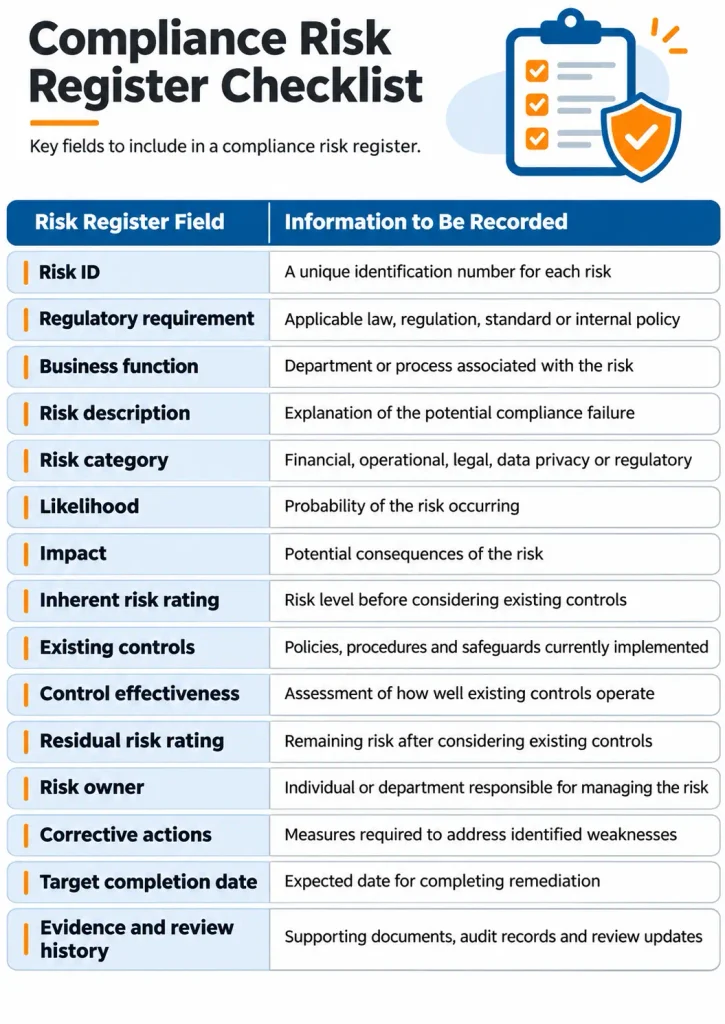
These fields provide a consistent structure for documenting risks across different business functions. Additional fields can also be introduced depending on regulatory requirements, organisational size and audit complexity.
Also, refer this guide for more information – 10 Documents You Need Ready Before Any Compliance Audit in India
Conducting Compliance Risk Assessment Using One Register
A centralised register becomes valuable when it is supported by a repeatable assessment methodology. Auditors follow the steps below to establish and maintain an effective framework.
Step 1: Identifying Applicable Regulatory Requirements
It begins by identifying the laws, regulations, industry standards, contractual obligations and internal policies relevant to the organisation. Requirements are mapped against the departments and business activities responsible for implementing them.
For instance, data protection obligations may involve IT, HR, customer service and legal teams. This mapping exercise helps auditors establish which requirements need to be included in the register and where compliance responsibilities overlap.
Step 2: Identifying Potential Compliance Risks
Once applicable requirements have been documented, auditors identify situations that could result in non-compliance. These may include outdated policies, inadequate employee training, missing approvals, incomplete documentation, weak access controls or inconsistent reporting practices.
Information are gathered through interviews, internal audits, process walkthroughs, document reviews, regulatory updates and discussions with control owners. Each identified risk is recorded separately, even when several risks relate to the same regulatory requirement.
Step 3: Evaluating Likelihood and Impact
The next stage involves determining how likely each risk is to occur and the potential consequences if it materialises. A simple scoring methodology can be adopted, using a scale of 1 to 5 for both likelihood and impact.
For example:
Risk Score = Likelihood × Impact
| Score | Risk Level | Suggested Priority |
|---|---|---|
| 1–4 | Low | Routine monitoring |
| 5–9 | Moderate | Periodic review |
| 10–16 | High | Planned corrective action |
| 17–25 | Critical | Immediate management attention |
The scoring thresholds is aligned with the organisation’s risk appetite and assessment methodology. Auditors distinguish between inherent risk and residual risk to understand how much exposure remains after existing controls have been considered.
Step 4: Evaluating Existing Controls
Risk identification alone does not provide a complete picture of compliance exposure. Auditors examine whether the controls introduced to prevent or detect non-compliance are operating effectively.
For example, an organisation may have a documented data access policy. However, if employee access permissions are not reviewed periodically, the control may not provide adequate protection. Evidence such as approval records, system logs, training registers, policy acknowledgements and monitoring reports should be examined before control effectiveness is determined.
Step 5: Recording Compliance Gaps and Assigning Corrective Actions
The compliance gap ought to be registered in the register also when a control is absent, insufficiently realized or not working as expected. Each finding must include its root cause, potential impact, owner, and suggested remedial action.
An example here is when employee training records are not fully filled in, where the remedial response could be to implement a centralised training tracker, departmental allocation, and setting of regular reviews of completion. The plans should not have overambitious deadlines and completion standards because it is then to be checked in the following audits.
Step 6: Reviewing, Updating and Reporting Risks
A risk register is not to be used as a one-time audit document. All the processes of change are regulatory requirements, business operations, technologies and organisational structures.
Reviews should thus be done regularly in order to detect new risks, reassess the current ratings, and confirm whether corrective measures have been taken. The management reports will be able to point out the serious risks, outstanding remediation efforts, repeat findings, and areas needing more controls.
Conclusion
A well-maintained risk register can present auditors with a uniform perspective of compliance requirements, areas of control deficiency, and remaining risks in an organisation. The presence of regulatory requirements, risk ratings, control assessments, evidence and corrective actions together enables organisations to decrease information gaps and enhance the coordination of audits.
A clear compliance risk assessment periodic reviews, and sound evidence management should support an effective compliance risk assessment framework. By keeping all these components in unity, auditors will be able to spot emerging concerns sooner, prioritise material exposures and give management more valuable information regarding the position of compliance to the organisation.
If you are looking for the same, get in touch with Kratikal today!

Book Your Free Cybersecurity Consultation Today!
FAQs
- What is a compliance risk assessment?
An assessment of the potential risks that could occur due to failure to comply with laws and regulations, internal policies, and/or industry standards.
- What is a compliance risk register?
A centralized document used to capture, evaluate, prioritize, and manage compliance risks.
- Why is it important for auditors to have a single risk register?
It helps auditors identify compliance gaps, avoid duplication of records, assign responsibility, and track remedial actions.
- What kind of information should be included in a compliance risk register?
Risk description, the requirements/regulations, potential risk impact, likelihood, risk ratings, remedial actions, responsible teams, and the status of the remedial actions should be captured in the register.
- How often should an organization review and update their compliance risk register?
It should be updated and reviewed regularly. New risks and changes to existing risks, as well as modifications to the way the business is conducted, should be captured and reflected in the risk register.
- How does a compliance risk assessment aid financial institutions?
It helps banks and NBFCs close regulatory gaps and take prioritized actions to enhance internal controls and systems and prepare for regulatory audits.
- What are the challenges in managing a compliance risk register?
Changing regulations, fragmented records of compliance, duplication of risks, and unclear responsibility for remediation, among others.
- What are possible solutions to challenges stated in question no. 7?
Among others, frequent assessments and remedial actions, and a centralized approach to risk register management.