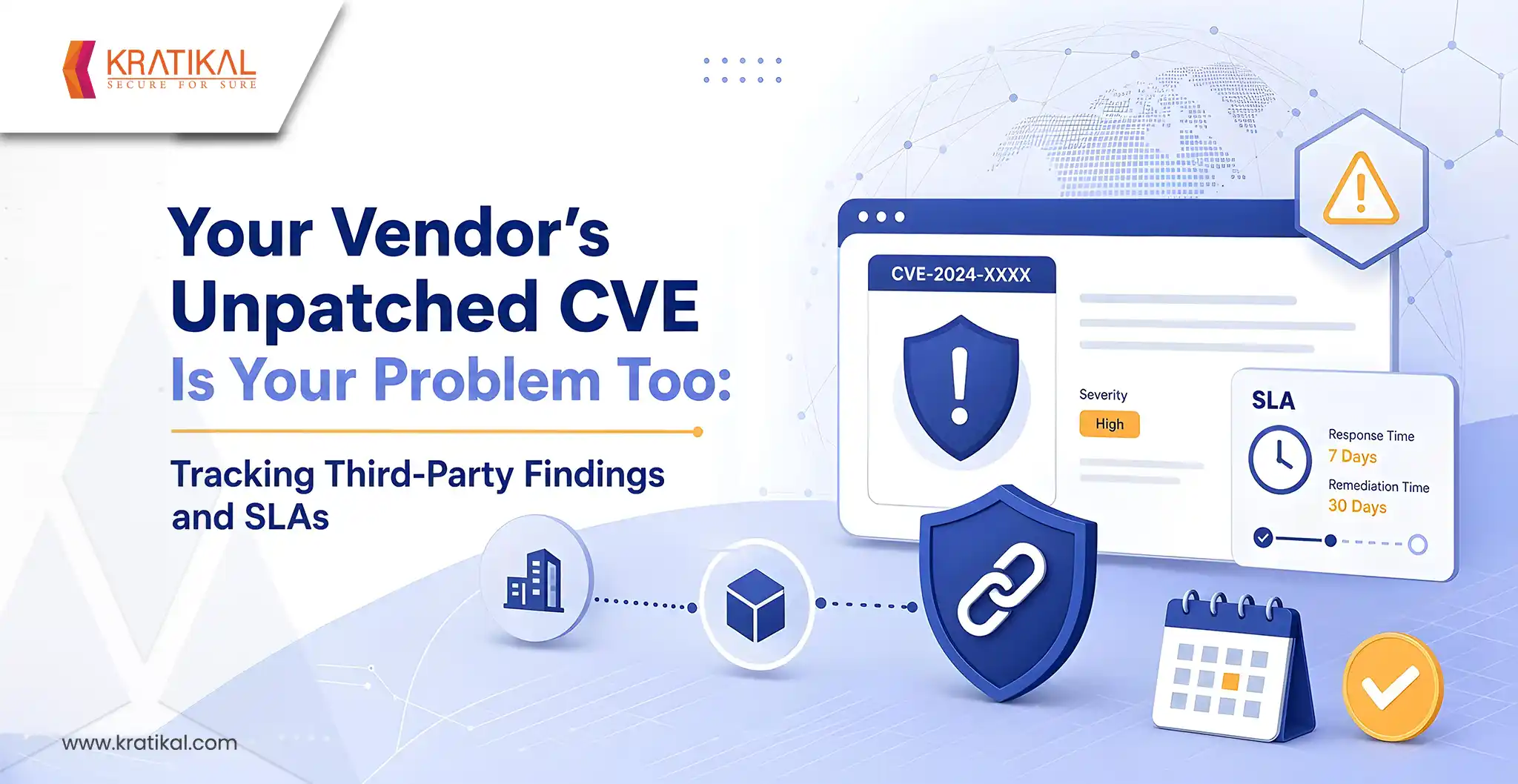
Your team patched everything last week. Your payroll provider did not. Guess whose employee data ends up in the news? This is the quiet truth of third-party risk management. An unpatched CVE in a vendor’s software or cloud service does not stay in the vendor’s building. It travels through the access, data and integrations you gave them. Your customers and your regulator will not ask who wrote the code. They will ask why you did not know. Here is how to track vendor findings, set vulnerability remediation SLAs that hold, and close the gap.
Why Your Vendor’s Unpatched CVE Is Your Problem Too?
Third-party vendor vulnerability management is the practice of finding, tracking and closing security flaws that sit in software, cloud services and systems run by your vendors but can still expose your data. It means knowing which vendors are affected by a unpatched CVE, agreeing how fast they must fix it, and proving that they did.
Think of it like renting an office. You can fit the best lock on your own door. But if the building’s back entrance is broken, your files are still at risk. You cannot fix the entrance yourself, but you can ask the landlord for a repair date, check the repair happened, and move the sensitive files in the meantime.
The problem is that most teams only do the first part: buy the vendor and fill out a questionnaire. Nobody tracks what happens when a new CVE drops six months later.

Book Your Free Cybersecurity Consultation Today!
Third-Party Unpatched CVEs Are a Critical Risk in 2026 – Here’s Why?
The numbers are hard to ignore.
- According to Verizon’s 2026 Data Breach Investigations Report, third parties were involved in 48% of breaches, up 60% in one year. The same measure was 15% in 2024.
- The same report found that exploiting vulnerabilities is now the number one way attackers get in, at 31%, passing stolen credentials for the first time.
- Fixing is slow. Analysis of the 2026 DBIR data reports that only 26% of CISA Known Exploited Vulnerabilities were fully remediated in 2025.
- Black Kite’s 2026 Third-Party Breach Report found that the average vendor breach spread to 5.28 other organizations, up from 2.56 a year earlier.
In short, attackers love vendors because one weak vendor opens many doors at once. And vendors are often slow to close them: the same DBIR coverage notes that only 23% of third-party organizations fully fixed missing multi-factor authentication on their cloud accounts.
A recent example: PHP2Shell, a flaw that sat hidden in the PHP engine for about 14 years and lets attackers run code on a server without logging in. Every vendor running an unpatched PHP stack became a possible way into their customers.
How a Vendor’s Unpatched CVE Becomes Your Breach?
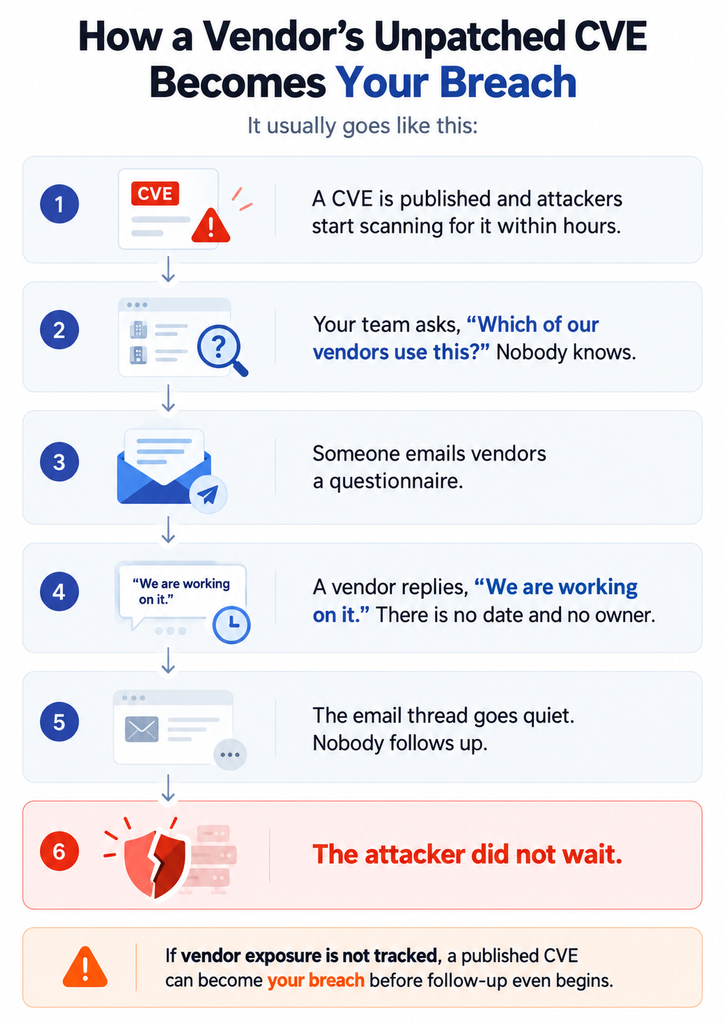
It usually goes like this:
1. A CVE is published and attackers start scanning for it within hours.
2. Your team asks, “Which of our vendors use this?” Nobody knows.
3. Someone emails vendors a questionnaire.
4. A vendor replies, “We are working on it.” There is no date and no owner.
5. The email thread goes quiet. Nobody follows up.
6. The attacker did not wait.
Three gaps cause this every time: no inventory, meaning you cannot see who uses what; no vulnerability remediation SLA, meaning no agreed deadline; and no tracking, meaning no single place showing what is open, overdue, or fixed.
What Unpatched CVE and Vendor Security Assessment Means for CISOs and Security Leads?
Two things change when you treat vendor flaws as your own:
- Your risk numbers become honest. A dashboard that only shows your own assets hides the risk you inherited.
- Your board conversation gets simpler. “Eleven critical vendor findings, three overdue, here is who owns each” is a clear message. “We sent a questionnaire” is not.
How AutoSecT Helps You Track Vendor Findings
Tracking vendor findings fails when it lives in email and spreadsheets. AutoSecT, Kratikal’s AI-driven pentest and VM platform, keeps it in one place.
Vendor Vulnerability Management Hub: Bring the IT service vendors who build and run your assets, such as development, network and cloud teams, into the same vulnerability lifecycle. Everyone works from one shared view.
Vulnerability Remediation SLA Tracking: Findings are managed by risk (critical, high, medium, low), with reminder emails and remediation SLA progress on the analytics dashboard.
Risk Prioritization You Can Trust: AI-verified findings ranked by CVSS, business impact and your own parameters, so you chase what is truly exploitable.
AI-Driven Fixes: Each finding comes with AI-generated remediation guidance, so vendors know exactly what to do.
Leadership View: A CISO dashboard shows exploitable risk, and role-based access keeps vendors to what they need to see.
The result: fewer chasing emails, faster closure, and an audit trail you can show a regulator.
Key Takeaways
Third-party vulnerability management starts with one idea: a vendor’s unpatched CVE is your risk. Third parties were involved in 48% of breaches in Verizon’s 2026 report. Regulators hold you accountable. DPDP, CERT-In, NIST CSF 2.0 and the SEC all expect evidence that you managed vendor risk. Fix the three gaps: inventory, SLAs and tracking. Close every finding with proof, not promises. Move vendor tracking out of email and into one platform. AutoSecT’s vendor vulnerability management feature makes that practical.
See how it works. Book a free demo of AutoSecT.
Join our weekly newsletter and stay updated
Unpatched CVE’s FAQs
- Who is responsible when a vendor has an unpatched CVE?
The vendor owns the fix, but you remain accountable to your customers and regulators. Under India’s DPDP Act, the data fiduciary stays responsible even when a processor handles the data. Contracts decide who pays, not who answers first.
- What is a good SLA for third-party patching?
A common baseline is 5 days for Critical, 15 for High and 30 for Medium, with a faster track for actively exploited flaws. Tighten it for vendors that hold sensitive data or have network access.
- How do I know which vendors are affected by a new CVE?
Keep a vendor register with the products and components each vendor uses, ideally backed by an SBOM. Then match every new CVE and every CISA KEV update against it the same day.
- What is an SBOM and why should I ask vendors for one?
A software bill of materials is the ingredient list of a product. It lets you see quickly whether a vulnerable library is inside a vendor’s software, instead of waiting for them to tell you.
- What if a vendor cannot patch in time?
Ask for compensating controls while the permanent fix is built, such as virtual patching, switching off the affected feature, enforcing MFA, or segmenting the network. Record the exception, the owner and an end date.
- Does CERT-In require vendors to disclose vulnerabilities?
CERT-In’s guidelines of 10 June 2026 place direct disclosure and patching duties on technology providers supplying products to Indian organizations.