
Kubernetes has become a core part of modern cloud infrastructure, helping organisations deploy and scale applications across public, private, and hybrid environments. But as Kubernetes adoption grows, so does the attack surface surrounding clusters, workloads, APIs, containers, identities, and cloud integrations. During cloud pentests, security teams frequently uncover Kubernetes misconfigurations that can expose sensitive workloads or give attackers opportunities to move deeper into the environment. Many of these issues do not require sophisticated exploitation. Weak access controls, excessive permissions, exposed dashboards, insecure container settings, and poorly configured network policies can be enough to create a significant security gap. Strong Kubernetes Security therefore requires more than securing individual containers. It involves securing the entire cluster and its relationship with the underlying cloud environment.
Why Kubernetes Security Matters in Cloud Environments?
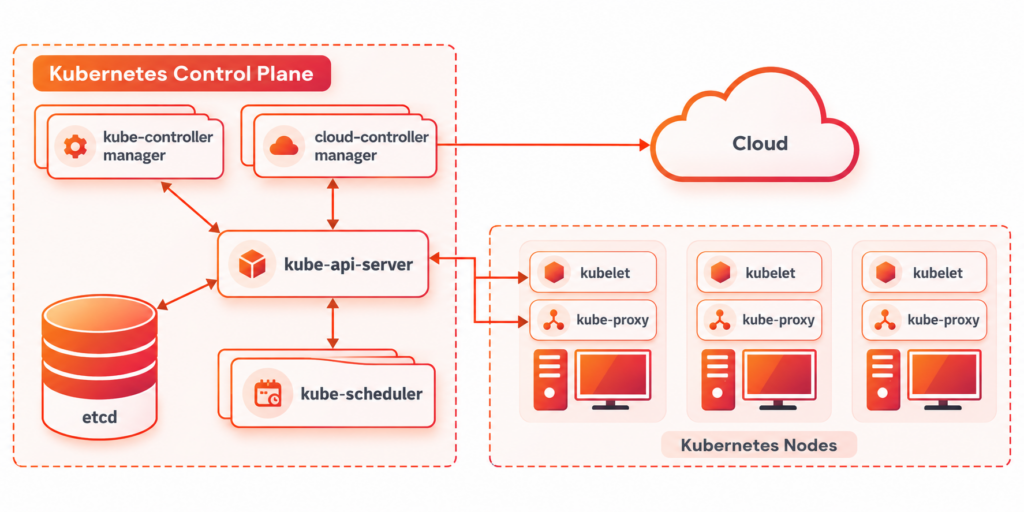
A Kubernetes cluster typically contains several interconnected components, including the control plane, worker nodes, containers, service accounts, secrets, APIs, ingress controllers, and cloud resources.
A weakness in one component can affect others. For example, a compromised pod with excessive permissions may allow an attacker to access Kubernetes APIs. If those permissions extend to cloud resources, the compromise could potentially move beyond the cluster.
Cloud pentests help identify these attack paths by assessing Kubernetes configurations from an attacker’s perspective. Instead of simply checking whether individual vulnerabilities exist, testers can determine how multiple weaknesses could be chained together.
Common Kubernetes Misconfigurations Found During Cloud Pentests
Cloud pentests often reveal recurring Kubernetes misconfigurations that can expose workloads, credentials, and critical cloud resources to attackers.
Overly Permissive RBAC Permissions
Role-Based Access Control (RBAC) determines what users, groups, and service accounts can do inside a Kubernetes cluster.
A common issue is granting broader permissions than workloads or users actually need. For example, a service account may have permissions to:
- Create or modify pods
- Read secrets
- Access sensitive resources
- Execute commands inside containers
- Modify deployments
- Access resources across multiple namespaces
If an attacker compromises a workload associated with an overprivileged service account, these permissions can significantly increase the impact of the compromise.
Security Recommendation: Follow least privilege when creating Roles, ClusterRoles, and service-account permissions. Regularly review permissions and remove unused or excessive privileges.
Exposed Kubernetes API Server
The Kubernetes API server is a critical control-plane component. If it is unnecessarily exposed to the public internet, it becomes a high-value target. Cloud pentests may identify API endpoints that are reachable externally or protected by weak authentication and access controls.
An exposed API server does not automatically mean the cluster is compromised. However, weak authentication, excessive permissions, or configuration errors can make the exposure much riskier.
Security recommendation: Restrict API-server access to trusted networks, VPNs, private endpoints, or approved administrative sources. Enforce strong authentication and monitor API activity.
Publicly Accessible Kubernetes Dashboards
Kubernetes dashboards and management interfaces can provide visibility into workloads, deployments, namespaces, and cluster resources. When these interfaces are exposed without adequate authentication or network restrictions, attackers may gain valuable information about the environment. In some cases, excessive dashboard permissions can also enable administrative actions.
Cloud pentests commonly check whether management interfaces are unintentionally accessible from external networks.
Security recommendation: Keep management interfaces private, enforce strong authentication, apply RBAC, and restrict access based on trusted networks or identities.

Book Your Free Cybersecurity Consultation Today!
Privileged Containers
Containers should generally operate with only the privileges they require. However, cloud pentests frequently find workloads running in privileged mode.
A privileged container has significantly greater access to the underlying host than a standard container. If an attacker compromises such a workload, the security boundary between the container and host can become weaker.
Other risky configurations include:
- Running containers as root
- Allowing privilege escalation
- Excessive Linux capabilities
- Host filesystem mounts
- Host network access
- Host PID namespace access
Security recommendation: Use security contexts to enforce non-root execution, disable privilege escalation where possible, drop unnecessary Linux capabilities, and avoid privileged containers unless there is a clearly documented requirement.
Missing Network Policies
Without appropriate network controls, workloads within a cluster may communicate more freely than necessary. For example, a compromised frontend pod could potentially communicate with backend services, databases, or internal APIs that it does not actually need to access.
Network policies can restrict communication between namespaces, pods, and external endpoints. During cloud pentests, testers may examine whether unnecessary east-west communication allows a compromised workload to move laterally.
Security recommendation: Implement a deny-by-default network model where practical and explicitly allow only required traffic between workloads.
Join our weekly newsletter and stay updated
Kubernetes Security Checklist
Use this list to close the gaps that cloud pentests find most often:
- Give least-privilege access, with no wildcards and no auto-mounted tokens
- Keep the API endpoint private and turn off kubelet anonymous access
- Set Pod Security Admission to restricted and block privileged pods
- Encrypt secrets with KMS and store them in a vault
- Add “deny all” network policies for incoming and outgoing traffic
- Enforce IMDSv2, block metadata access, and use per-app cloud identity
- Scan, sign, and pin images; put dashboards behind SSO
- Turn on audit logs and runtime alerts
Final Thoughts
Kubernetes introduces powerful capabilities, but those capabilities can become security risks when configurations are not carefully managed. Many cloud vulnerabilities discovered during cloud pentests are not caused by flaws in Kubernetes itself. They arise from excessive permissions, exposed interfaces, insecure workloads, weak segmentation, or gaps between Kubernetes and the underlying cloud environment.
Effective Kubernetes Security requires continuous visibility across identities, workloads, APIs, networks, containers, secrets, and cloud services. Regular security assessments can help organisations identify exploitable misconfigurations before attackers do.
For organisations running business-critical workloads on Kubernetes, combining secure-by-default configurations with continuous monitoring, vulnerability management, and periodic cloud pentesting can significantly reduce the risk of cluster compromise and lateral movement.
FAQs
- Why are cloud pentests important for Kubernetes?
Cloud pentests identify exploitable Kubernetes and cloud misconfigurations that automated security checks may overlook.
- How can Kubernetes RBAC improve security?
RBAC limits what users and service accounts can access, helping enforce the principle of least privilege.
- Are Kubernetes Secrets secure by default?
Kubernetes Secrets provide a mechanism for storing sensitive data, but improper permissions or exposure can still make them accessible to attackers.
- How often should Kubernetes environments be tested?
Kubernetes environments should be assessed regularly, especially after major configuration, application, infrastructure, or cloud changes.
- What should a Kubernetes security assessment cover?
It should cover RBAC, APIs, containers, secrets, network policies, workloads, cloud IAM, exposed services, and potential attack paths.
- Can Kubernetes misconfigurations lead to cloud compromise?
Yes. Excessive permissions or exposed credentials can potentially allow attackers to move from a compromised Kubernetes workload to connected cloud resources.