

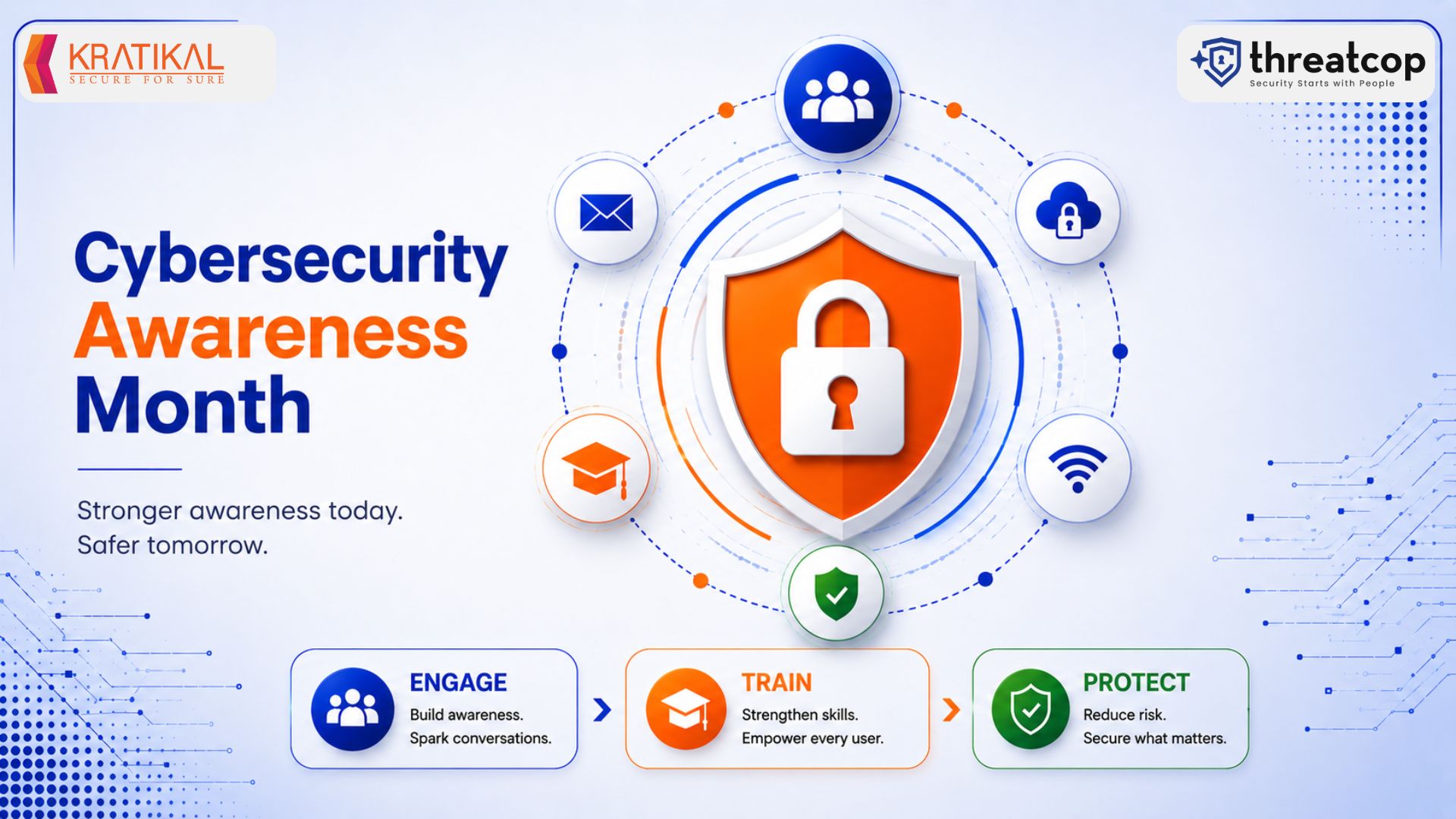
Most Cybersecurity Awareness Month (CSAM) initiatives fail to achieve lasting impact. A poster is displayed, a reminder email is overlooked, and a brief annual quiz is forgotten almost immediately, leaving organizations exposed when employees face actual cyber threats. Modern threat actors no longer rely solely on basic email scams. Instead, they weaponize AI-driven deepfakes, voice cloning, and social engineering across multiple communication channels. To eliminate these critical vulnerabilities, Kratikal developed Threatcop, a people-centric cybersecurity platform. Threatcop transforms passive awareness into an active, continuous defense strategy, empowering workforces to instantly recognize, report, and neutralize sophisticated cyber attacks.
Table of Contents
Why Is Cybersecurity Awareness Month Still Relevant?
October has been Cybersecurity Awareness Month since 2004 and is spearheaded by CISA and the National Cybersecurity Alliance. Although participation is optional, CISA still encourages adopting foundational security measures, including using strong passwords, enabling MFA, keeping software up to date, and spotting phishing attempts. Threatcop takes those core concepts further by addressing new threats such as deepfakes, AI-powered phishing, and voice impersonation.
Threats change more rapidly than most awareness programs. On any platform, several practices prove effective.
- Select one theme per week. The more topics covered at once, the more likely they are to be forgotten. A weekly focus- phishing one week, and passwords the next- helps employees retain what they learn.
- Keep awareness visible. Sometimes it’s better to send a quick Slack message or a two-minute reminder in a team meeting than to leave another training link in the inbox.
- Reward participation. Instead of viewing awareness as a chore, leaderboards, team challenges, or small rewards help employees get involved.
- Measure progress. Conduct a phishing simulation before October and again after. The results are compared to determine if the campaign achieved improved employee behavior.
These principles apply to any organization, regardless of its size.
Book Your Free Cybersecurity Consultation Today!

What Threatcop’s CSAM 2026 Program Covers?
Threatcop’s awareness program is segmented into five focus areas, corresponding to the most common attack methods today, giving modern organizations the tools to respond to the threats employees are most likely to face.
1. AI Attacks and Deepfake Fraud
Train security teams to spot the most prevalent types of AI-powered scams, such as phishing, video scams, and voice cloning. This category covers deepfake CEO fraud, GenAI data leakage, and unsafe shadow AI use to minimize exposure before it becomes an attack.
2. Phishing 2.0, Multi-Channel
Provide leaders with a solution for training employees on the channels attackers use most—not just email. This includes the smishing, vishing, quishing, and MFA-fatigue attacks, ensuring that organizations are better equipped to build awareness across SMS, calls, QR codes, and account takeover attempts.
3. Human Risk and Social Engineering
Create a more robust human defense layer, attacking what attackers rely on the most- urgency, authority, and fear. This category helps build decision-making skills in real-world scenarios and minimizes the risk of breaches caused by human error or insider threats.
4. Identity and Access Security
Support teams in securing the modern perimeter, which attackers target for credentials, sessions, and tokens. This category strengthens password hygiene, password managers, multi-factor authentication, and passkeys to help leaders better secure accounts and minimize MFA fatigue.
5. Remote Work and Device Security
Minimize exposure on the growing attack surface of hybrid work. This category includes public Wi-Fi, BYOD, VPN usage, mobile threats, and shadow apps, and can help leaders enhance employee security wherever they go.
In all 5 areas, the program also contains the Cybersecurity Olympic, a series of 42 virtual games that transform awareness into action. Content is distributed across October, not all at once, to ensure that leaders have the opportunity to maintain their interest and build on their learning over time.
Join our weekly newsletter and stay updated
Choosing a Package
Threatcop offers CSAM 2026 in three formats:
- Virtual
- Physical Event
- Hybrid
All formats are available in three scalable tiers: Core, Pro, and Premium, designed to fit organizations of every size and awareness goal.
| Tiers | Core | Pro | Premium |
| Ideal for | Entry-level for small teams | Balanced for growing organizations | Full content for mid-large organizations |
| Coverage | Up to 500 employees | Up to 1,000 employees | Up to 2,500 employees |
| Day-0 launch & introduction | Launch kit | Launch kit + wallpaper | Full intro kit |
| Weekly content drops | Basic | Expanded | Full library |
| CybersecurityOlympic (42 games) | Basic | Expanded | Full library |
| Tool access (during October) | 1 month | 1 month | 1 month |
| Support & enablement | Basic | Standard | Detailed analytics |
Organizations can also download a free CSAM 2026 Toolkit now, which includes a starter kit to help launch their awareness campaign.
The Bottom Line
Cybersecurity Awareness Month achieves its greatest impact when approached as an ongoing security initiative rather than a mere compliance task.
Establish distinct weekly themes. Maintain a constant focus on security. Foster active participation. Evaluate outcomes.
Creating a comprehensive month-long program that includes training, simulations, activities, and reporting demands considerable time and coordination, which many security teams find challenging to allocate. Threatcop’s all-in-one CSAM program alleviates this operational strain, providing leaders with a streamlined solution to enhance engagement, boost employee preparedness, and empower teams to identify genuine threats before they escalate into incidents.
FAQs
- What is Cybersecurity Awareness Month, and why does it matter?
Every October, it’s a global effort to raise awareness about the impact of everyday employee behavior on an organization’s security. Phishing, deepfakes, and social engineering attacks are harder to identify at a glance, and as each year passes, they become more important.
- What are some good ideas for Cybersecurity Awareness Month?
The ideas that really work are hands-on: phishing simulations across email, text, and voice; a live gamified event like Threatcop’s Cybersecurity Olympic; and short weekly themes instead of a long training day dumped on employees at once.
- What activities work best for Cybersecurity Month?
A mix of formats beats repeating the same one all month: a week of phishing simulations, one live gamified event, an identity and password session, and short self-paced modules for remote work topics.
- When is Cybersecurity Awareness Month, and who runs it?
It takes place every October and has been co-led by CISA and the National Cybersecurity Alliance since 2004. Participation is optional for organizations, though CISA encourages baseline practices like MFA and phishing awareness.
- How does Threatcop make Cybersecurity Awareness Month engaging for employees?
Through the Cybersecurity Olympic, a set of 42 virtual games, plus weekly content drops and live simulations across email, voice, text, and QR codes, so training feels like something employees take part in rather than a box they check.





Leave a comment
Your email address will not be published. Required fields are marked *