



Every organisation connected to the internet is a target, whether it realises it or not. Attackers don’t need to break down the front door anymore; an exposed remote service or an unpatched system is often enough to get inside. Once they’re in, the difference between a minor incident and a full-blown breach usually comes down to one thing: how quickly the intrusion is detected.
This is what network intrusion detection is all about: spotting unauthorised or malicious activity on a network before it turns into real damage. And as attacks get more sophisticated, the way security teams approach detection has had to evolve, too. One of the most valuable additions to that evolution is MITRE ATT&CK mapping, which we’ll get into shortly. But first, let’s understand network intrusion detection itself.
Table of Contents
A Snapshot of Network Intrusion Detection
Network intrusion detection is the process of monitoring network traffic and system activity to identify signs of unauthorised access, misuse, or attack attempts. A Network Intrusion Detection System (NIDS) sits at strategic points in the network, continuously analysing traffic and comparing it against known threat patterns or unusual behaviour.
The goal is simple: catch attackers early, whether they’re trying to break in from outside or already have a foothold and are trying to move deeper into the network.
Broadly, intrusion detection works in two ways:
- Signature-based detection compares network activity against a database of known attack patterns, similar to how antivirus software matches known malware signatures. It’s fast and reliable for known threats, but it struggles against new or modified attacks it hasn’t seen before.
- Anomaly-based detection builds a baseline of what “normal” network activity looks like, then flags anything that deviates from it. This approach can catch new or unknown threats but tends to generate more false positives if not tuned carefully. Most mature security setups use a combination of both, along with threat intelligence feeds, to cover a wider range of attack techniques.
Book Your Free Cybersecurity Consultation Today!

Strategic Advantage of MITRE ATT&CK in Network Intrusion Detection
MITRE ATT&CK is a globally recognised knowledge base that documents how real attackers actually operate, based on thousands of real-world incidents. It breaks attacker behaviour into tactics (the “why”, like Initial Access, Lateral Movement, or Exfiltration) and techniques (the “how” the specific methods used to achieve each tactic).
Here’s the role it plays in strengthening network intrusion detection:
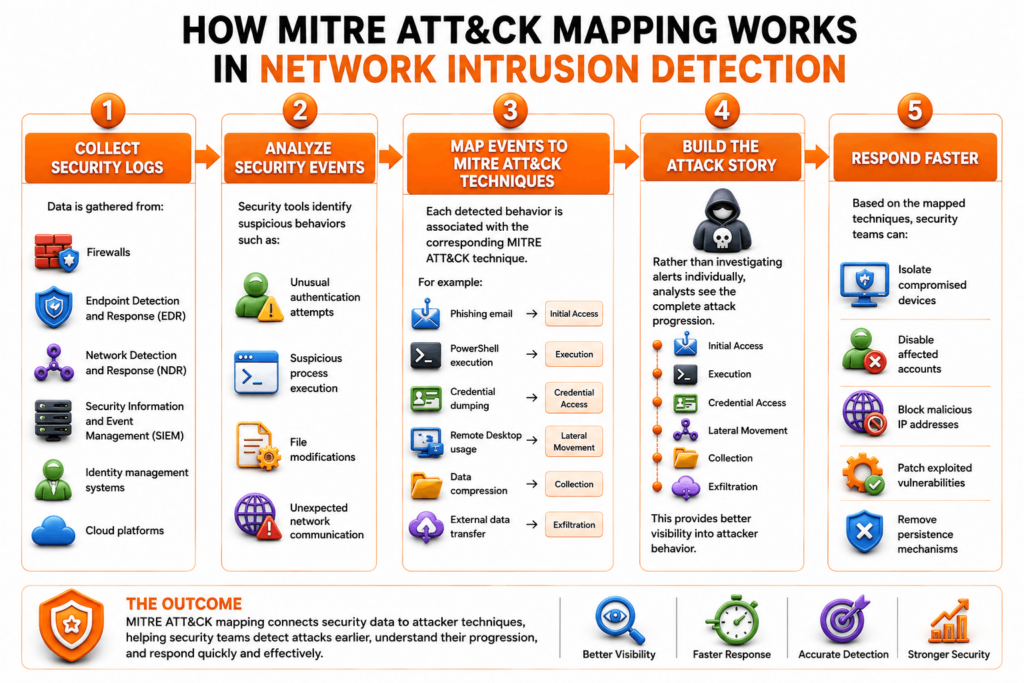
- Connects the dots between isolated alerts: A single alert rarely tells the full story. But when alerts are mapped to ATT&CK tactics, patterns emerge. An unusual PowerShell command, followed by an attempt to access a domain controller, followed by a large outbound data transfer, mapped individually, these look unrelated, but tagged as Execution → Lateral Movement → Exfiltration, they clearly form one continuous attack. This is the single biggest value ATT&CK mapping brings to detection: context.
- Exposes detection blind spots: By mapping existing detection rules against the full ATT&CK matrix, security teams can clearly see which techniques they detect well and which ones they don’t detect at all. Many teams discover, for instance, that they’re strong at catching initial access attempts but blind to lateral movement, a gap that’s easy to miss without this kind of structured view.
- Enables smarter, more targeted threat hunting. Instead of hunting blindly, analysts can proactively search for evidence of specific techniques used by threat actors targeting their industry, rather than waiting passively for alerts to fire.
- Creates a shared language across teams ATT&CK technique IDs are now widely understood across SOC analysts, incident responders, red teams, and even leadership. This shared vocabulary speeds up communication significantly during an active incident, when every minute counts.
| Are your security alerts telling the complete story? Kratikal empowers organizations with the visibility and expertise needed to detect, investigate, and respond to evolving cyber threats. |
How MITRE ATT&CK Mapping Works in Network Intrusion Detection?
Benefits of MITRE ATT&CK Mapping
Organizations that integrate MITRE ATT&CK Mapping into their Network Intrusion Detection strategy gain several advantages:
- Better visibility into attacker behavior
- Faster investigation of security incidents
- Improved detection accuracy
- Reduced false positives
- Enhanced threat hunting capabilities
- Stronger incident response processes
- Easier communication between security teams
- Improved compliance reporting
- Better measurement of security maturity
Instead of reacting to isolated alerts, organizations develop a proactive understanding of how attackers operate.
Get in!
Join our weekly newsletter and stay updated
Bringing It Together
Network intrusion detection is no longer just about deploying a tool and waiting for alerts. It’s about building a detection strategy that understands attacker behaviour at every stage, from the first foothold to data exfiltration, and MITRE ATT&CK mapping is one of the most effective ways to bring that level of understanding into everyday detection work.
For organisations running regular VAPT exercises alongside detection efforts, ATT&CK mapping adds even more value. Red team findings can be documented using the same technique IDs, making it easy to validate whether existing detection controls would actually catch a real-world attack path. The bigger question security leaders should be asking isn’t just “are we detecting intrusions?” It’s “do we know exactly where in the attack lifecycle we’re catching them, and where we’re still blind?” That’s the question MITRE ATT&CK mapping helps answer, and it’s what separates a reactive detection setup from a truly resilient one.
FAQs
- How does MITRE ATT&CK Mapping help identify a Network Intrusion?
MITRE ATT&CK Mapping connects security events to known attacker tactics and techniques, allowing security teams to identify patterns that indicate a Network Intrusion. This makes it easier to detect sophisticated attacks that unfold over multiple stages.
- What data sources are required for MITRE ATT&CK Mapping?
MITRE ATT&CK Mapping relies on data from multiple security sources, including firewalls, EDR solutions, NDR platforms, SIEM systems, identity management tools, cloud logs, and endpoint activity. Combining these sources provides a comprehensive view of attacker behavior.
- How does MITRE ATT&CK Mapping improve incident response?
By showing the sequence of attacker activities, MITRE ATT&CK Mapping helps analysts quickly understand the scope of an attack, identify compromised systems, and take targeted remediation actions, reducing response time.
- Does MITRE ATT&CK Mapping replace traditional Network Intrusion Detection systems?
No. MITRE ATT&CK Mapping complements traditional Network Intrusion Detection systems by adding context to the alerts they generate. It enhances detection accuracy rather than replacing existing security solutions.
- How often should organizations update their MITRE ATT&CK Mapping?
Organizations should regularly review and update their ATT&CK mappings to align with the latest MITRE framework releases, emerging threat techniques, and changes to their own security infrastructure.
- What are the key benefits of combining MITRE ATT&CK Mapping with SIEM, EDR, and NDR?
Integrating MITRE ATT&CK Mapping with SIEM, EDR, and NDR provides centralized visibility, correlates alerts across multiple security layers, improves threat detection accuracy, and enables faster investigation and response to Network Intrusion incidents.
- What are the common signs of a Network Intrusion?
Some common indicators of a Network Intrusion include unusual login attempts, unexpected network traffic, unauthorized privilege escalation, suspicious PowerShell activity, unexplained file modifications, and communication with unknown external servers.






Leave a comment
Your email address will not be published. Required fields are marked *