
The Indian banking and financial sector is facing constant cyber risks. Banks, NBFCs, and insurance firms now handle millions of digital transactions every day. This rapid digital growth has improved customer access. It has also increased the chances of cyber crimes targeting India’s BFSI Sector. Also, cyber attackers not only target large banks but also target payment gateways, cloud environments, and employees. So, due to these increasing risks, business leaders should understand the real risks facing the financial sector. For CISOs, CXOs, and decision-makers, cybersecurity is no longer an IT issue as it directly affects customer trust, regulatory compliance, business continuity, and brand reputation. This makes understanding the top 5 cyber crimes in India extremely important for business leaders.
BFSI Sector A Growing Target for Cyber Attackers
The BFSI industry stores highly sensitive information such as customer financial records, Aadhaar and PAN details, banking credentials, credit card data, insurance records, etc. Also, many organizations now depend on cloud infrastructure, mobile banking apps, APIs, UPI systems, and remote work platforms. Each digital connection creates another possible entry point for attackers.
Cyber attackers know that financial institutions cannot afford downtime. Even a small breakdown can affect millions of users and result in big financial losses. As per Money Control Reports Indian BFSI organizations experience cyberattacks 1.6 times more than the global sector. And it has doubled in recent years.
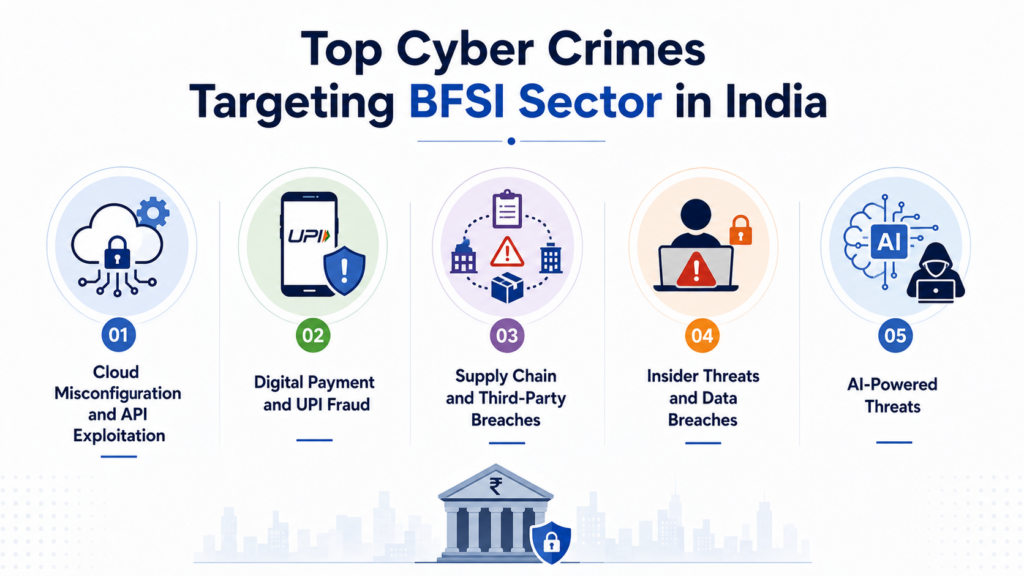
Top 5 Cyber Crimes – India’s BFSI Sector
Here is the list with detailed explanation and remediation measures:
1. Cloud Misconfiguration and API Exploitation
Cloud and API attacks are rising fast in India’s BFSI sector. Many banks and fintech firms now depend on cloud platforms, APIs, and digital payment systems for daily operations. An article in ET Ciso (Economic Times) highlights that API attacks in India increased by 126% in H1 2025. BFSI applications also saw a 46% rise in vulnerability.
Cloud misconfiguration happens when cloud security settings are not set properly. This can include open storage, weak passwords, exposed databases, or poor access control. Attackers use these security gaps to steal customer and financial data. API attacks are also increasing in the BFSI sector. APIs help in connecting payment gateways, banking apps, UPI platforms, and third-party systems together. If APIs are not secured properly, attackers can steal data, enter banking systems without permission, or manipulate transactions. Attackers target –
- Open cloud storage and weak cloud settings
- Insecure APIs used in UPI and payment systems
- Weak authentication and access controls
- Third-party integrations and vendor systems
Security Measures to Prevent Cloud and API Attacks:
- Conduct regular Cloud Security and API Security Testing
- Continuous VAPT assessments
- Use Multi-Factor Authentication (MFA)
- Encrypt sensitive banking data
- Secure APIs with strong authentication
- Monitor cloud environments in real time
- Follow CERT-In, RBI, ISO 27001, and PCI-DSS security guidelines
2. Digital Payment and UPI Fraud
India’s digital payment ecosystem has grown rapidly in recent years. UPI transactions now dominate the financial landscape. Unfortunately, cyber attackers have also evolved their fraud techniques. These frauds involve fake payment links, QR code scams, refund frauds, remote access app scams, SIM swap attacks, and fake customer care calls.
Reports indicate that UPI and internet banking channels remain major gateways for banking fraud in India. Many attackers exploit customer trust rather than technical vulnerabilities. They manipulate users into authorizing fraudulent transactions themselves.
Digital payment fraud affects banking reputation, fraud response costs, customer retention, and regulatory compliance. As digital banking expands across Tier-2 and Tier-3 cities, awareness gaps continue to increase the risk of fraud. This makes digital payment fraud one of the top 5 cybercrimes in India that BFSI firms cannot ignore.
Security Measures To Reduce Digital Payment Frauds:
- Fraud monitoring systems
- Transaction behavior analysis
- Real-time anomaly detection
- Customer awareness campaigns
- AI-powered fraud prevention systems
- Perform regular application security testing
3. Supply Chain and Third-Party Breaches
BFSI organizations work with several third-party vendors, fintech platforms, cloud providers, and software partners. They help BFSI industries improve digital banking services, but they also increase cybersecurity risks.
Also, attackers often target third-party vendors because their security systems may be weaker than those of financial institutions. Once attackers enter a vendor system, they try to access the main banking network. Supply chain attacks can affect payment systems, customer data, cloud platforms, and internal banking operations. A single weak vendor can create serious security and compliance risks for the entire organization.
Security Measures to Reduce Supply Chain & Third-Party Risks in BFSI:
- Conduct regular third-party security assessments
- Monitor vendor access continuously
- Apply Zero Trust security controls
- Limit unnecessary access permissions
- Perform regular VAPT assessments
- Secure APIs and cloud integrations
- Follow CERT-In, RBI, ISO 27001, and PCI-DSS security guidelines
4. Insider Threats and Data Breaches
Not every cyber attack comes from outside the organization because the threats can also come from inside. Indeed, insider threats create serious risks across the BFSI industry. These threats may involve malicious employees, negligent staff, third-party vendors, contractors, and privileged account misuse.
Financial organizations manage large volumes of confidential data. So, an insider attack can create severe damage to it. Moreover, data breaches can expose banking records, insurance data, financial statements, loan details, and corporate account information. Industry discussions and intelligence reports continue to highlight concerns around third-party access and internal exposure risks within financial institutions.
Many BFSI organizations now use hybrid work environments, cloud infrastructure, vendor integrations, and shared access systems, which increases security risks. Weak access control allows attackers to move freely through networks.
Minimize Insider Attacks By Implementing:
- Zero Trust architecture
- Controlled access management
- User behavior analytics
- Continuous monitoring
- Strict vendor risk assessments
5. AI-Powered Threats
Of course, artificial intelligence is changing cybersecurity. But cyber attackers also use AI for faster attacks. AI-powered cybercrime now includes AI-generated malware, advanced bot activity, and intelligent credential attacks.
The Reserve Bank of India identified that AI-powered cyberattacks are becoming a big threat to the financial sector. Cyber attackers now use Advanced Persistent Threats (APTs) to stay secretly inside systems for a long time. These attacks mainly target payment networks, banking infrastructure, insurance databases, investment systems, and core financial platforms.
As AI-driven threats continue to evolve, they have become one of the top 5 cyber crimes in India, affecting modern BFSI organizations. AI helps attackers automate reconnaissance, avoid detection, and scale attacks faster.
To Reduce AI-Powered Threats, Businesses Should Adopt:
- AI-driven vulnerability assessments
- Threat intelligence platforms
- Real-time incident response
- Continuous risk assessments

Book Your Free Cybersecurity Consultation Today!
The Business Impact of Cyber Crimes on BFSI
Cyberattacks not only create technical problems but also impact business operations directly. A successful attack can cause financial losses, service disturbance, legal issues, regulatory penalties, customer loss, and damage to brand reputation. Recent reports show cyber fraud incidents and financial losses continue to rise across India’s banking ecosystem. For CISOs and CXOs, cybersecurity must now become part of the overall business strategy.
How BFSI Organizations Can Enhance Their Cybersecurity?
Understanding the top cyber crimes in India is the first step to improving cybersecurity in the financial sector. Organizations must also build a proactive defense strategy.
Key Security Measures for BFSI Firms
- Regular VAPT and audits
- Strong identity and access controls
- Employee awareness training
- Threat monitoring
- Vendor risk management
- Incident response planning
Every BFSI organization should have a tested response plan for ransomware, data breaches, fraud incidents, and insider threats.
How Kratikal Helps BFSI Organizations Through VAPT Services?
Kratikal is a CERT-In empanelled security auditor helping BFSI organizations identify and fix security issues before attacks. It provides advanced VAPT services that the internal VAPT team might not be able to provide to defend against various cyber threats.
Our VAPT services include
- Web Application Security Testing
- Mobile Application Security Testing
- API Security Testing
- Cloud Penetration Testing
- Network Penetration Testing
- IoT Security Testing
- AI Pentesting
- Red Teaming
- Root Cause Analysis
- Software Composition Analysis
All these services help BFSI secure their internet banking platforms, UPI systems, customer portals, cloud environments, and internal networks against cyberattacks. We also help BFSI firms find risks such as insecure APIs, weak access controls, and cloud security gaps.
Along with VAPT services, we support BFSI organizations with compliance audits aligned with CERT-In guidelines, RBI expectations, ISO 27001, PCI-DSS, and other security standards. It helps them improve compliance readiness and strengthen their overall security.
Moreover, Kratikal’s AutoSecT helps BFSI organizations reduce cyber risks through AI-driven pentesting and vulnerability management. It secures web applications, mobile banking apps, APIs, cloud environments, and networks through automated security testing. Also, AutoSecT has already secured 1150+ Web Apps, 750+ Mobile Apps, 2200+ Cloud Assets, 6000+ API, 25000+ Network Assets platforms.
For BFSI firms, AutoSecT helps:
- Detect exploitable vulnerabilities in banking websites and customer portals
- Secure mobile banking and payment apps
- Protect APIs used in UPI and digital payment systems
- Identify cloud misconfigurations and security risks
- Monitor network security in real time through its RAG-powered AI Agentic engine
- Reduce false positives and improve faster risk detection
- Vulnerability compliance mapping for ISO 27001, SOC 2 etc.
Join our weekly newsletter and stay updated
Conclusion
The BFSI sector is one of the most targeted industries in India’s cyber threat arena. Cyber attackers now use insider threats and AI-based attacks to target businesses. These attacks create serious risks for BFSI organizations. Also, the increasing use of digital banking has raised the threat level. That’s why cybersecurity has now become a top priority for the BFSI sector. It affects regulatory compliance, customer trust, and business continuity. A strong security system helps organizations in long-term business growth and operational stability. To reduce the threat level, organizations need experienced cybersecurity partners with deep technical knowledge.
FAQs
- Why is the BFSI sector a major target for cyber attackers?
The BFSI sector contains sensitive financial and personal information. Millions of digital transactions are processed by banks and financial companies every day. These organizations are attacked to steal their money, customer details, and banking credentials by cyber attackers. Even the case of a minor violation can cause enormous financial and reputation losses.
- What are the top 5 cyber crimes in India amongst BFSI organizations?
UPI fraud, insider threats, and AI-based attacks are considered to be the most serious threats. These attacks target banking systems, payment solutions, employees, and customers.
- How do cyber attacks impact banks and financial institutions?
Cyber attacks trick employees, businesses, or customers into providing passwords, OTPs, or banking information. Attackers attack with the help of fake emails, SMS messages, or cloned websites. An effective attack attempt may result in financial fraud, account compromise, and data breaches.
- How does UPI and digital payment fraud happen?
Stolen money is obtained by cyber attackers with the help of fake payment requests, QR code scams, remote access applications, and social engineering tricks. Most of the frauds occur when the user unknowingly approves transactions. Other fraudulent activities that risk payment fraud in India are increasing with the increase in digital banking.
- What is the role of CERT-In in cybersecurity compliance?
CERT-In helps to increase cybersecurity preparedness among Indian organizations. It offers security policies, incident reporting policies, and cybersecurity advisories. To enhance security practices, BFSI organizations tend to adhere to CERT-In-aligned security practices to boost their defenses and minimize cyber threats.
- How can BFSI organizations reduce cyber threats?
Regular VAPT evaluations, enhancing access control, workforce training, and continuous network monitoring, and securing third-party vendors should be implemented by organizations. A business should also develop effective incident response strategies to respond quickly to cyberattacks in order to minimize operational impacts.
- Why should BFSI businesses work with CERT-In Empanelled cybersecurity companies?
A CERT-In Empanelled Security Auditor is recognized by the Indian government for meeting stringent technical, operational, and quality standards. For organizations, partnering with such an auditor ensures trusted security assessments, supports regulatory compliance, identifies exploitable vulnerabilities, strengthens cyber resilience, reduces business risk, and enhances confidence among regulators, customers, and stakeholders.